Home › Custom parts › Technical Ceramics
Technical Ceramics Made to Drawing – Ceramic Parts in Series
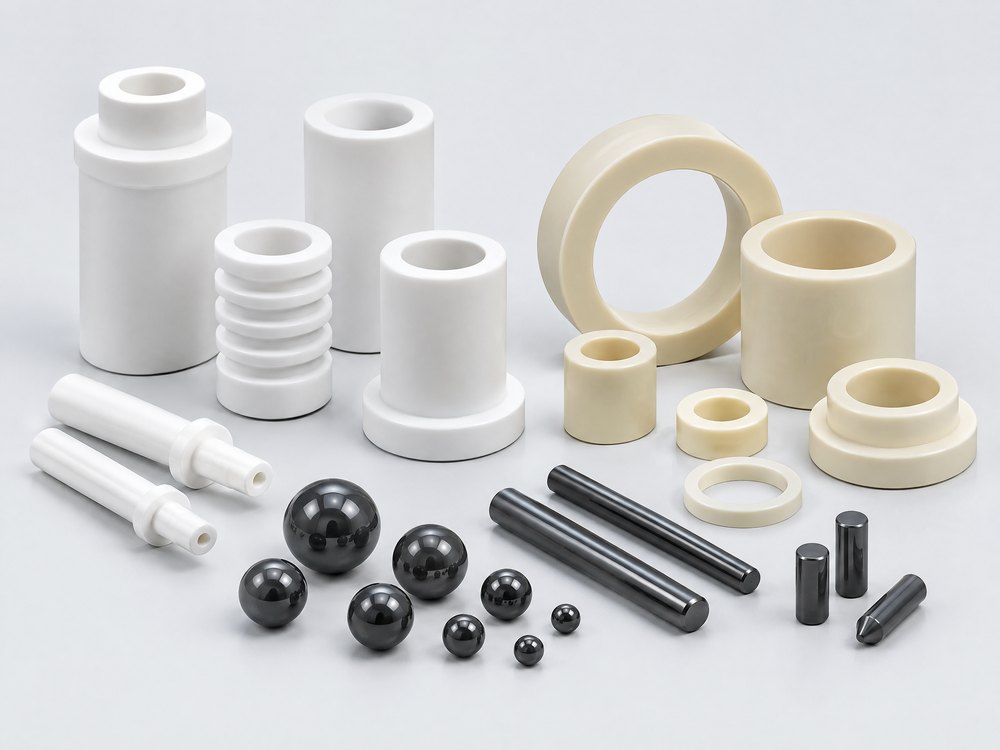
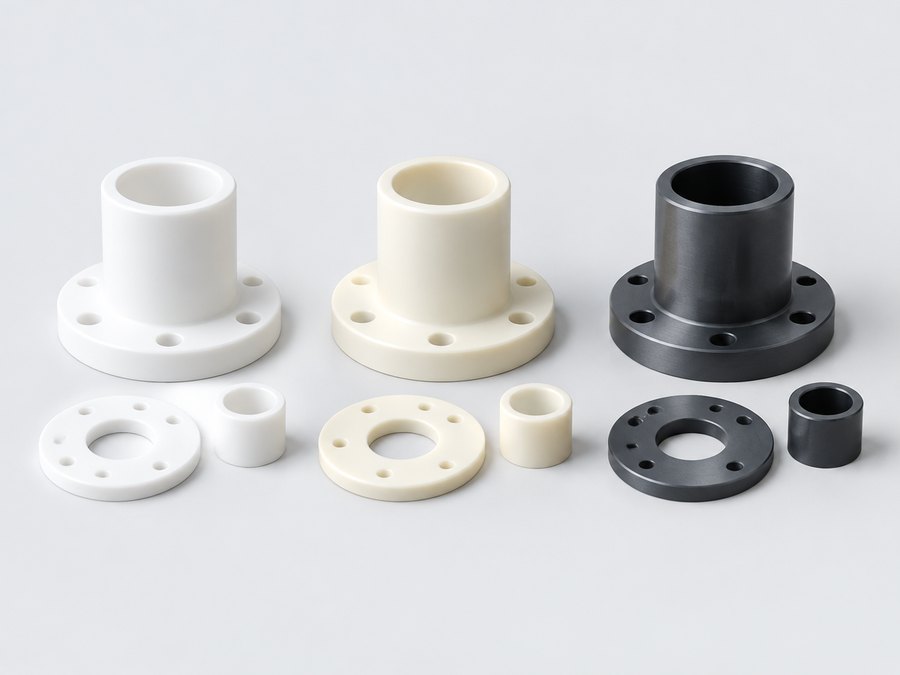
We source technical ceramics made to your drawing from specialised partner factories in China – insulators, wear parts, sealing rings, guides and substrates made of alumina, zirconia, silicon nitride, silicon carbide and steatite. We clarify in advance which dimensions can stay as-sintered and where hard machining is needed.
- Al₂O₃, ZrO₂, Si₃N₄, SiC, steatite
- As-sintered or diamond-ground
- Glass and ceramic parts made to drawing
- Based in Jena since 2011
- Selected partner factories in China
- One contractual partner in Germany
- Pre-shipment inspection included
Technical ceramics: what ceramic parts are used for
Technical ceramics are hard, wear-resistant, electrically insulating and chemically resistant – even at temperatures where metals and plastics fail. Typical parts are thread guides, nozzles, slide rings, bearing bushes, insulating sleeves, heating element carriers and cutting elements.
The downside: ceramics are brittle, and any machining after sintering is done with diamond tools. Cost and feasibility therefore depend heavily on how many dimensions have tight tolerances.
Technical specifications: technical ceramics
| Feature | Specification |
|---|---|
| Materials | Alumina 95–99.7 % (C 795 / C 799 to DIN EN 60672), zirconia Y-TZP, silicon nitride, silicon carbide (SSiC, SiSiC), steatite C 221, cordierite; borosilicate and quartz glass |
| Part weight / size | From a few millimetres up to approx. 500 mm, depending on forming method and material; larger parts after individual review |
| Tolerances | As-sintered typically ±1–2 % of nominal dimension, at least approx. ±0.1 mm (general tolerances to DIN 40680-1); hard-machined ±0.01 mm, special cases down to ±0.002 mm |
| Surface finishes / post-processing | As-sintered surface Ra approx. 0.8–1.6 µm; ground Ra 0.2–0.4 µm; lapped or polished Ra below 0.05 µm; metallisation for brazing, glazing |
| Quantities | No fixed minimum order quantity – whether sourcing pays off depends on the part, quantity and tooling costs; talk to us. Pressed and injection-moulded parts (CIM) typically pay off in larger series, hard-machined parts in smaller ones too |
| Inspections | Dimensional report, density, visual inspection for cracks and chipping, dye penetrant testing, roughness, dielectric strength for insulators, material data sheet |
| Lead time | First samples in approx. 3 weeks at best, usually longer – up to approx. 10 weeks depending on complexity; series production approx. 4–8 weeks depending on quantity and complexity (production time only, plus transport) |
| Data for your enquiry | Drawing and 3D model, material with purity, functional dimensions, operating conditions (temperature, voltage, medium), annual volume |
Alumina, zirconia, silicon nitride and more compared
Typical properties as guide values; individual grades may differ.
| Material | Density | Flexural strength | Thermal conductivity | Strengths |
|---|---|---|---|---|
| Alumina 99.7 % | approx. 3.9 g/cm³ | 300–400 MPa | approx. 25–30 W/mK | Insulator, wear-resistant, low cost |
| Zirconia Y-TZP | approx. 6.0 g/cm³ | 900–1,200 MPa | approx. 2–3 W/mK | High toughness, thermal expansion similar to steel |
| Silicon nitride | approx. 3.2 g/cm³ | 700–1,000 MPa | approx. 20–30 W/mK | Thermal shock, rolling elements, welding pins |
| Silicon carbide SSiC | approx. 3.1 g/cm³ | 400–450 MPa | approx. 100–150 W/mK | Very hard, acid-resistant, mechanical seals |
| Steatite C 221 | approx. 2.7 g/cm³ | approx. 140 MPa | approx. 2–3 W/mK | Inexpensive insulator, easy to press |
Design guidelines for ceramic parts
Accept as-sintered tolerances
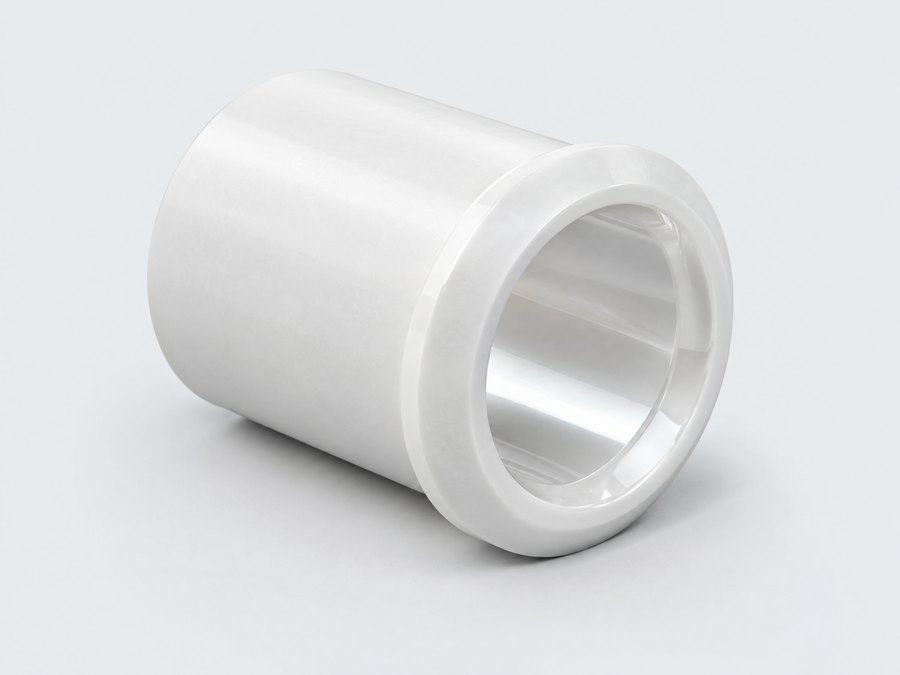
Ceramics shrink by about 15–25 % during sintering. Wherever possible, leave dimensions as-sintered and grind only functional surfaces.
Radii instead of sharp edges
Sharp internal corners are crack initiation points; sharp external edges chip. Provide chamfers of approx. 0.2–0.5 mm and internal radii.
Uniform wall thicknesses
Material accumulations sinter unevenly and distort. Keep wall thicknesses as uniform as possible and make transitions smooth.
Load in compression, not tension
Ceramics withstand high compressive stress but little tension and bending. Design the installation position and clamping to avoid stress peaks.
No threads in ceramics
Threads in sintered ceramics are expensive and prone to breakage. It is better to bond, shrink-fit or braze in metal sleeves.
Green, white and hard machining: where the costs arise
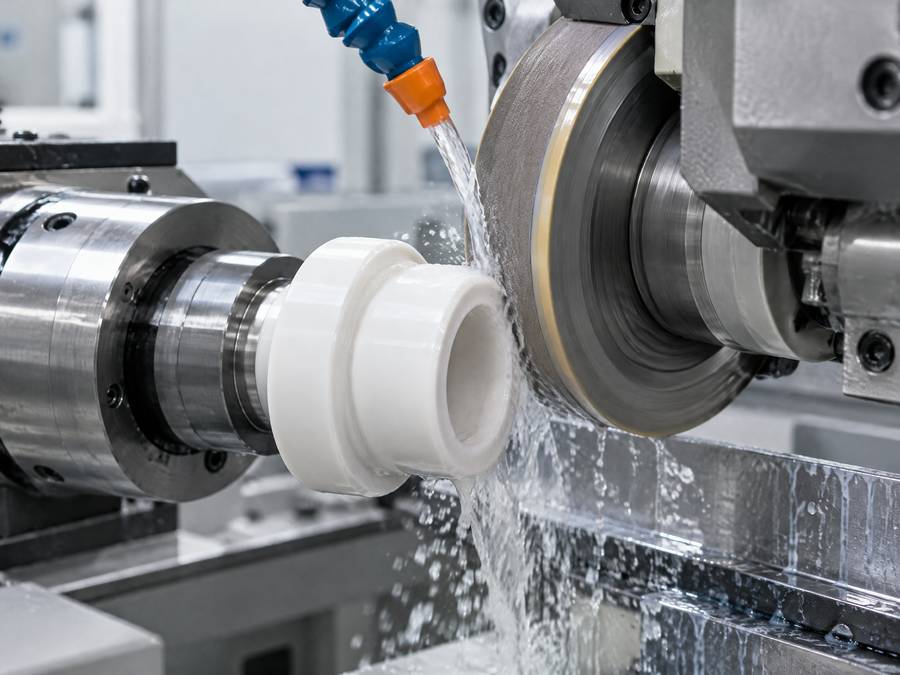
Ceramic parts are pressed, isostatically pressed, extruded or injection-moulded (CIM). In the green or white (pre-sintered) state before final sintering, they can still be machined with carbide tools – fast and inexpensive, but with the uncertainty of sintering shrinkage.
After sintering, only diamond grinding, lapping or polishing will do. This hard machining is slow: a fully ground part can cost many times as much as an as-sintered part. That is why it pays to assign tolerances selectively, as explained in our guide to tolerances.
- Hard-machine functional surfaces only, leave the rest as-sintered
- Provide holes with a large length-to-diameter ratio in the green state
- Lap flat surfaces instead of grinding when flatness matters more than size
Typical defects in ceramic parts
Microcracks and chipping
Caused by grinding, handling or transport. Dye penetrant testing at the first sample stage and individual foam packaging are a must.
Wrong purity
“Alumina” can mean 92 % or 99.7 %. Ask for the purity or material designation to DIN EN 60672 and a material data sheet.
Zirconia ageing
Y-TZP loses strength in hot, humid environments (roughly above 150–200 °C with steam). For such conditions, alumina or ATZ is the better choice.
Process for ceramic parts made to drawing
Clarify material and tolerances
Assess operating conditions, define as-sintered and ground dimensions.
Select factory and forming method
Pressing, CIM or extrusion depending on geometry and quantity; quotation including tooling costs.
First samples
Dimensional report, density, crack testing and functional testing at your site.
Series production
Inspection plan with visual inspection per batch, breakage-proof packaging, delivery according to the agreed Incoterm.
Frequently asked questions about technical ceramics
What tolerances can technical ceramics achieve without grinding?
As-sintered, about ±1–2 % of the nominal dimension is usual, at least around ±0.1 mm. Tighter tolerances require diamond grinding.
Alumina or zirconia?
Alumina is cheaper, harder and a better insulator with higher thermal conductivity. Zirconia is much tougher and more fracture-resistant – a sensible choice for impact, bending or thin cross-sections.
When is steatite sufficient instead of alumina?
For electrical insulating parts with moderate temperature and load, such as terminal blocks or heating element holders, steatite C 221 is an inexpensive choice. For wear, higher temperatures or high dielectric strength requirements, alumina is superior.
Can glass parts made to drawing also be sourced?
Yes, for example sight glasses, tubes and discs made of borosilicate or quartz glass. Information on thermal cycling, pressure and edge finishing is important.
How are ceramic parts joined to metal?
By bonding, shrink-fitting, clamping or active brazing after metallisation. The choice depends on temperature, tightness and differing thermal expansion – for example in assemblies with a ceramic insert.
When are ceramics better than hardened steel?
With heavy abrasive wear, corrosion, high temperatures or when electrical insulation is needed. Under impact and bending loads, steel usually remains superior.
Related part types
Enquiry: Technical Ceramics made to your drawing
Upload your drawing and 3D model, tell us the quantity and your deadline – we check feasibility and get back to you with questions or a quotation.
- Technical clarification before the request for quotation
- Quotations from audited partner factories
- One contact person in Germany
- Non-disclosure agreement (NDA) in advance on request
Prefer to call? 03641 9286337 · Mon–Fri 8 am–6 pm (CET)