
Home › Custom parts › Toolmaking & mould making
Injection moulds, die casting dies, stamping dies – toolmaking in China for your series parts
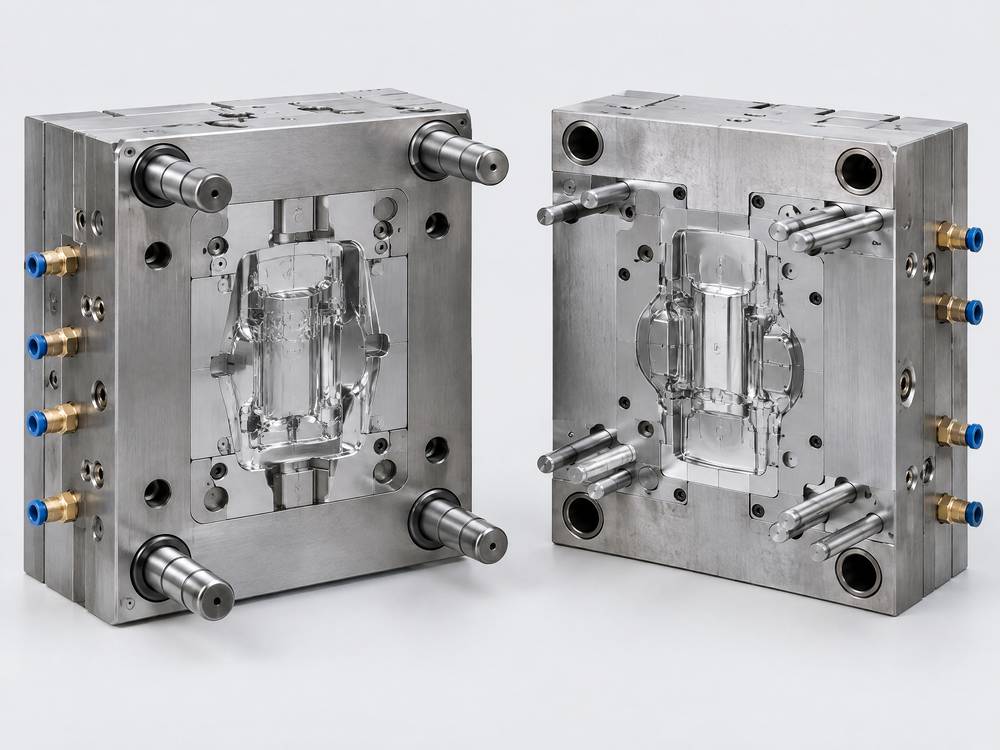
The injection mould or stamping die determines the quality, unit price and delivery capability of your series parts for years. We source tooling from toolmakers and mould makers in China together with the series parts – and help you define the tool class, tool steel and ownership properly up front.
- Injection moulds, die casting dies, stamping dies
- Tool class matched to quantity
- Ownership and maintenance agreed
- Based in Jena since 2011
- Selected partner factories in China
- One contractual partner in Germany
- Pre-shipment inspection included
Toolmaking in China: what to clarify before you order
A tool is an investment that is amortised over the series production of the part. The key question is therefore not “What does the mould cost?” but “How many parts is it to produce over what service life?” – this determines the tool class, steel and number of cavities.
Mould making in China is competitive because many toolmakers work closely with injection moulders, foundries and stamping plants. We therefore generally source tooling together with the series parts: the factory that runs the tool is also responsible for part quality.
Technical specifications: toolmaking and mould making
| Feature | Specification |
|---|---|
| Materials | Mould steels 1.2311, 1.2738, 1.2083; hot-work steels 1.2343, 1.2344; cold-work steel 1.2379 and carbide for stamping dies; aluminium for prototype moulds |
| Part weight / size | Tool size depends on part, number of cavities and machine; stating the target machine in the enquiry is useful |
| Tolerances | Tool dimensions are designed so that the parts meet the drawing tolerance; corrections via T1/T2 loops |
| Surface finish / post-processing | Polished, EDM-textured, grained (VDI 3400 or texture pattern), nitriding and coating to extend tool life |
| Quantities | Designs from prototype tools (a few hundred shots) to high-performance tools (over 1 million cycles) |
| Inspections | DFM report before ordering steel, mould flow simulation, material verification, T1 samples with measurement report, tool photos and shot counter |
| Lead time | Tool to first samples (T1) in approx. 3 weeks at best, usually longer – up to approx. 10 weeks depending on complexity; series production approx. 4–8 weeks depending on quantity and complexity (production time only, plus transport) |
| Data for your enquiry | 3D model (STEP) and drawing of the part, material, annual volume and planned service life, surface finishes, target machine if known, required tool class |
SPI mould classes: 101 to 105
The SPI classification of the US plastics industry (now PLASTICS) is also widespread in China and is well suited to defining clearly what you expect from an injection mould.
| Class | Design cycles | Typical construction | Application |
|---|---|---|---|
| 101 | over 1 million | Hardened mould inserts and slides, guides, temperature control in all plates | High-volume series parts, abrasive materials |
| 102 | up to 1 million | Hardened mould inserts, guide rails | Large series, including glass-fibre-reinforced plastics |
| 103 | up to 500,000 | Pre-hardened steel, e.g. 1.2311 or 1.2738 | Medium series – the most common case in mechanical engineering |
| 104 | up to 100,000 | Mild steel or aluminium | Small batches, unreinforced plastics |
| 105 | up to approx. 500 | Aluminium, cast resin or simplest construction | Prototypes and samples |
Choosing the right tool steel: 1.2311, 1.2738, 1.2343
1.2311 (40CrMnMo7)
Pre-hardened mould steel, usually listed as “P20” in China. Standard for medium-volume injection moulds for unreinforced plastics; easy to polish and machine.
1.2738 (40CrMnNiMo8-6-4)
Like 1.2311, but with nickel for uniform hardness even in large cross-sections; often listed as “718” in China. For large mould plates and textured visible surfaces.
1.2343 (X37CrMoV5-1)
Hot-work steel, hardened to about 48–52 HRC. For die casting dies and mould inserts for glass-fibre-reinforced plastics; for die casting often in ESR quality, 1.2344 (≈ H13) is also common.
1.2083 (X40Cr14)
Corrosion-resistant mould steel for high-gloss polished and transparent parts and for corrosive materials such as PVC.
1.2379 (X153CrMoV12)
Ledeburitic cold-work steel for cutting punches and dies in stamping tools; for very high stroke counts, carbide or PM steel inserts.
Specify the steel in writing
Material and hardness of mould plates and inserts belong in the purchase order, ideally with a material certificate. “Equivalent” without proof is a common source of later problems.
Injection mould costs: typical guide values and cost drivers
Specific prices can only be given on the basis of the part. As rough, typical ranges in China (without guarantee): a simple single-cavity mould for a small part without slides a few thousand euros, medium-sized moulds with slides typically €8,000–25,000, large multi-cavity or hot runner moulds considerably more.
More on costing in our guide Tooling costs in China.
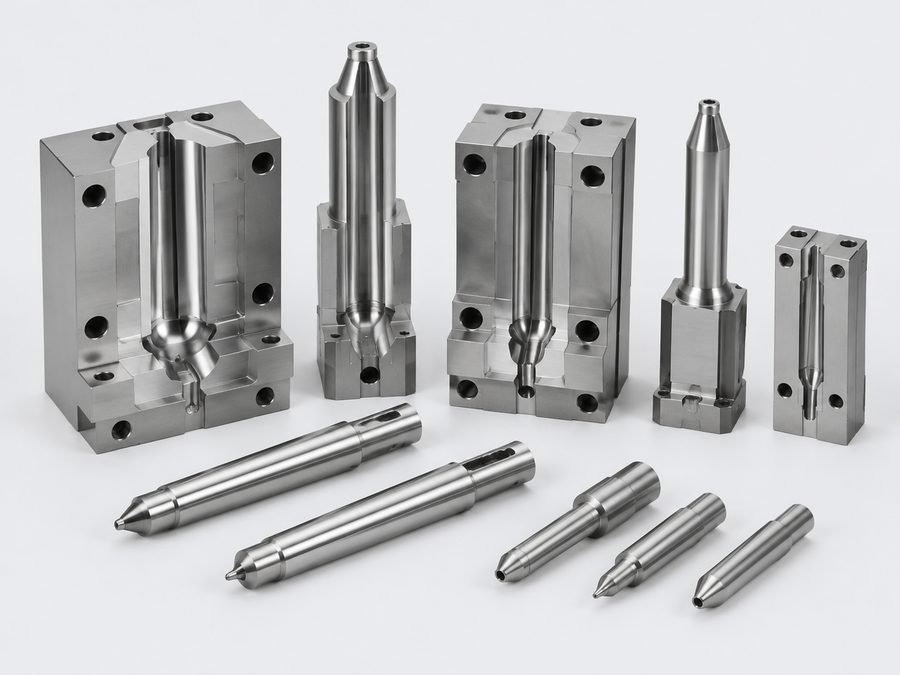
- Number of cavities and hot runner instead of cold runner
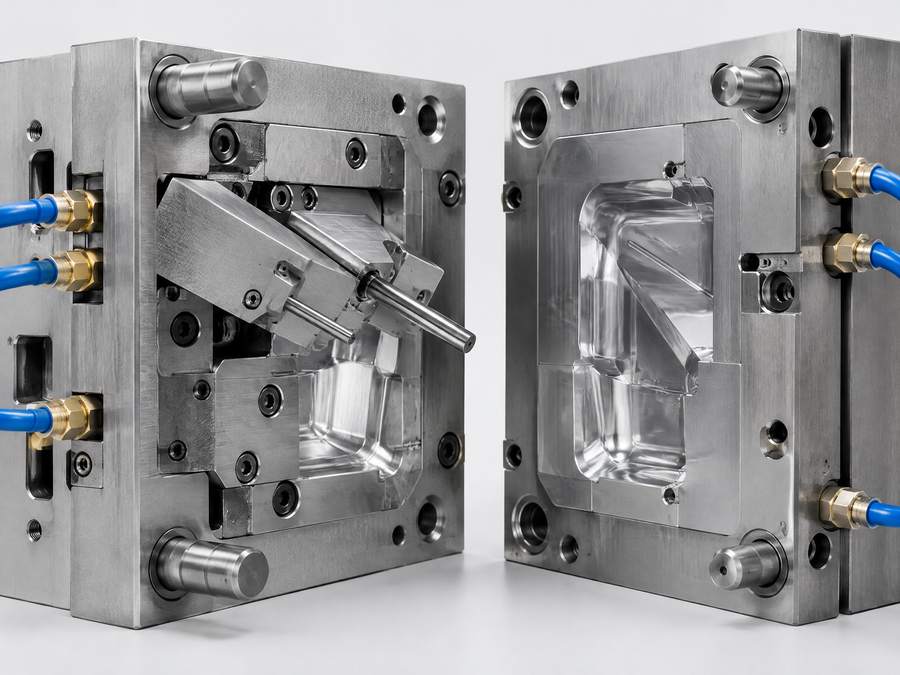
- Slides, core pulls and angled lifters for undercuts
- Tool class and hardened inserts
- High-gloss polishing or texturing
- Number of correction loops until approval – clean tolerances save time and money here
Tool ownership, tool maintenance and transfer to Germany
Agree ownership in writing
Paying does not automatically mean owning – which is why we make it clear: once paid in full, the tool becomes your property, remains at the factory for production and is marked, e.g. with a nameplate. This is set out in the quotation.
Guaranteed shot count
Specify for how many cycles the toolmaker guarantees the tool, and who pays for repair or replacement in the event of wear.
Tool maintenance
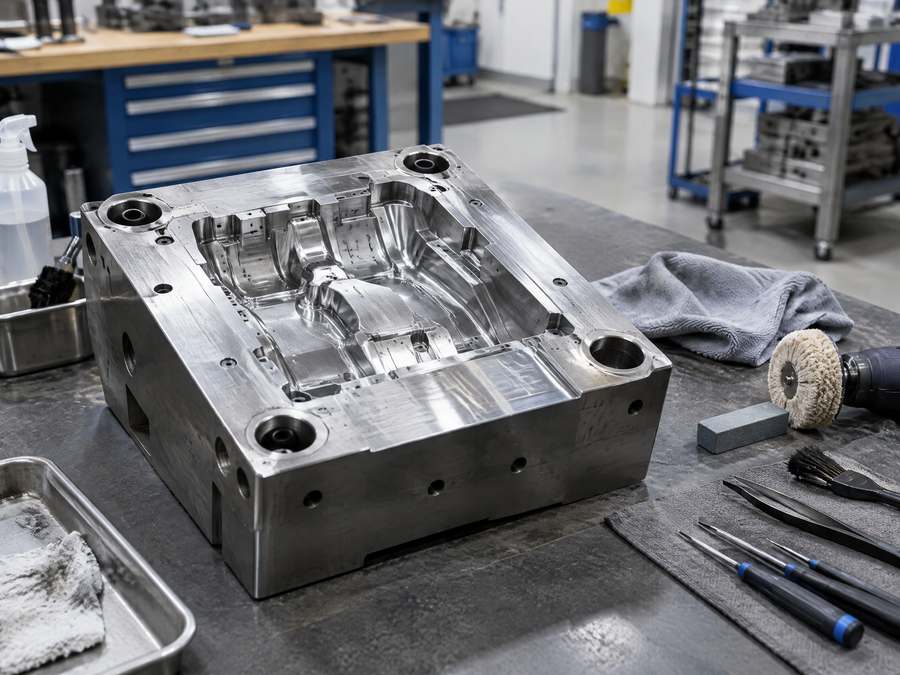
Maintenance according to shot count, cleaning of cooling channels, preservation during downtime. A shot counter on the tool makes wear traceable.
Tool documentation
3D data of the tool, a bill of materials for standard components and spare parts, and the cooling layout belong in the scope of delivery if a later transfer is to be possible.
Transfer to Germany
Check before transport: locating ring, nozzle radius, clamping dimensions, ejector pattern, cooling connections and hot runner connectors of the target machine. Chinese standard components (e.g. LKM) do not always match HASCO or Meusburger parts. On request, we organise the transfer of a tool to Germany or Europe.
Mind the customs value
Tools paid for by the buyer can be relevant to the customs value of the imported parts. More in our guide Customs and importing from China.
Process: from DFM report to series approval
DFM report
The toolmaker checks demoulding, wall thicknesses, gate location and parting line and proposes changes – before the steel is ordered.
Tool design
Approval of the tool drawing with number of cavities, slides, cooling, steel and hardness.
T0 and T1 samples
T0 is the toolmaker’s internal first trial, T1 the first sample delivery to you with a measurement report. These terms are not standardised – they should be defined in the quotation or order confirmation.
Correction and approval
Dimensional corrections in T2/T3, followed by first article inspection (first article inspection report (FAIR / EMPB)) and series approval.
Series production and tool monitoring
Shot counts, maintenance and part quality are tracked over the entire service life.
Who a tool from China is suitable for
A good fit if …
- Series parts with a predictable annual volume over several years
- Plastic, die-cast or stamped parts that are to be made in China anyway
- Parts where tooling makes up a high share of the total cost
Less suitable if …
- Prototypes with no foreseeable series production
- Tools that need constant modification because the design is not yet finalised
- Very small quantities where 3D printing or CNC machining is cheaper
Frequently asked questions about injection moulds and toolmaking
Which tool class do I need?
Multiply the annual volume by the planned service life. For up to 500,000 cycles, an SPI 103 mould made of pre-hardened steel is often sufficient; for glass-fibre-reinforced plastics or higher volumes, hardened inserts make sense.
Can I transfer an existing tool to China?
In principle yes, if documentation and condition are suitable. Tool condition, machine size and spare parts should be checked in advance; the first parts are sampled in the same way as first samples.
What is the difference between T0 and T1?
T0 are the first shots at the toolmaker for internal checking; T1 are the first samples you receive with a measurement report. Correction loops then follow until approval.
Do I get the 3D data of the tool?
Only if this has been agreed. For a later transfer or repair by third parties, the tool design and spare parts list should be part of the scope of delivery.
How long does a die casting die last?
For aluminium die casting, typically in the range of 50,000–150,000 shots, depending on part, steel and maintenance. The limiting factor is usually heat checking on the die surface.
Who pays for tool repairs?
This should be agreed before ordering: usually the toolmaker bears repairs up to the guaranteed shot count, and the owner thereafter.
Related part types
Enquiry: Toolmaking & mould making made to your drawing
Upload your drawing and 3D model, tell us the quantity and your deadline – we check feasibility and get back to you with questions or a quotation.
- Technical clarification before the request for quotation
- Quotations from audited partner factories
- One contact person in Germany
- Non-disclosure agreement (NDA) in advance on request
Prefer to call? 03641 9286337 · Mon–Fri 8 am–6 pm (CET)