
Home › Guides › Preparing an RFQ with drawings
How to prepare a request for quotation with drawings
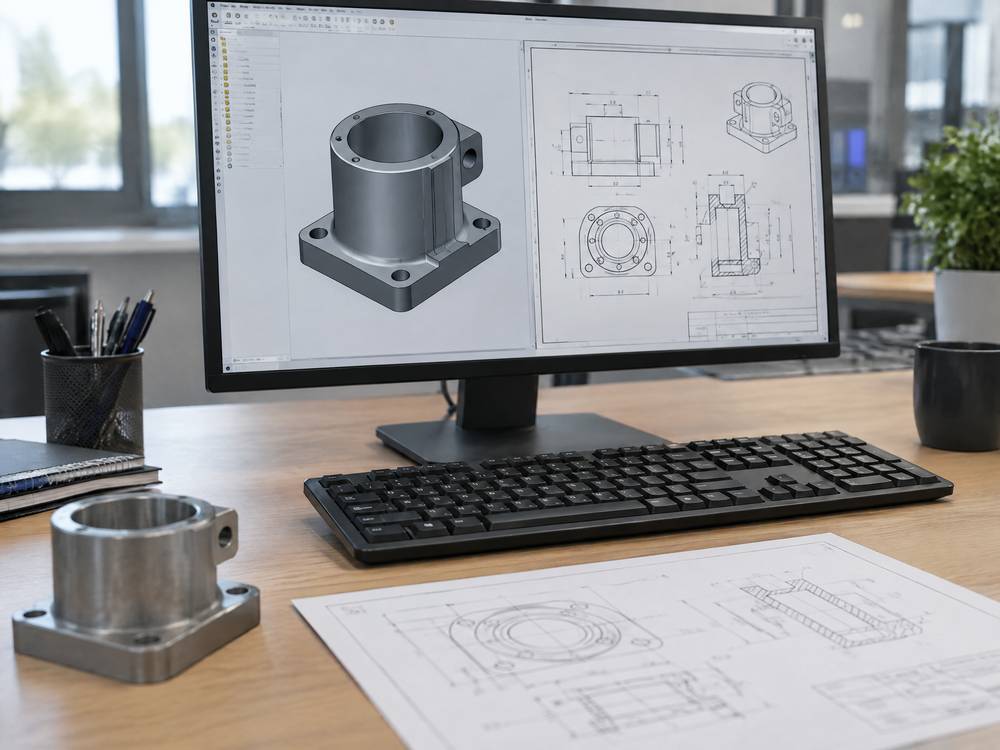
A good request for quotation (RFQ) based on drawings includes a 3D model (STEP) and a toleranced 2D drawing (PDF), material and surface finish, the quantity structure of annual volume, batch size and call-offs, plus inspection requirements, packaging and deadlines. The more complete this information, the faster quotations arrive – and the easier they are to compare.
- Checklist for your RFQ
- Make quotations comparable
- Avoid common gaps
Why the RFQ decides the price
Suppliers quote on what they can read from your documents. If information is missing, they make an assumption – usually in their own favour or with a safety margin. If it is missing for several suppliers, each one assumes something different. The result: three quotations that differ by a factor of two, and nobody knows why.
A complete RFQ with drawings therefore does more than save follow-up questions – it is the precondition for a fair comparison. This is especially true for suppliers in China, where every query can cost a day because of the time difference. The checklist below helps you not to forget anything important.
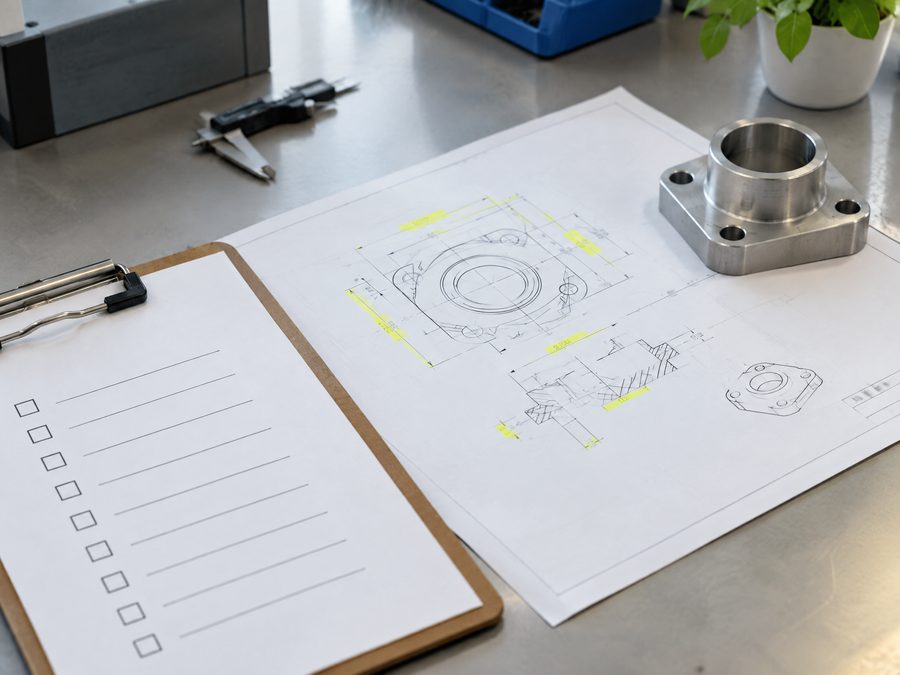
Checklist: what belongs in an RFQ with drawings
3D model as STEP
STEP (AP214 or AP242) is the neutral format that every toolmaker and CAM programmer can read. Send native CAD formats only in addition. The model shows the geometry, but not the requirements.
2D drawing as PDF
With dimensions, tolerances, general tolerance (e.g. ISO 2768-mK), geometrical tolerances (GD&T), surface specifications, material, drawing number and revision. If it contradicts the 3D model, it must be clear which one applies – usually the drawing.
Material to standard
Material number or standard designation, e.g. EN AC-46000 (AlSi9Cu3(Fe)), 1.4301 or S355J2. Do you accept equivalent materials? Then say so – it often lowers the price.
Surface finish and treatment
Coating with layer thickness and standard (e.g. zinc flake, powder coating with RAL colour, anodising with layer thickness), heat treatment with hardness, roughness on functional surfaces. Requirements for corrosion protection during sea transport.
Quantity structure
Annual volume, batch size per order, call-off frequency, expected project lifetime. The annual volume determines tooling and process; the batch size determines set-up costs per part.
Inspection features and documentation
Mark functional dimensions, scope of the first article inspection report (FAIR / EMPB), material certificate (e.g. 3.1 to EN 10204), special tests such as leak testing, X-ray or salt spray testing.
Packaging and labelling
Individual or bulk packaging, load carrier (Euro pallet, mesh box pallet, small load carrier/KLT), labelling, corrosion protection. Without a specification, parts are packed as cheaply as possible.
Target price and deadlines
A target price is not a must, but it helps: the factories can calculate realistically from the start, and suggestions for simplification are more likely. Deadlines: requested date for samples, start of series production, preferred delivery terms.
Stating quantities correctly: annual volume, batch and call-off
The most common cause of unsuitable quotations is an unclear quantity. “5,000 pieces” can mean a one-off order, an annual volume or a total over three years – for the supplier, these are three completely different calculations.
So always give three figures: the annual volume (determines tool design and number of cavities), the batch size (quantity per production order, determines the share of set-up costs and material purchasing) and the call-off (how often and in what quantities you take delivery). If, for example, you want 12,000 pieces a year produced in two batches but delivered at 1,000 pieces a month, you need a warehouse – at the supplier, at a service provider or on your own premises.
Ask for graduated prices, for example for 1,000, 5,000 and 10,000 pieces per batch. This shows you how strongly set-up costs drive the price.
Tolerances and functional dimensions: less is more
A drawing on which every dimension is tightly toleranced becomes expensive – and the supplier cannot tell which dimensions really matter. Tolerances should follow from the function: fits, sealing surfaces, interface dimensions. Everything else is covered by the general tolerance.
Mark functional dimensions or special characteristics on the drawing. That way the supplier knows where to concentrate inspection effort and process reliability. More on this in the article Specifying tolerances correctly.
No up-to-date drawing available?
Especially with spare parts or older machines, there is often only a sample part, an old paper drawing or a model without tolerances. You can still send an enquiry – it just takes longer, because the missing information has to be worked out first.
In this case, send photos with a scale, the existing material and a description of the function: where does the part sit, what is connected to it, which forces, temperatures and media act on it? Geometry and material can be determined from a sample part, but not the tolerances the designer originally intended. You have to approve these. The page Reverse engineering describes how this works.
What makes quotations comparable
Ask all suppliers for the same quotation structure. These items should be shown separately:
| Item | Why separately? |
|---|---|
| Tooling costs incl. number of cavities and tool life | A cheap single-cavity tool with a short life cannot be compared with a 4-cavity tool for 1 million shots. |
| Unit price per quantity tier | Shows the share of set-up costs and the influence of batch size. |
| Surface finish and post-processing | Coating is often subcontracted and is a cost driver in its own right. |
| Samples and first article inspection report | Some quotations include the FAIR and material certificate, others do not. |
| Packaging | Disposable cartons or returnable containers make a noticeable difference for small parts. |
| Delivery terms (Incoterm) and place | FOB prices can only be compared with DDP prices after adding freight, customs duty and ancillary costs. |
| Lead time for samples and series | A low price with 16 weeks of toolmaking can put the start of series production at risk. |
| Validity and raw material clause | For aluminium, copper and steel, price adjustment clauses are common – the basis and index should be known. |
Common gaps in RFQs
Drawing revision missing
If a revised drawing is sent later, it is unclear what the quotation refers to. Revision and date belong on every document.
General tolerance not specified
Without an entry in the title block, no general tolerance applies – the supplier can interpret every untoleranced dimension generously.
Material given only as a trade name
“Stainless steel” or “alu” is not enough. State the material number or standard designation.
No information on threads
Thread class (e.g. 6H), thread depth, rolled or cut, thread insert – this affects price and function.
Assembly without a bill of materials
For assemblies, bought-in parts, standard parts or the tightening torque are often missing. A complete bill of materials with manufacturers and alternatives is essential.
Legal requirements missing
REACH, RoHS or industry-specific requirements (e.g. food contact) must be in the RFQ, not only in the purchase order.
Your RFQ in five steps
Bundle the documents
STEP, PDF and – for assemblies – the bill of materials in one folder, with file names containing part number and revision.
Add the requirements
Material, surface finish, inspection scope, packaging, legal requirements – as text in the RFQ or as a specification (requirements specification).
State quantities and deadlines
Annual volume, batch, call-off, project lifetime, requested dates for samples and series production.
Specify the quotation structure
Request tooling, unit prices per tier, ancillary costs and delivery terms separately.
Clarify confidentiality
For sensitive drawings, sign a non-disclosure agreement (NDA) in advance.
Send your RFQ to TOP Asia Technik GmbH
TOP Asia Technik GmbH handles the technical clarification of your drawing, selects several suitable factories and obtains quotations. Before drawings go to a factory, they are always neutralised – customer name and logo are removed. On request, we sign a non-disclosure agreement in advance; we also sign your own NDA.
You can send your documents via the enquiry form; you will receive an e-mail confirmation of receipt and a response within 24 hours on working days. For simple parts with complete documents, you will usually receive a quotation within 1–2 weeks; complex parts and assemblies can take longer. If you have a target price, feel free to state it with your enquiry. What happens next is described under Sourcing from China. If you are not sure which process is suitable, you will find guidance on the individual part pages, such as CNC precision parts, sheet metal parts or assemblies.
Frequently asked questions about RFQs with drawings
Is a 3D model without a drawing enough?
Sometimes, for a rough price estimate. Not for a binding quotation: tolerances, surface finishes, material and inspection features are only on the drawing or have to be described separately.
Should I state a target price?
Yes, if you like, but it is not a must. If you have a target price, state it with your enquiry – this lets the factories calculate realistically and competitively from the start. In the Far East, the first quotation is usually understood as a serious price; large discounts afterwards are unusual there, because they give the impression that the first quotation was inflated. A target price from the outset therefore usually leads to a good price faster than late renegotiation. Without a target price, you will of course still receive a quotation.
Can I send an enquiry with a drawing in inches?
Yes. Chinese manufacturers also work to inch drawings and ANSI/ASME standards. What matters is that tolerances and material specifications are unambiguous and are not mixed between systems of standards.
How many parts should I bundle in one RFQ?
Parts made with the same process and from similar materials can easily be quoted together – this saves freight and inspection costs per part. Very different parts (e.g. castings and electronics) are better quoted separately, because they go to different factories.
Downloads
Checklist: request for quotation to drawing
All the details for a fast, accurate quotation, ready to tick off. PDF.
Guide: sourcing parts from China
What buyers need to watch out for – from the enquiry to delivery. PDF.
Free downloadSend your drawing – get a quotation
Upload your drawing and 3D model, tell us the quantity and your deadline – we check feasibility and get back to you with questions or a quotation.
- Technical clarification before the request for quotation
- Quotations from audited partner factories
- One contact person in Germany
- Non-disclosure agreement (NDA) in advance on request
Prefer to call? 03641 9286337 · Mon–Fri 8 am–6 pm (CET)