
Home › Custom parts › Sintered Parts & MIM
Sintered Parts and MIM Parts Made to Drawing – Powder Metallurgy in Series
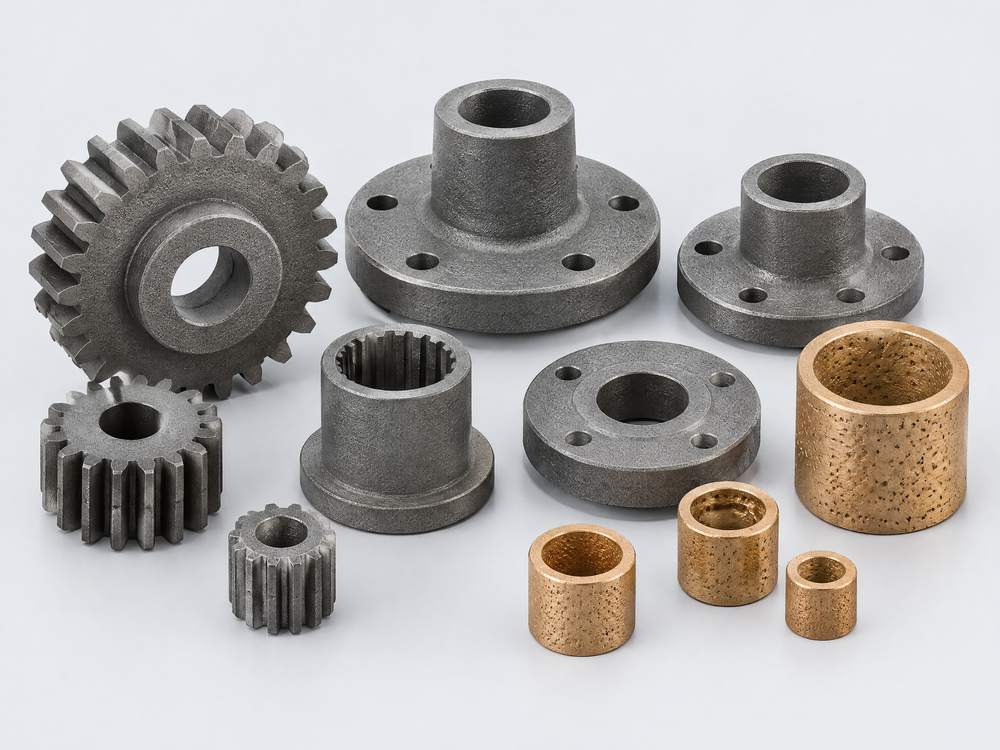
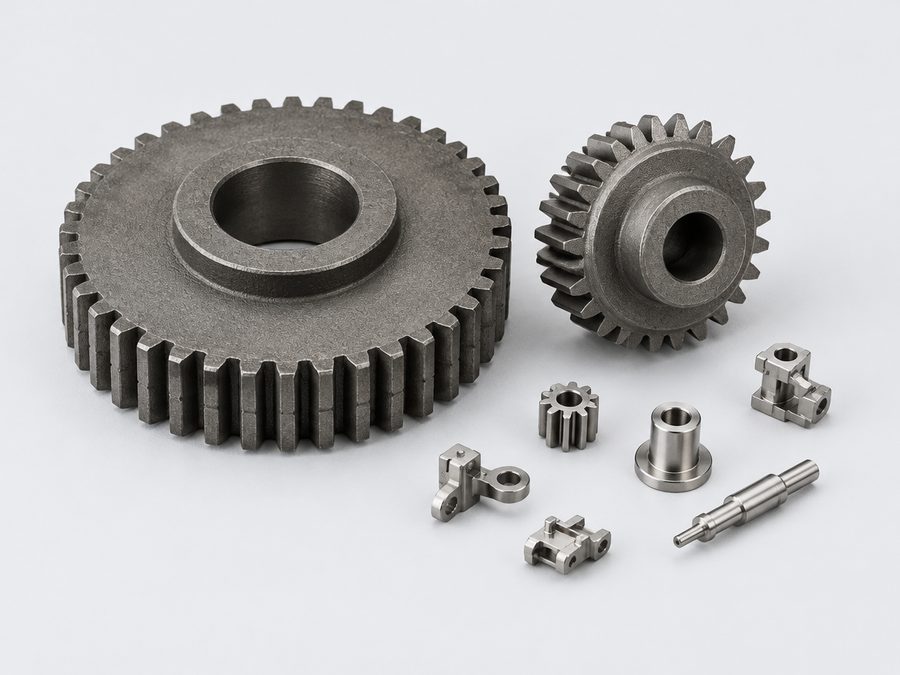
We source sintered parts and MIM parts (metal injection moulding) made to your drawing from factories in China – from pressed structural parts and sintered bearings to small, complex stainless steel parts. In large series, powder metallurgy saves material and machining; we check with you whether your part is suitable.
- Press-and-sinter and metal injection moulding
- Fe-Cu-C, bronze, 316L, 17-4PH
- cost-effective in large series
- Based in Jena since 2011
- Selected partner factories in China
- One contractual partner in Germany
- Pre-shipment inspection included
When to sinter instead of machining or investment casting?
Powder metallurgy forms parts to near-net shape in a tool. Almost all of the material is used, and machining is largely eliminated. In return, you need a press tool or an injection mould – and its cost only pays off over large quantities.
As a rule of thumb, pressed sintered parts and MIM parts pay off mainly in large, recurring series, because the tool has to be amortised over the volume. We have no fixed minimum order quantity – whether sourcing makes sense depends on the part, the quantity and the tooling costs. For smaller quantities, CNC precision parts or investment casting are usually cheaper.
Technical specifications: sintered parts and MIM parts
| Feature | Specification |
|---|---|
| Materials | Press-and-sinter: Fe, Fe-Cu, Fe-Cu-C (e.g. MPIF FC-0208), Fe-Ni-Mo, sintered bronze CuSn10, sintered stainless steel 316L / 410L; MIM: 316L, 17-4PH (1.4542), 42CrMo4, Fe-2Ni, Ti-6Al-4V |
| Part weight / size | Press-and-sinter approx. 1 g–2 kg, height in pressing direction usually up to approx. 2.5 × diameter; MIM approx. 0.1–100 g, wall thickness 0.5–6 mm; larger parts on request |
| Tolerances | Sintered part radial IT8–IT10, after sizing IT6–IT7; in pressing direction IT11–IT12; MIM approx. ±0.3–0.5 % of nominal size, at least approx. ±0.03 mm |
| Surface finish / secondary operations | Sizing (calibration), steam treatment, hardening or sinter hardening, oil impregnation (sintered bearings), resin impregnation for tightness, vibratory finishing, machining of cross holes and threads |
| Quantities | No fixed minimum order quantity – whether sourcing makes sense depends on the part, the quantity and the tooling costs; talk to us; press-and-sinter and MIM typically pay off in large series |
| Inspections | Density to ISO 2738, dimensional report, hardness (apparent and microhardness), metallographic section, tensile test on test bars, oil content of sintered bearings |
| Lead time | First samples in approx. 3 weeks at best, usually longer – up to approx. 10 weeks depending on complexity; series production approx. 4–8 weeks depending on quantity and complexity (production time only, plus transport); toolmaking included in the first-sample time |
| Data for your enquiry | Drawing and 3D model, function of the part, required strength or density, material or standard, surface treatment, annual volume |
Powder metallurgy compared: sintered parts, MIM, investment casting, machining
| Criterion | Press-and-sinter | MIM | Investment casting | Machining |
|---|---|---|---|---|
| Typical part size | 1 g–2 kg | 0.1–100 g | 10 g–100 kg | almost any |
| Density | 85–92 % (6.6–7.2 g/cm³ for Fe) | 96–99 % | approx. 100 % | 100 % |
| Geometry | 2.5D, no undercuts across the pressing direction | complex 3D, small details | complex 3D | limited by tool access |
| Tooling costs (guide value) | approx. €5,000–30,000 | approx. €10,000–50,000 | approx. €2,000–20,000 | none |
| Cost-effective from | large series | large series, small parts | small to medium series | single part |
Design guidelines for sintered parts
Think in the pressing direction
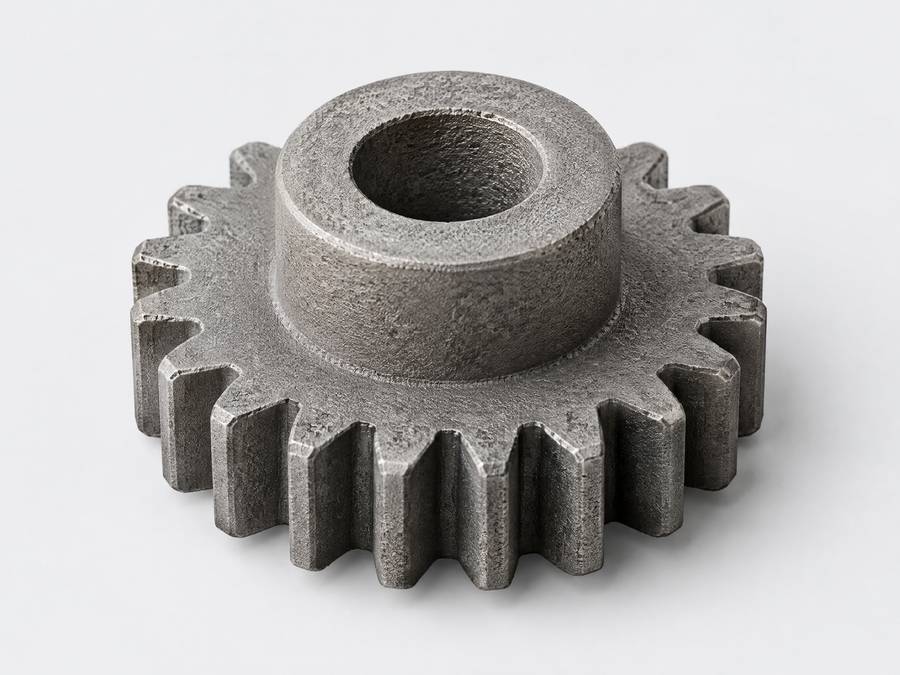
The powder is compacted axially. Features parallel to the pressing direction are no problem; cross holes, transverse grooves and undercuts have to be machined afterwards.
Limit height to diameter
Long, slender parts compact unevenly. A height-to-diameter ratio of up to about 2.5–3 gives a uniform density.
No knife edges
Sharp edges and walls thinner than about 1.5–2 mm break in the green compact or in the tool. Small chamfers and radii extend tool life.
Steps instead of slopes
Several height levels are possible with split punches. But every level increases the tooling costs – keep them to a minimum.
Use sizing selectively
Apply tight tolerances only to functional dimensions, such as a bearing bore or outside diameter. These are sized; the rest stays as-sintered.
MIM parts: metal injection moulding for small, complex parts
In metal injection moulding, fine metal powder is mixed with a binder to form granules (feedstock) and processed on injection moulding machines. After debinding, the part shrinks by around 15–20 % during sintering and reaches 96–99 % density – with properties close to those of wrought material.
MIM is suited to small parts with details that would be expensive to machine: locking elements, levers, lock and tool parts, components for measuring and instrument technology. The materials are described in ISO 22068 and MPIF Standard 35.
- Design uniform wall thicknesses and core out material accumulations
- Provide a flat support surface for sintering, otherwise the part will distort
- Agree the gate position and ejector marks with the factory
- Functional dimensions tighter than ±0.3 % only with secondary machining
Sintered bearings and typical quality issues
Specifying sintered bearings correctly
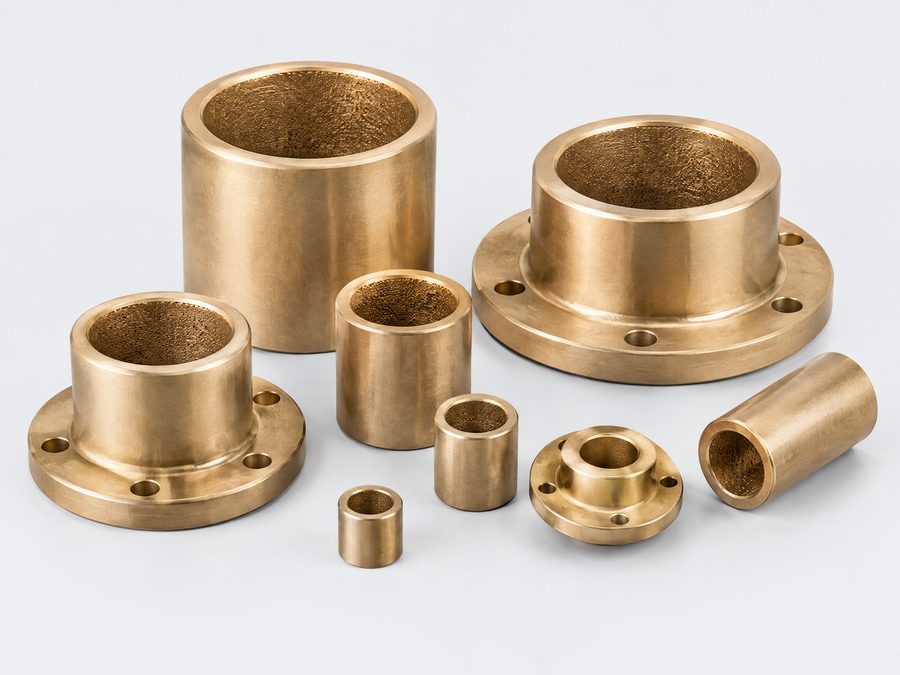
Sintered bearings made of bronze or iron-copper have about 15–30 % pore volume, filled with oil. Oil type, oil content and press-fit belong on the drawing.
Density variations
Uneven density leads to differences in strength. We have the density verified to ISO 2738 on defined areas of the part in the first samples.
Corrosion of ferrous materials
Porous sintered parts rust from the inside. Agree steam treatment, oiling or resin impregnation before coating; electroplated coatings without impregnation are critical.
Distortion in MIM
The high shrinkage causes distortion in thin, long sections. Clarify flatness requirements with the factory early on and plan for sizing or straightening if necessary.
Cost drivers in powder metallurgy – and where you can save
Tool complexity
Every height level needs its own punch, and every MIM slide increases the mould costs. Simplifying the contour often reduces the one-off costs more than the part price.
Secondary operations
For sintered parts, cross holes, threads and grinding cost more than the sintering process itself. Place functional features in the pressing direction wherever possible.
Density and material
Higher density requires double pressing or warm compaction. Fe-Cu-C is considerably cheaper than Fe-Ni-Mo or stainless powders – only specify as much strength as you need.
Batch size and furnace loading
Sintering furnaces run continuously. Larger batches with scheduled call-offs noticeably reduce set-up and start-up costs per part.
Process for sintered parts and MIM parts
Check suitability
Assess geometry, quantity and material; compare with machining, investment casting or stamped parts.
Quotation with tooling costs
Part price and tooling costs shown separately; background in our guide to tooling costs.
Tool and first samples
First samples with dimensional report, density, hardness and microstructure; approval by you.
Series production
Series inspection plan per sintering batch, traceability via powder batches, delivery under the agreed Incoterm.
Frequently asked questions about sintered parts and MIM parts
Are sintered parts as strong as turned parts?
Because of their residual porosity, pressed sintered parts have lower strength and toughness than solid material. Hardened Fe-Cu-C materials, however, reach tensile strengths of several hundred MPa and are sufficient for many gears, hubs and levers.
What is the difference between a sintered part and a MIM part?
Sintered parts are pressed from powder, MIM parts are injection moulded. MIM allows more complex 3D shapes and higher density, but is limited to small parts and has higher tooling costs.
Can sintered parts be hardened?
Yes, by case hardening, quenching and tempering, or sinter hardening directly in the sintering furnace. Because of the porosity, hardness is measured as apparent hardness; microhardness is more meaningful.
Are sintered parts leak-tight?
Not automatically. Parts that have to hold pressure need resin impregnation. MIM parts with more than 96 % density are usually leak-tight.
Can gears be made as sintered parts?
Yes, spur gears with straight or helical teeth for up to about medium loads are a classic sintered part. For highly loaded gearboxes, milled and ground gears remain the better choice.
Which stainless steels are available as MIM parts?
Most commonly 316L for corrosion resistance and 17-4PH (1.4542) for high strength after precipitation hardening. 420 and 440C are also widely used for wear-resistant parts.
Related part types
Enquiry: Sintered Parts & MIM made to your drawing
Upload your drawing and 3D model, tell us the quantity and your deadline – we check feasibility and get back to you with questions or a quotation.
- Technical clarification before the request for quotation
- Quotations from audited partner factories
- One contact person in Germany
- Non-disclosure agreement (NDA) in advance on request
Prefer to call? 03641 9286337 · Mon–Fri 8 am–6 pm (CET)