
Home › Custom parts › Vessels & tanks
Stainless steel vessels, tanks and trays made to your drawing
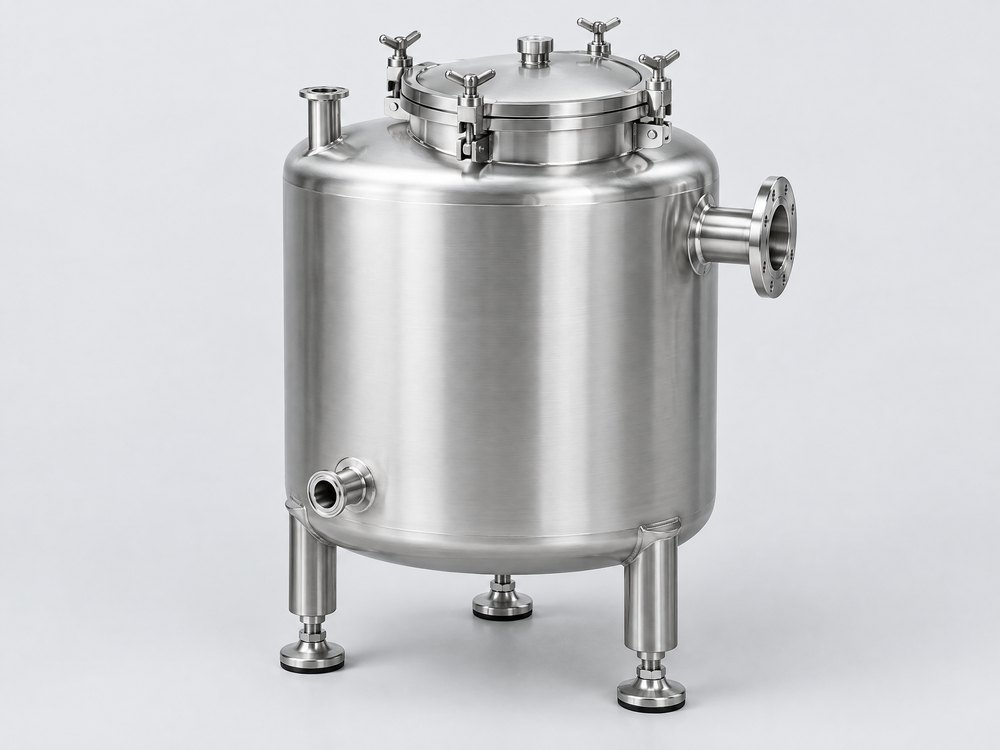
We source stainless steel vessels, non-pressurised tanks, hoppers and trays made to your drawing in series. For machine and plant builders who need identical vessels on a recurring basis and value clean welds, defined surface finishes and documented leak testing.
- Welds pickled and passivated
- Surface finish 2B or 240 grit
- Documented leak testing
- Based in Jena since 2011
- Selected partner factories in China
- One contractual partner in Germany
- Pre-shipment inspection included
Vessel fabrication in series: what we supply – and what we don’t
In vessel fabrication from the Far East, non-pressurised or virtually non-pressurised vessels are the most attractive: storage tanks, drip trays, hoppers, coolant and rinsing tanks, covers. They are made of bent and rolled sheet with many metres of weld – exactly the labour content where manufacturing in China is cheaper.
Pressure vessels with a maximum allowable pressure above 0.5 bar fall under the Pressure Equipment Directive 2014/68/EU (PED). Depending on the category, they require a conformity assessment involving a notified body, qualified welding procedures and CE marking. Our focus is on non-pressurised vessels and tanks. We source pressure vessels to PED 2014/68/EU only on request after individual review – through a factory with the corresponding approval. We will tell you clearly before quoting whether this is possible for your vessel.
Technical specifications: stainless steel vessels
| Feature | Specification |
|---|---|
| Materials | 1.4301 (X5CrNi18-10), 1.4307, 1.4404 (X2CrNiMo17-12-2) where chlorides are present; 1.4571; aluminium EN AW-5754 for lightweight trays |
| Part weight / size | From small hoppers to large non-pressurised tanks with volumes of several 10,000 l; larger vessels on request |
| Tolerances | Welded structures to DIN EN ISO 13920; connection flanges and nozzles to drawing |
| Surface finish / post-processing | Sheet 2B or 2R to EN 10088-2, ground to 240 grit (guide value Ra approx. 0.4–0.6 µm), welds ground flush, pickled and passivated, electropolished |
| Quantities | No fixed minimum order quantity – whether sourcing pays off depends on the vessel, quantity and freight; talk to us |
| Inspections | Leak testing (water fill test, leak detection spray, dye penetrant testing), visual inspection of welds, roughness measurement, material certificate 3.1 |
| Lead time | First samples in approx. 3 weeks at best, usually longer – up to approx. 10 weeks depending on complexity; series production approx. 4–8 weeks depending on quantity and complexity (production time only), plus transport (sea freight approx. 30–45 days) |
| Data for your enquiry | Drawing, 3D model, material, surface finish inside and outside, medium and temperature, type of leak test, annual volume |
Surface finishes for stainless steel tanks: 2B, 240 grit, electropolished
The surface finish determines cleanability, appearance and price. Roughness values are guide values.
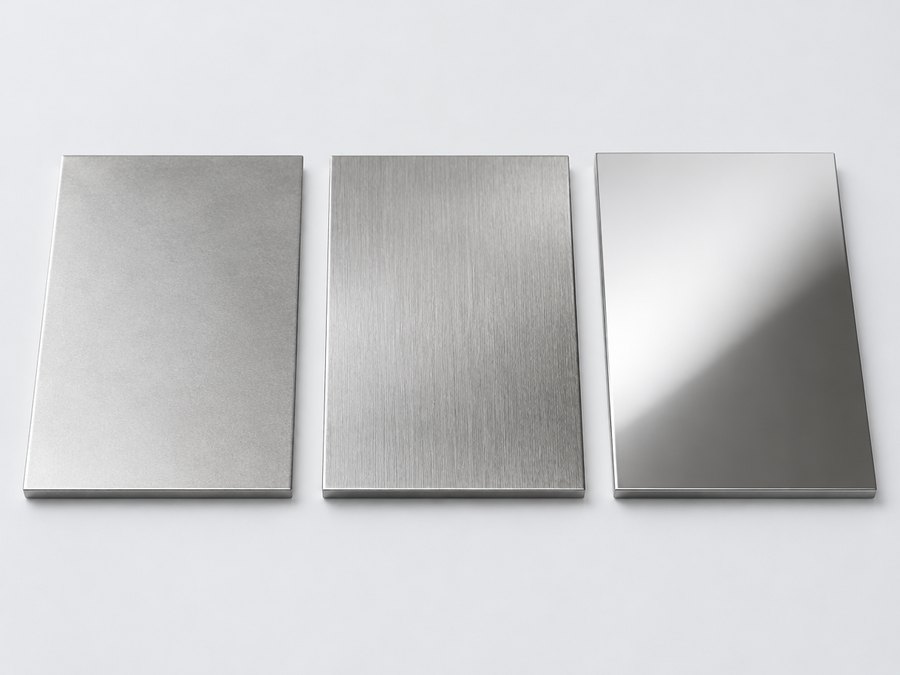
| Finish | Description | Roughness approx. | Application |
|---|---|---|---|
| 2B | Cold-rolled, annealed, pickled, skin-passed | Ra 0.1–0.5 µm | Standard for vessels, internal surfaces without hygiene requirements |
| 2R | Bright-annealed, glossy | Ra < 0.2 µm | Visible parts, easy to clean |
| Ground 240 grit | Mechanically ground, directional finish | Ra 0.4–0.6 µm | Visible surfaces, food industry exteriors |
| Electropolished | Electrochemically smoothed | Significantly reduced compared with initial condition | Pharmaceutical, hygiene areas, internal surfaces |
Pickling and passivating welds: guidelines for vessel fabrication
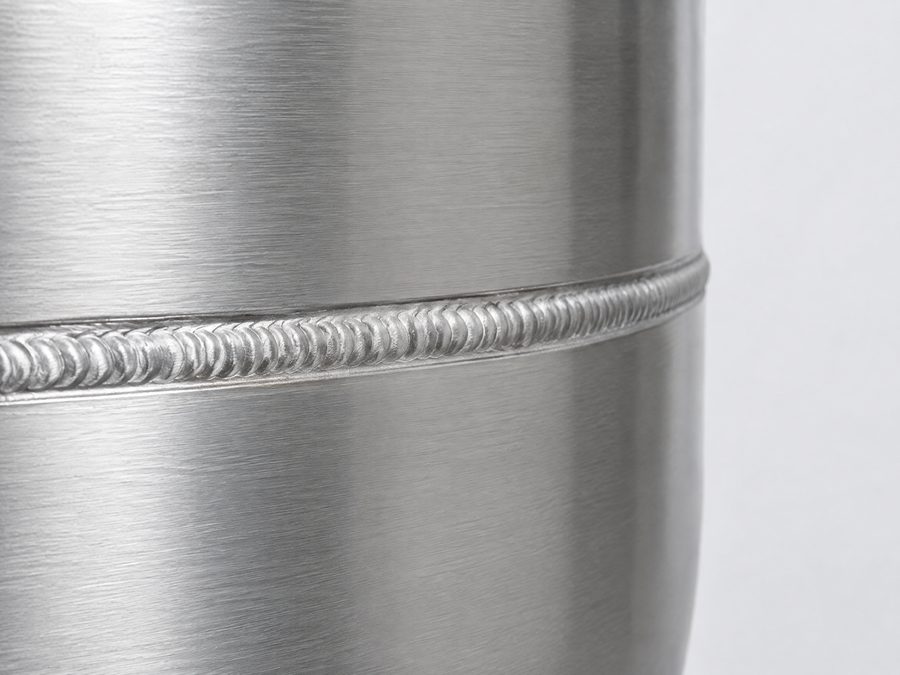
Remove heat tint
Heat tint next to the weld is depleted in chromium and rusts. Pickling by immersion bath, spray pickling or pickling paste removes it; the passive layer then re-forms. Brushing alone is not enough.
Root protection inside
Weld with backing (purge) gas for clean internal welds. Without purging, the root side becomes oxidised (scaled) and is hard to pickle in corners.
No iron contamination
Tools, brushes and supports previously used on carbon steel leave iron particles behind – rust spots are the result. Require separate stainless steel production in your enquiry.
Design for complete drainage
Bottoms sloped towards the outlet, no horizontal ledges inside, radii in corners. Standing liquid promotes corrosion and microbial growth.
Trays from a single blank
Where possible, bend hoppers and trays rather than welding them from individual sheets. Less weld means less pickling effort and fewer leak points.
Leak testing for non-pressurised vessels
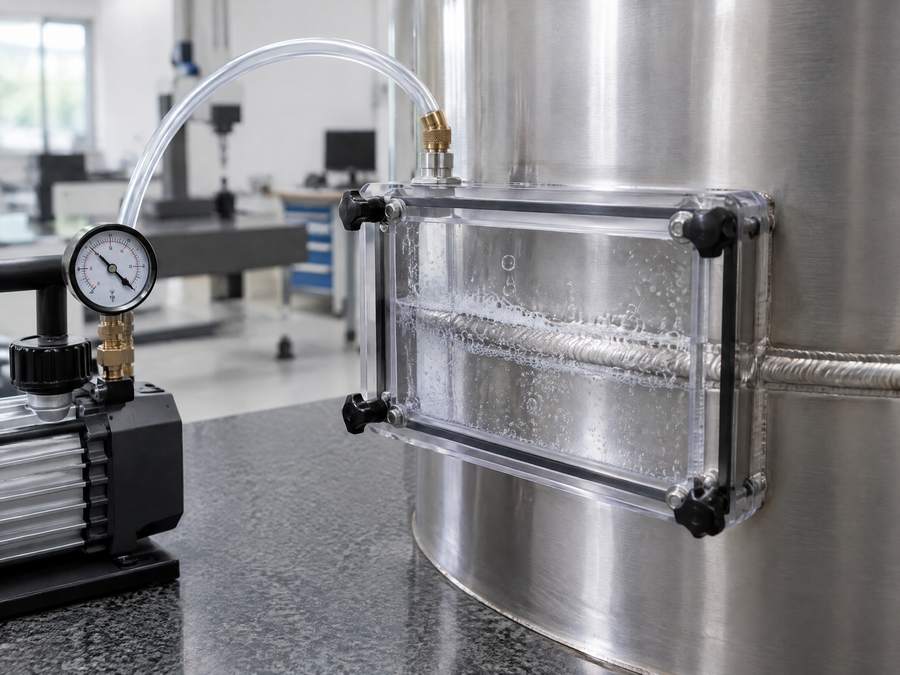
The test must be stated in the enquiry; otherwise it will not be done, or only superficially. Common methods for non-pressurised vessels are the water fill test with a defined holding time, testing with low air overpressure and leak detection spray, and dye penetrant testing to ISO 3452-1 on individual welds.
Specify the test method, test duration and documentation – for example a test record with serial number and photo. Test scope and results become part of the quality documentation.
Typical defects in stainless steel tanks and trays
Dents in large surfaces
Thin side walls of 1.5–2 mm visibly distort during welding. Plan beads, bends or stiffening frames instead of simply switching to thicker sheet.
Crevice corrosion at overlaps
Overlapping sheets or fillet welds welded from one side only form crevices where liquid collects. Use full-penetration butt welds on wetted surfaces.
Surface finish specified only outside
If nothing is specified for the inside, it will not be ground there and often not pickled. Specify the inside and outside surface finish separately on the drawing.
Nozzles welded in at an angle
Connections distort during welding. Tolerance the position and angle of nozzles and have them welded in a fixture if they connect to pipework.
Cost drivers in vessel fabrication
The price of a stainless steel vessel depends less on the material than on the weld length and surface treatment. Every metre of weld has to be welded, ground, pickled and inspected. Internal grinding to 240 grit in a narrow vessel can cost more than the sheet itself.
- Bent corners with a radius instead of welded corners
- 2B surface finish inside where there are no hygiene requirements
- Use standard wall thicknesses (1.5 / 2 / 3 mm) and standard flanges
- Design vessels to be stackable or nestable – this considerably reduces freight per piece
How a stainless steel vessel project runs
Clarify requirements
Medium, pressure, temperature, surface finish and testing – including whether the PED applies.
First samples with test record
Dimensional inspection, roughness measurement, leak testing and photos of the pickled welds – you receive the first sample for inspection and approval.
Approval and series production
Inspection plan with leak testing for each vessel, packaging with protection against scratches and iron contamination.
Is your vessel suitable for sourcing from the Far East?
A good fit if …
- Non-pressurised stainless steel tanks and storage vessels in series
- Hoppers, trays and collecting vessels with many metres of weld
- Vessels that pack well and – where possible – can be shipped stacked
Less suitable if …
- Pressure vessels under the PED without a suitably approved factory
- Very large individual vessels where heavy transport and freight eat up the price advantage (we check this case by case)
- Vessels with connections that change at short notice from order to order
Frequently asked questions about stainless steel vessels
When is my vessel a pressure vessel?
Under the Pressure Equipment Directive 2014/68/EU, when the maximum allowable pressure exceeds 0.5 bar. Conformity assessment and marking then apply, and depending on the category a notified body must be involved. Our focus is on non-pressurised vessels; we source pressure vessels only on request after individual review, through a factory with the corresponding approval.
Is 1.4301 sufficient or do I need 1.4404?
For water, oils and many foods, 1.4301 is sufficient. With chlorides, salt water or chlorine-containing cleaning agents, 1.4404 with molybdenum is significantly more resistant.
Are the welds pickled or just brushed?
You decide. For corrosion-resistant vessels, we recommend specifying pickling and passivating as a mandatory operation on the drawing.
What surface finish do vessels in the food industry need?
For product-contact surfaces, a roughness of Ra ≤ 0.8 µm is a common guide value, e.g. according to EHEDG recommendations. This includes smoothly ground, crevice-free welds and complete drainage. Compliance of the material with food legislation is proven by certificates; hygienic design lies in your drawing.
How is leak-tightness verified?
Usually by a water fill test or a test with low air overpressure and leak detection spray, documented for each vessel. Method and duration belong in the enquiry.
Can vessels be supplied with add-on parts such as level sensors?
Yes, nozzles, flanges and brackets are welded on as part of the vessel. We only fit electrical components if they are specified and approved for the EU market.
Related part types
Enquiry: Vessels & tanks made to your drawing
Upload your drawing and 3D model, tell us the quantity and your deadline – we check feasibility and get back to you with questions or a quotation.
- Technical clarification before the request for quotation
- Quotations from audited partner factories
- One contact person in Germany
- Non-disclosure agreement (NDA) in advance on request
Prefer to call? 03641 9286337 · Mon–Fri 8 am–6 pm (CET)