Home › Custom parts › Cable Assemblies & Wiring Harnesses
Cable Assemblies from China – Cable Sets and Wiring Harnesses Made to Your Drawing
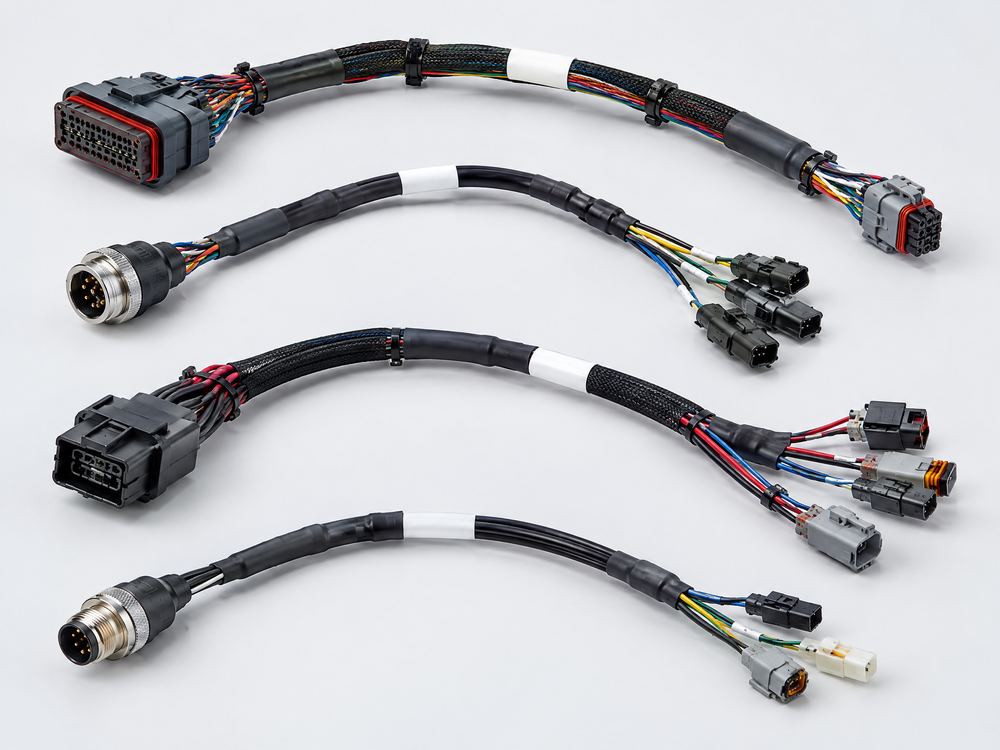
We source cable assemblies through our partner network in China: assembled cables with connectors, cable sets and wiring harnesses of moderate complexity for machines, equipment and vehicles. What matters is not only price and delivery date, but the right connectors, verifiable crimp quality and complete electrical testing.
- Crimping to IPC/WHMA-A-620
- Original or approved connectors
- 100 % continuity test of every cable set
- Based in Jena since 2011
- Selected partner factories in China
- One contractual partner in Germany
- Pre-shipment inspection included
Cable assembly in China: what it is suited to
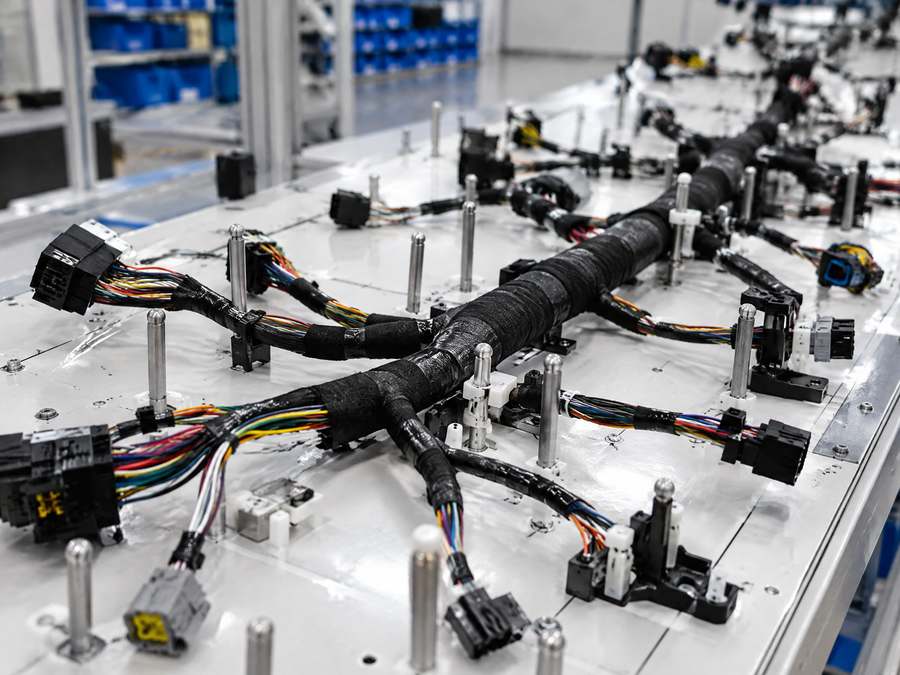
Cable assembly is labour-intensive: cutting to length, stripping, crimping, loading the housings, routing on the harness board, bundling and testing. Especially with wiring harnesses with many wires and branches, labour makes up a large part of the price – and this is where the cost advantage of production in China lies.
Well suited are cable sets with a stable layout and a plannable annual volume, such as equipment wiring, sensor and motor cables, control wiring for machines or wiring harnesses for commercial vehicles and agricultural machinery. They can often be sourced together with the housing or assembly, see mechanical assemblies.
Less suited are cable sets whose lengths or pin assignments change frequently, and many variants each in small quantities – there, short distances to the cable assembler are often more important than the unit price. What is technically feasible (complexity, cross-sections, test equipment) depends on the individual factory – we clarify this for your cable set on request.
Technical specifications: cable assemblies and wiring harnesses
| Feature | Specification |
|---|---|
| Materials | Copper strands (bare or tinned), insulation of PVC, PUR, TPE, silicone, PTFE; conductors from approx. 0.08–6 mm² (AWG 28–10), larger cross-sections on request |
| Part weight / size | From single-core connecting cables to branched cable sets; lengths to drawing; limits per factory on request |
| Tolerances | Length tolerance usually ±(5–10) mm up to 1 m or ±1 % for longer cables; strip lengths and crimp height according to the contact data sheet |
| Surface finish / secondary operations | Heat-shrink tubing, corrugated conduit, braided sleeving, tape, cable ties, grommets, overmoulding, printing and marking |
| Quantities | No fixed minimum order quantity – whether sourcing makes sense depends on the part, the quantity and the tooling costs; talk to us; scheduled call-offs possible |
| Inspections | 100 % continuity and short-circuit test, insulation / high-voltage test on request, crimp height measurement, cross-section analysis, pull-out force, visual inspection to IPC/WHMA-A-620 |
| Lead time | First samples in approx. 3 weeks at best, usually longer – up to approx. 10 weeks depending on complexity; series production approx. 4–8 weeks depending on quantity and complexity (production time only, plus transport); also depends on connector availability |
| Data for your enquiry | Cable drawing with lengths and tolerances, circuit diagram or pin assignment table, cable types, connectors with manufacturer part number, marking, inspection requirements, annual volume |
Connectors: original or compatible?
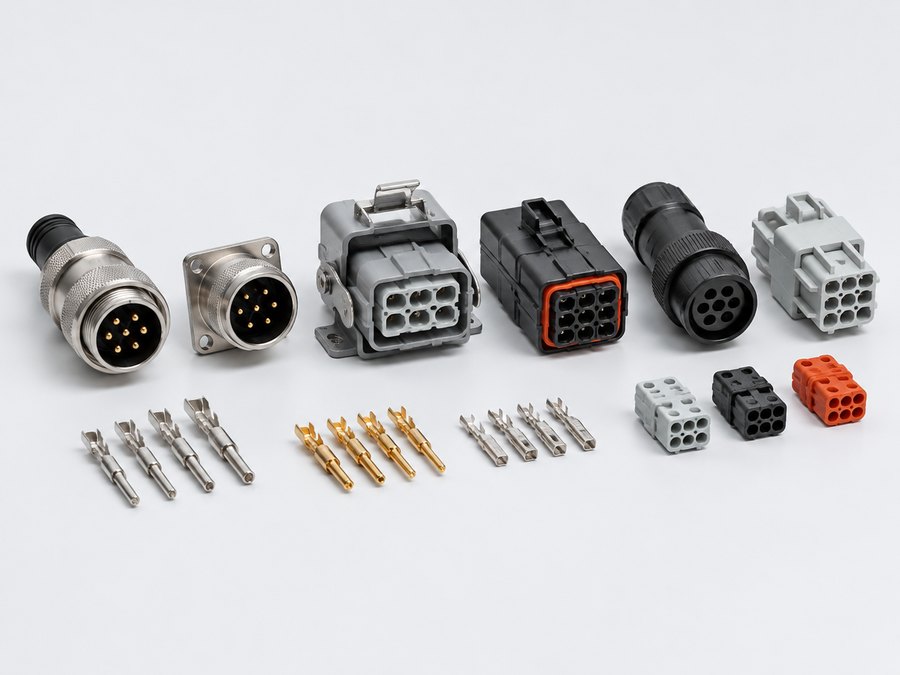
Connectors and contacts are the biggest quality risk in cable assemblies from China. Besides original parts from well-known manufacturers, there are “compatible” parts from local manufacturers and – unfortunately – counterfeits.
| Option | Advantages | Risks | Recommendation |
|---|---|---|---|
| Original from the brand manufacturer, via authorised distribution | Data sheet and crimp specifications apply, mates with the counterpart, traceable | Higher price, lead times during shortages | Recommended for high reliability requirements, mandatory if the mating part is original |
| Compatible part from a local manufacturer | Considerably cheaper, readily available | Different tolerances, contact material and plating, higher contact resistance, mating forces do not match | Only after sampling and written approval with part number |
| Counterfeit branded part | – | Looks like the original but does not meet its specification | Request proof of origin (distributor invoice or CoC), check at goods receipt |
Design guidelines for cable sets and wiring harnesses
Manufacturer part number instead of a description
“Connector 4-pin, 2.54 mm pitch” leaves too much open. State housing, contact, secondary lock and seal with manufacturer and part number – and add whether alternatives are permitted.
Dimension lengths sensibly
Dimension branches from the end of the connector housing or from the centre of the branch and define the tolerance. Overly tight length tolerances on long wiring harnesses increase scrap and price.
Specify the cable type completely
Cross-section, number of cores, colours, shielding, temperature range, oil resistance, suitability for drag chains, UL style or standard cable type where applicable.
Define the marking
Labels, wire-end markers or printing with part number and date make assembly and traceability easier.
Clarify shield termination
How is the shield terminated – via the connector housing, via a pigtail or not at all? Faulty shield termination is a frequent cause of EMC problems.
Strain relief and protection
Define bending radii, grommets, kink protection and chafe protection at edges – especially if the wiring harness is routed along sheet metal parts.
Crimping to IPC/WHMA-A-620 and 100 % testing
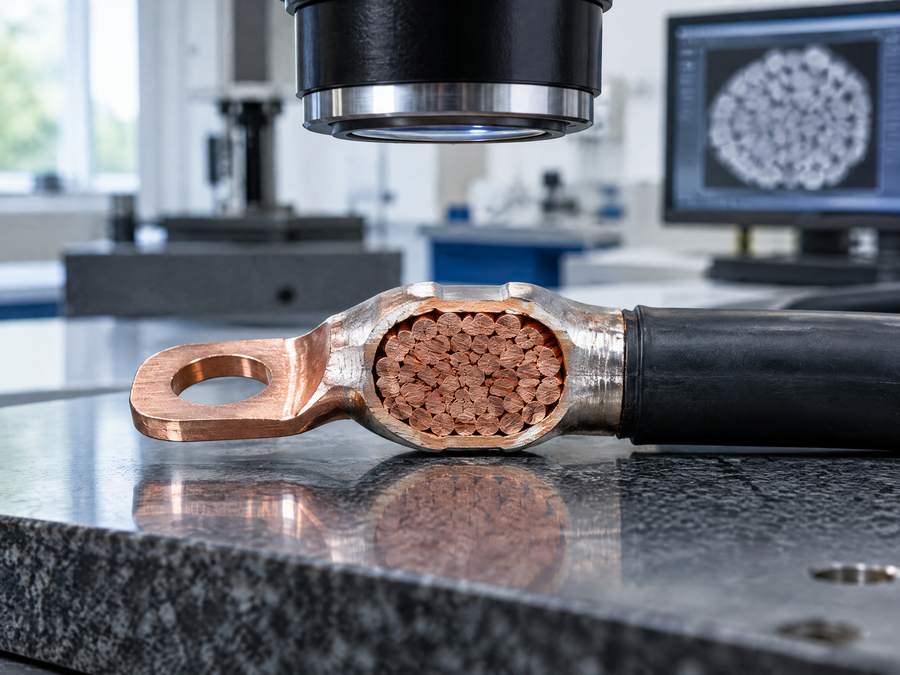
IPC/WHMA-A-620 is the widely used acceptance standard for cable and wire harness assemblies worldwide. It distinguishes three product classes: Class 1 (general electronics), Class 2 (equipment with high reliability requirements, the standard in industry) and Class 3 (highest reliability, failure cannot be tolerated). The class belongs on the drawing. Our focus is on cable sets for industrial and equipment applications.
A good crimp connection cannot be recognised from the outside. That is why the following evidence is customary:
- Crimp height according to the contact manufacturer’s data sheet, measured at set-up and at intervals
- Cross-section (micrograph) at first samples and tool changes: compaction, symmetry, no voids
- Pull-out force per cross-section, e.g. to IEC 60352-2
- Crimp force monitoring on the machine, where available
- 100 % continuity test of every cable set for open circuits, short circuits and miswiring, with high-voltage insulation testing if required
UL cables, RoHS and REACH
For the North American market, UL-listed cables (e.g. AWM styles to UL 758) are often required. Check the printed UL file number in the UL database – printing is counterfeited too. If the entire cable set is to be UL-certified, the cable assembler itself must be listed accordingly.
In the EU, cable sets are subject to the RoHS Directive 2011/65/EU with its substance restrictions (including lead, cadmium and certain phthalates in PVC) as well as the REACH information obligation for SVHC substances above 0.1 per cent by weight. Request declarations of conformity and material data sheets as well.
Cost drivers in cable assembly
Connectors
Original connectors can cost more than the entire labour. Check where an approved alternative is technically acceptable – and where it is not.
Manual work
Every branch, every grommet and every individually inserted contact takes time. Fewer variants and standardised branches lower the price.
Testing effort
High-voltage testing and test adapters for special connectors are one-off costs. For series production, a dedicated test adapter almost always pays off.
Overmoulding
Overmoulded connectors need a mould. This only pays off from larger quantities; below that, heat-shrink solutions are cheaper.
Process for your cable assembly
Check documents
Drawing, pin assignment and BOM checked for completeness; clarification of which connectors must be original.
Quotation and parts availability
Quotation with price per variant, test adapter and connector availability.
Samples with evidence
Sample cable sets with crimp heights, micrograph, test record and proof of origin for the connectors.
Approval and series production
Process approval, 100 % testing in series production, schedule tracking, marking and packaging as specified.
Frequently asked questions about cable assemblies
Are wiring harnesses made in China fitted with original connectors?
If you specify it, yes. Without a specification, many factories use compatible parts. So state in the BOM and drawing whether original parts are mandatory, and request proof of origin.
How can I recognise counterfeit connectors?
Often not visually at all. Signs are missing or blurred embossing, different colour or mating force and packaging without a manufacturer label. Only purchasing through authorised distributors and random checks at goods receipt give certainty.
Which IPC/WHMA-A-620 class should I specify?
Class 2 is customary for industrial machines and equipment. Class 3 is intended for applications where failure cannot be tolerated, and it increases testing effort and price.
Is a continuity test sufficient?
For most cable sets, yes, if it is carried out at 100 % and detects miswiring. For mains voltage, long cables in damp environments or safety-relevant applications, an insulation test should be carried out in addition.
Are the cables UL-certified?
That depends on the cable type used. UL cables can be recognised by the style number and UL file number on the insulation. UL certification of the complete cable set is a separate matter and must be clarified in advance.
Can cable sets be supplied together with housings and assemblies?
Yes, this often makes sense. Cable set, housing and assembly from a single source avoid interface problems during installation.
Related part types
Enquiry: Cable Assemblies & Wiring Harnesses made to your drawing
Upload your drawing and 3D model, tell us the quantity and your deadline – we check feasibility and get back to you with questions or a quotation.
- Technical clarification before the request for quotation
- Quotations from audited partner factories
- One contact person in Germany
- Non-disclosure agreement (NDA) in advance on request
Prefer to call? 03641 9286337 · Mon–Fri 8 am–6 pm (CET)