
Home › Custom parts › Forgings
Forgings made to drawing – closed-die forgings, rings and flanges in series
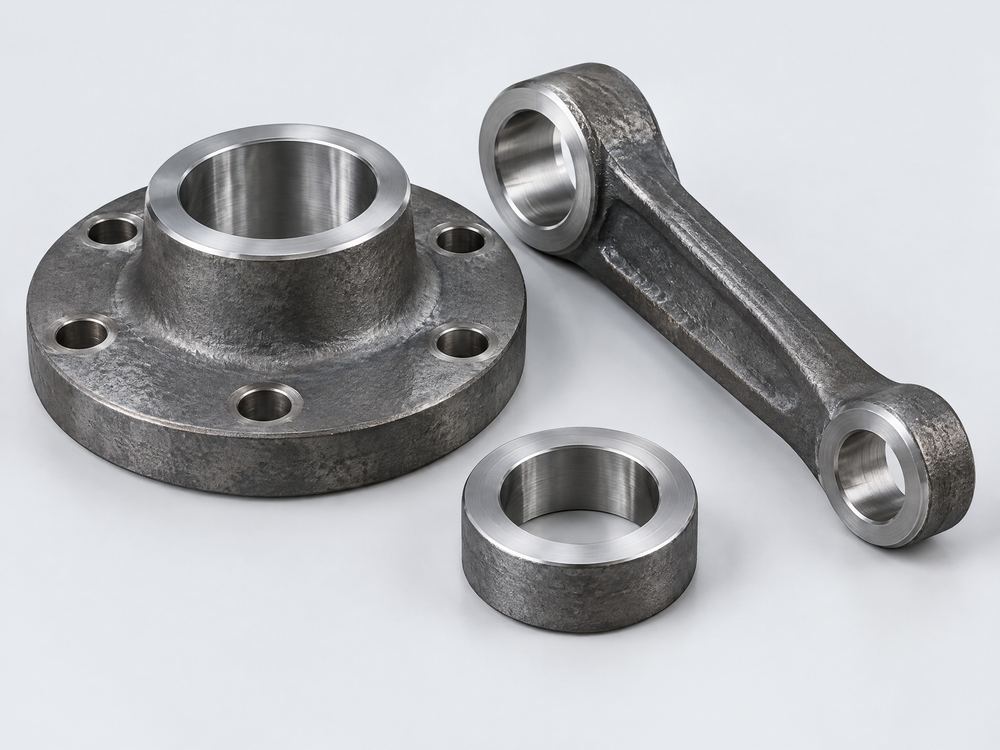
Forgings are used wherever components must reliably carry high and alternating loads: shafts, levers, clevises, flanges and gear blanks. TOP Asia Technik sources closed-die forgings, open-die forgings and rolled rings to your drawing from forges in China – raw, heat-treated or machined ready for installation, with material and inspection certificates.
- Closed-die, open-die and ring-rolled parts
- Quenched and tempered, machined ready for installation
- Ultrasonic and crack testing available
- Based in Jena since 2011
- Selected partner factories in China
- One contractual partner in Germany
- Pre-shipment inspection included
Why forgings – and when not
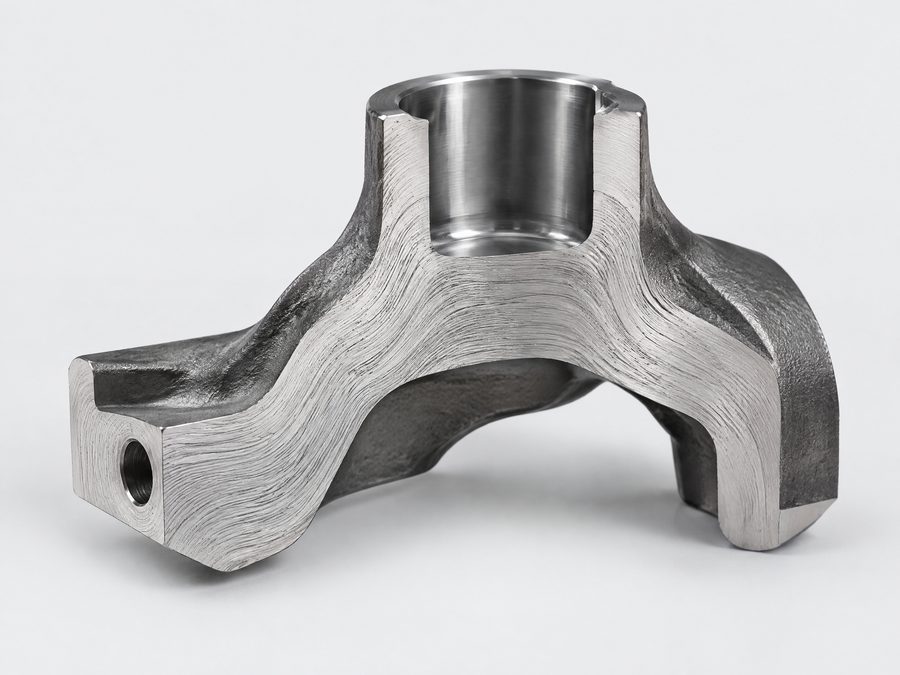
In forging, the material is plastically deformed in a heated state, not melted. This preserves a continuous grain flow that follows the contour of the part. Pores and shrinkage cavities, as found in castings, practically do not occur. The result is higher fatigue strength and toughness than with a casting of the same weight or a part turned from solid.
The limits: internal cavities and very thin walls cannot be forged, and tolerances are coarser than with investment casting. Complex but lightly loaded parts are therefore often cheaper as investment castings; simple turned parts in small quantities are better made from bar stock.
Technical specifications: forgings
| Feature | Specification |
|---|---|
| Materials | Quenched and tempered steels C45 (1.0503), 42CrMo4 (1.7225), 34CrNiMo6 (1.6582); case-hardening steel 16MnCr5 (1.7131); precipitation-hardening ferritic-pearlitic (AFP) steel 38MnVS6 (1.1303); pressure vessel steel P250GH (1.0460); stainless steel 1.4301, 1.4404; aluminium EN AW-6082, EN AW-7075; brass |
| Part weight / size | Closed-die forgings from approx. 0.1 kg to approx. 500 kg; open-die forgings up to several tonnes; rolled rings up to approx. Ø 5,000 mm; larger parts on request |
| Tolerances | Steel closed-die forgings to DIN EN 10243-1 (tolerance grade F normal, E close); aluminium forgings to DIN EN 586-3; open-die forgings with machining allowances to DIN 7527 |
| Surface finish / post-processing | Trimming, blasting, heat treatment (normalising, quenching and tempering, case hardening, aluminium T6), sizing/coining, CNC turning and milling, galvanising, painting, corrosion protection oil |
| Quantities | No fixed minimum order quantity – whether sourcing pays off depends on the part, quantity and tooling costs; just get in touch. Closed-die forging becomes more economical as quantities rise, because the die cost is spread across the parts; open-die forging and ring rolling also in small batches |
| Inspections | Spectral analysis, hardness, tensile and notched-bar impact testing, macro-etching of the grain flow, ultrasonic testing to DIN EN 10228-3, magnetic particle testing to DIN EN 10228-1, measurement report, inspection certificate 3.1 |
| Lead time | First samples after approx. 3 weeks at best, usually longer – depending on complexity up to approx. 10 weeks; series production approx. 4–8 weeks depending on quantity and complexity (production time only, plus transport); die making included in the first sample lead time |
| Data for your enquiry | Finished part drawing, forging drawing if required, material and strength or hardness specification, heat treatment condition, annual volume, inspection requirements, grain flow orientation for critical parts |
Closed-die forgings, open-die forgings and rolled rings
Which forging process is right depends on geometry, size and quantity:
| Process | Typical parts | Tooling | Quantity |
|---|---|---|---|
| Closed-die forging (with flash) | levers, clevises, connecting rods, hubs, flanged shafts | part-specific die made of hot-work tool steel | medium to large series (die cost spread across the parts) |
| Precision forging (low-flash) | gear blanks, bevel gears, joint parts | complex die, tight process control | large series |
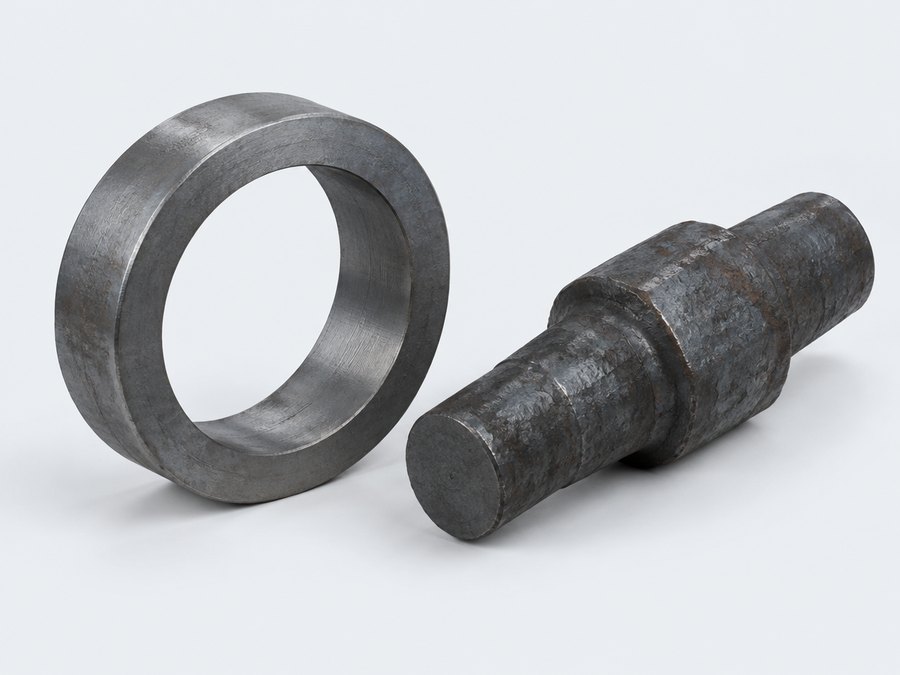
| Open-die forging | shafts, blocks, discs, large blanks | universal tools, no die | single pieces possible, large parts |
| Ring rolling (seamless rolled rings) | bearing rings, gear rim blanks, large-diameter flanges | universal rolls, profiled rolls optional | small to medium batches |
Design guidelines for closed-die forgings
Define the parting line
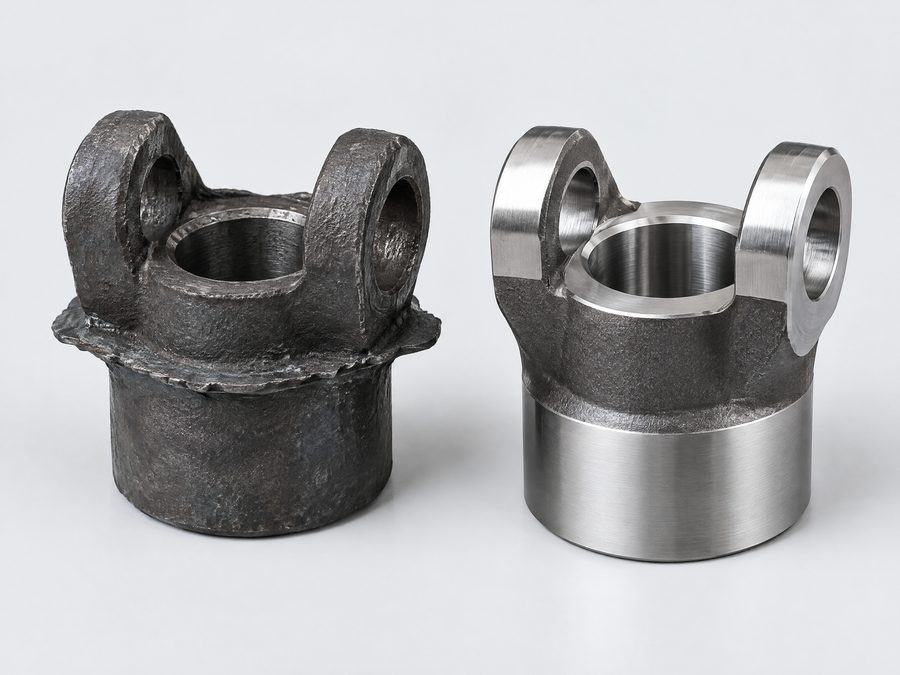
The flash line lies in the parting plane of the die. Do not place it on functional surfaces, and bear in mind that mismatch at the flash line is permitted to DIN EN 10243-1.
Forging draft
To release the part from the die, vertical faces need draft angles of approx. 3–7° (guide value), with inner faces needing more than outer faces.
Generous radii
Small edge radii fill poorly and wear the die quickly. Edge and fillet radii of several millimetres are usual in steel forging.
Make use of grain flow
The main load direction and the grain flow should be aligned. For safety-critical parts, the grain flow can be verified by macro-etching on the first sample.
Machining and stock allowance
Machining allowances of approx. 1.5–3 mm per surface are usual for medium-sized parts. Forging scale, surface decarburisation and mismatch must be completely removed.
Pre-forge holes
Through holes are pre-forged with a thin web, which is then punched out or drilled. Blind holes and threads are always machined.
Forging steels and heat treatment
For most machine components, a quenched and tempered steel such as C45 or 42CrMo4 is chosen. In the quenched and tempered condition, 42CrMo4 achieves tensile strengths of about 900–1,100 MPa depending on the cross-section; with larger cross-sections the value drops because through-hardening is limited. For very large cross-sections, 34CrNiMo6 is the usual choice.
An economical alternative is the precipitation-hardening AFP steel 38MnVS6: it achieves its strength through controlled cooling directly from the forging heat, so separate quenching and tempering is not needed. Gears and parts subject to wear are forged from case-hardening steel such as 16MnCr5 and case-hardened after machining – more on this under Gears and drive components.
Aluminium forgings
For high-strength lightweight construction, aluminium alloys such as EN AW-6082 or EN AW-7075 are forged and then age-hardened (T6). They replace steel parts in vehicle and equipment manufacturing when weight matters and the load allows it.
Forged rings and flanges made to drawing
Depending on size, flanges and rings are closed-die forged or seamlessly rolled. For pressure-bearing flanges, materials such as P250GH with inspection certificate 3.1 are usual; standard flanges must be distinguished from those made to customer drawings.
Typical forging defects and how to detect them
Laps and folds
These occur when material is folded over itself during forming. They are close to the surface and are reliably found by magnetic particle testing.
Underfill
Edges or ribs are not fully formed, often because the billet is too small or the die is worn. Visual inspection after trimming and measurement of the critical contours reveal this.
Mismatch
The upper and lower dies shift relative to each other. Permissible values are specified in DIN EN 10243-1; for machined parts, the stock allowance must cover the mismatch.
Surface decarburisation
The surface layer loses carbon during heating and becomes soft. On unmachined functional surfaces, this impairs hardness and fatigue strength.
Incorrect heat treatment
Nothing is visible from the outside. Hardness testing per batch and tensile tests on specimens from the same heat treatment lot provide certainty.
Cost drivers for forgings
Material input
For forgings, the input weight including flash and scale loss largely determines the price. A well-designed forging with little flash saves material on every piece.
Die and die wear
Dies wear and have to be reworked or replaced. Clarify whether die costs are charged once or spread proportionally across each piece.
Alloy steels
Chromium, molybdenum and nickel alloy steels are more expensive and more volatile in price than C45. Check whether an AFP steel or an unalloyed quenched and tempered steel is sufficient.
Tight tolerances on the forging
Tolerance grade E instead of F to DIN EN 10243-1 requires more process effort. It is often cheaper to stay with grade F and machine the functional surfaces.
Scope of inspection
100 % ultrasonic and crack testing makes sense for safety-critical components, but often not for simple levers. Specify inspections according to how critical the component is.
How forging sourcing works
Clarify process and forging design
Closed-die, open-die or ring rolling; parting line, draft and stock allowance agreed in a forging drawing.
Quotation
Die costs, forging, heat treatment and machining shown separately.
First samples
Material certificate, hardness and strength values, macro-etching if required, measurement report and first article inspection report.
Series production
Production according to the approved process, inspection according to the series inspection plan, traceability down to the melt of the starting material.
Frequently asked questions about forgings
What is the difference between closed-die forgings and open-die forgings?
Closed-die forgings are formed in a part-specific tool and are dimensionally close to the final contour – economical from medium quantities. Open-die forgings are produced with universal tools, are rougher and need more machining, but are suitable for large parts and small batches.
When is a forging worthwhile instead of a part turned from solid?
When the part is heavily loaded and would need a lot of machining, for example flanged shafts or levers with large differences in cross-section. Material input falls, and the grain flow improves fatigue strength.
Which tolerances apply to closed-die forgings?
For steel, usually DIN EN 10243-1 with tolerance grade F (normal) or E (close). The permissible deviations depend on part weight, material, shape and parting line and are specified in the forging drawing.
How is the grain flow verified?
By macro-etching a sectioned first sample. The etched section shows whether the grain follows the contour. For safety-critical parts, this test can also be agreed on a recurring basis.
Is 42CrMo4 from China comparable with European material?
Chinese factories often supply to the GB standard (42CrMo) or ASTM (4140), which are chemically similar but not identical. Specify material to DIN EN 10083-3 with inspection certificate 3.1 and have the analysis and strength checked during first sampling.
Can forged aluminium parts also be sourced?
Yes, for example in EN AW-6082 or EN AW-7075 with age hardening. Aluminium forgings are considerably stronger than aluminium castings and are chosen when weight and fatigue strength matter equally.
Related part types
Enquiry: Forgings made to your drawing
Upload your drawing and 3D model, tell us the quantity and your deadline – we check feasibility and get back to you with questions or a quotation.
- Technical clarification before the request for quotation
- Quotations from audited partner factories
- One contact person in Germany
- Non-disclosure agreement (NDA) in advance on request
Prefer to call? 03641 9286337 · Mon–Fri 8 am–6 pm (CET)