Home › Custom parts › Special Fasteners & Springs
Special Fasteners and Springs Made to Drawing – Fasteners and Wire Parts in Series
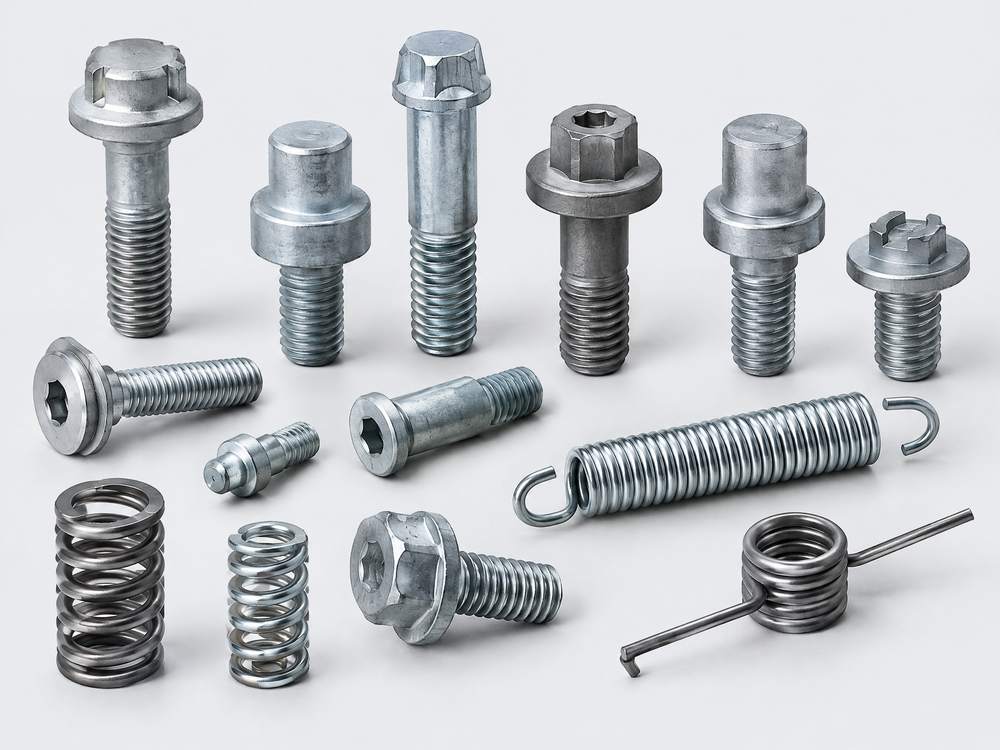
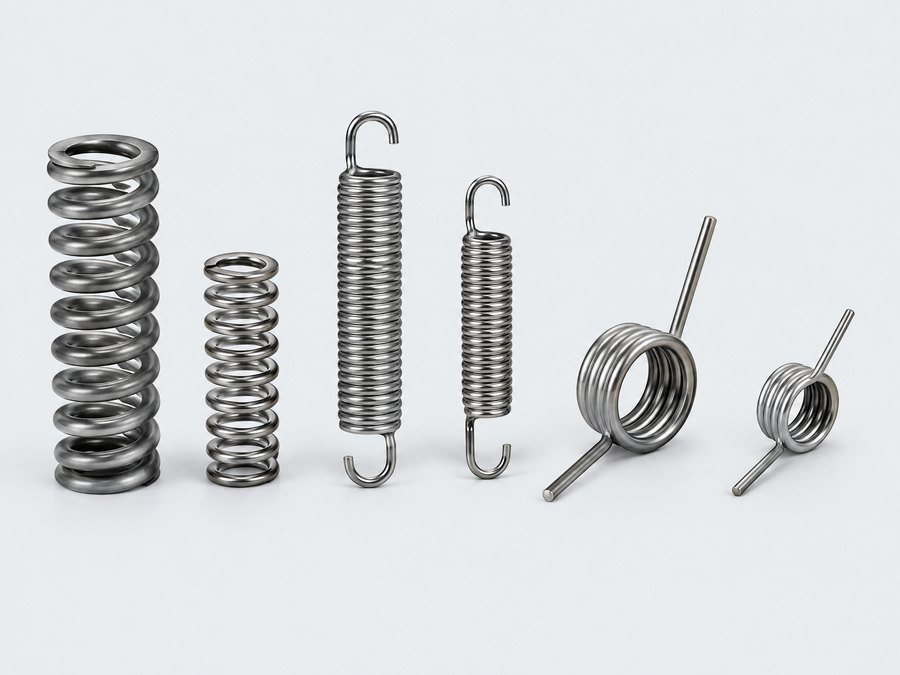
We source special screws, special bolts, compression, extension and torsion springs and wire parts made to your drawing in series. Catalogue goods are explicitly not part of this – it is about parts that do not exist in this form in a standard parts catalogue. Before every quotation for steel screws from China, we also check whether EU anti-dumping duties would upset the costing.
- Cold-formed to your drawing
- Property classes to ISO 898-1
- Anti-dumping duty checked in advance
- Based in Jena since 2011
- Selected partner factories in China
- One contractual partner in Germany
- Pre-shipment inspection included
Fasteners made to drawing: when sourcing pays off
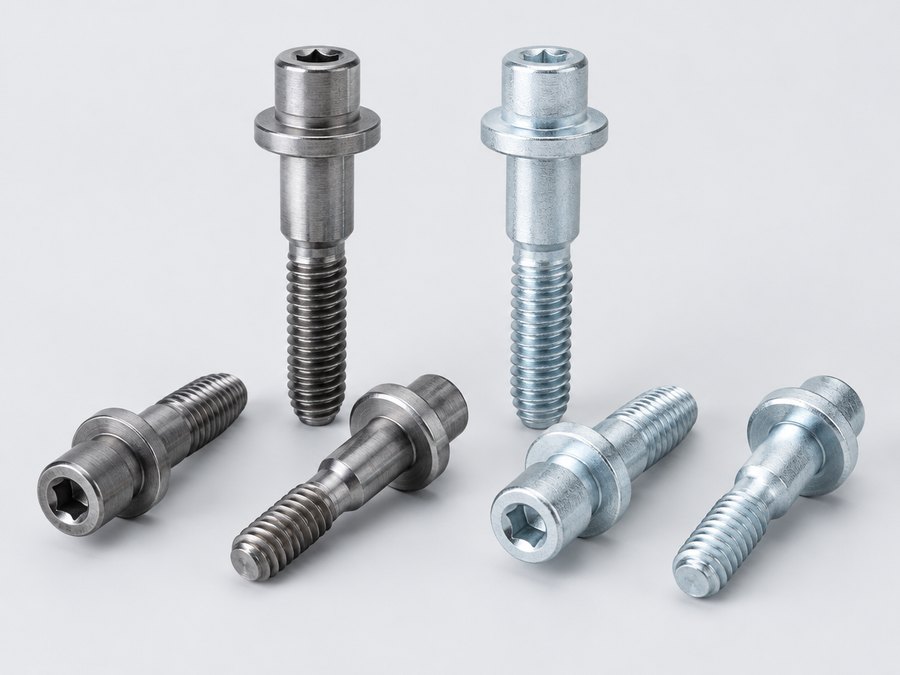
Special screws are needed when a standard part cannot do the job: special head shapes, shoulders, pins, cross holes, special threads, fitted or sealing shanks, non-standard lengths or materials. The same applies to springs made to drawing with a defined characteristic, special ends or unusual dimensions.
Production in Asia is economically attractive above all for large quantities of cold-formed parts and for springs with a high share of manual work (bent legs, loops, hooks). For steel screws with heads from China, however, you have to factor in the anti-dumping duty – more on this below.
Sourcing through us does not make sense for standard screws and catalogue springs – specialist distributors are usually faster and cheaper for these. For small quantities of special parts, we check whether turned parts are more economical than cold-formed ones.
Technical specifications: special screws, springs and wire parts
| Feature | Specification |
|---|---|
| Materials | Screws: cold-heading steels, boron steels (e.g. 23MnB4), quenched and tempered steels (e.g. 42CrMo4), stainless A2/A4 to ISO 3506-1, brass, aluminium. Springs: spring wire to EN 10270-1 (patented drawn, SL to DH), EN 10270-2 (oil-hardened and tempered, e.g. VDC), EN 10270-3 (stainless, e.g. 1.4310) |
| Part weight / size | Cold-formed screws usually about M3–M20, larger diameters hot-formed or turned; cold-formed springs about 0.2–16 mm wire diameter, thicker wires hot-formed (guide values); larger parts on request |
| Tolerances | Threads 6g/6H to ISO 965; screws otherwise to ISO 4759-1 or drawing; compression springs to DIN 2095, extension springs to DIN 2097, torsion springs to DIN 2194 (state the quality grade in each case) |
| Surface finish / secondary operations | Zinc flake (ISO 10683), electroplated zinc or zinc-nickel (ISO 4042 / ISO 19598), phosphating, black oxide; for springs shot peening, presetting, coating |
| Quantities | No fixed minimum order quantity – whether sourcing makes sense depends on the part, the quantity and the tooling costs; talk to us. Cold forming typically pays off with large batches; for smaller quantities, turned parts are often cheaper |
| Inspections | Tensile test and hardness to ISO 898-1, thread gauges, coating thickness and salt spray test (ISO 9227), for springs force-length measurement at L1/L2, solid length, relaxation behaviour; inspection certificate 3.1 |
| Lead time | First samples in approx. 3 weeks at best, usually longer – up to approx. 10 weeks depending on complexity; series production approx. 4–8 weeks depending on quantity and complexity (production time only, plus transport); including heat treatment and coating |
| Data for your enquiry | Drawing with material, property class or hardness, surface finish with corrosion requirement (hours in salt spray), for springs forces at defined lengths, annual volume, batch size |
Property classes to ISO 898-1 for special screws
Special screws should also be given a property class – then inspection, marking and choice of material are clearly defined. Values for screws made of carbon steel and alloy steel:
| Class | Tensile strength Rm (nominal / min.) | Yield strength or 0.2 % proof strength min. | Note |
|---|---|---|---|
| 4.6 | 400 / 400 MPa | 240 MPa | Not quenched and tempered, simple fastenings |
| 5.6 | 500 / 500 MPa | 300 MPa | Not quenched and tempered |
| 8.8 | 800 / 800 MPa (d ≤ 16 mm), 830 MPa (d > 16 mm) | 640 / 660 MPa | Quenched and tempered, standard in mechanical engineering |
| 10.9 | 1,000 / 1,040 MPa | 940 MPa | Quenched and tempered; hardness approx. 320–380 HV – electroplated zinc only with caution |
| 12.9 | 1,200 / 1,220 MPa | 1,100 MPa | Highly sensitive to hydrogen; avoid electroplated coatings |
Design guidelines for cold forming and cold extrusion
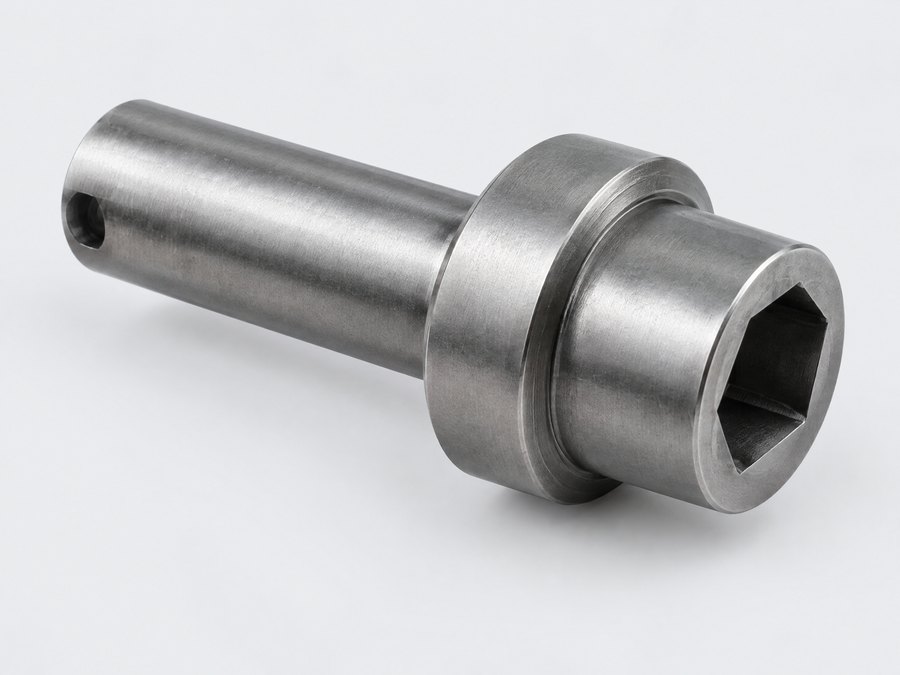
In series production, special screws are usually cold-formed on multi-station presses and the thread is then rolled. This is fast and saves material, but it limits the geometry.
Think in volume, not machining
In cold extrusion, material is displaced, not removed. Large jumps in cross-section and very large heads need more forming stages or can only be achieved by secondary machining.
Radii and transitions
Generous radii between head and shank increase tool life and fatigue strength. Sharp edges are expensive in cold forming.
Roll threads instead of cutting them
Rolled threads are stronger and cheaper. Choose the thread run-out and undercut on the drawing so that rolling is possible.
Cross holes and slots
Can only be produced by additional machining after forming and make the part considerably more expensive. Check whether an internal drive or a flat can do the job.
Springs: tolerance forces, not coils
For compression springs, tolerance the force at a defined length instead of the number of coils and the free length at the same time – otherwise the spring is over-specified.
Define the spring ends
Closed and ground, closed and unground, or open – the end type affects force, buckling behaviour and price. For extension springs, state the loop shape and position.
Surface finishes and hydrogen embrittlement
For high-strength fasteners made to drawing, the surface finish is not a minor detail. During electroplating with zinc and during pickling, hydrogen can penetrate the steel. From about 320 HV – i.e. from property class 10.9 and for hardened springs – there is a risk of hydrogen-induced brittle fracture: the screw breaks hours or days after assembly without warning.
Heat treatment after zinc plating (baking) reduces the risk but does not reliably eliminate it. For high-strength parts, a non-electrolytic zinc flake coating to ISO 10683 is therefore usually the better choice. Depending on the system and coating thickness, it often achieves 480–720 hours in the salt spray test to ISO 9227 without base metal corrosion.
- State the corrosion requirement as hours in the salt spray test, not just as a coating designation
- Specify the coefficient of friction if assembly is torque-controlled (e.g. µ = 0.09–0.14)
- Require chromium(VI)-free passivation – mandatory under RoHS and the End-of-Life Vehicles Directive
- For springs: shot peening increases fatigue strength, but must be done before coating
EU anti-dumping duty on screws from China (as of October 2026, without guarantee)
With Implementing Regulation (EU) 2022/191, the EU has been imposing definitive anti-dumping duties since 18 February 2022 on certain iron or steel fasteners (not of stainless steel) originating in China: wood screws and self-tapping screws, other screws and bolts with heads, and washers (including CN 7318 12 90, 7318 14 91/99, 7318 15 58–88, ex 7318 15 95, ex 7318 21 00, ex 7318 22 00). Depending on the manufacturer, the rates are between 22.1 % and 86.5 %; for all manufacturers not named individually, 86.5 % applies, in addition to the regular customs duty. The individual rate is only granted if the commercial invoice of the named manufacturer contains the prescribed declaration. According to the Commission’s notice of 29 May 2026, the measures expire on 18 February 2027 unless an expiry review is initiated – if one is initiated, the duties continue to apply during the review. Not covered by this regulation are, among others, stainless steel screws, nuts and springs. Rerouting via third countries does not change the origin and is prohibited as circumvention. We check the tariff classification before quoting; in case of doubt, binding tariff information (BTI) is recommended. More in our guide Customs and imports from China.
Cost drivers for special screws and springs
Customs duty and origin
For steel screws with heads from China, the anti-dumping duty can completely wipe out the price advantage. Alternatives: stainless steel, sourcing from the EU through our partner in the Czech Republic, or a design that does not fall under the affected commodity codes.
Forming stages and secondary operations
Every additional press stage, every cross hole and every grinding operation increases tooling and unit costs.
Heat treatment and surface finish
For small parts, quenching and tempering, baking and zinc flake coating can cost more than the forming itself.
Scope of inspection
100 % sorting (e.g. optical sorting for length and thread) or force testing of every spring increases the price, but for safety-relevant parts it is often cheaper than a complaint.
Spring tolerances
Quality grade 1 to DIN 2095 is considerably more expensive than quality grade 2. Only require the tightest tolerances for the functional dimension.
Process: from the drawing to the series screw or spring
Drawing and customs check
Technical clarification of material, strength and surface finish – and a check whether the commodity code is subject to anti-dumping duties.
Select factory and process
Cold forming, turning or spring coiling; quotation with tooling and unit costs.
Samples with inspection report
Dimensions, hardness, tensile test or spring characteristic, coating thickness, material certificate, first article inspection report (FAIR / EMPB) on request.
Series production with inspection plan
Series inspection plan, traceability down to the batch, packaging and schedule tracking.
Frequently asked questions about special screws and springs
Are special screws made to drawing subject to the anti-dumping duty?
That depends on the material and the customs tariff number, not on whether the part is made to drawing. Screws and bolts with heads made of non-stainless steel originating in China are frequently affected (as of October 2026). If in doubt, binding tariff information (BTI) should be obtained.
Are springs affected by the anti-dumping duty on fasteners?
Springs are classified under a different tariff heading (7320) and are not covered by Regulation (EU) 2022/191. Other customs measures should nevertheless be checked for each part.
Can I have high-strength screws electroplated with zinc?
From property class 10.9, this is critical because of the risk of hydrogen embrittlement. For high-strength screws, we recommend a zinc flake coating to ISO 10683.
From what quantity does cold forming pay off?
There is no fixed limit – geometry, tooling costs and batch size are decisive. Cold forming typically pays off with large batches; for smaller quantities, turned special screws are often more economical, see CNC precision parts. We compare both options for your part.
How do I specify a compression spring correctly?
State the wire diameter, outside or inside diameter, material, end type and one or two spring forces at defined lengths with tolerance. Add the quality grade to DIN 2095 and any fatigue strength requirement.
Do you also supply catalogue springs or standard screws?
No. We only source parts made to customer drawings in series. For standard parts, specialist distributors are the better choice.
What evidence do I receive for the material?
Customary is an inspection certificate 3.1 to EN 10204 for the wire and a factory test report on hardness, tensile test or spring force. On request, traceability down to the heat is possible.
Related part types
Enquiry: Special Fasteners & Springs made to your drawing
Upload your drawing and 3D model, tell us the quantity and your deadline – we check feasibility and get back to you with questions or a quotation.
- Technical clarification before the request for quotation
- Quotations from audited partner factories
- One contact person in Germany
- Non-disclosure agreement (NDA) in advance on request
Prefer to call? 03641 9286337 · Mon–Fri 8 am–6 pm (CET)