Home › Custom parts › Aluminium die casting
Aluminium die casting from China – made to your drawing, in series
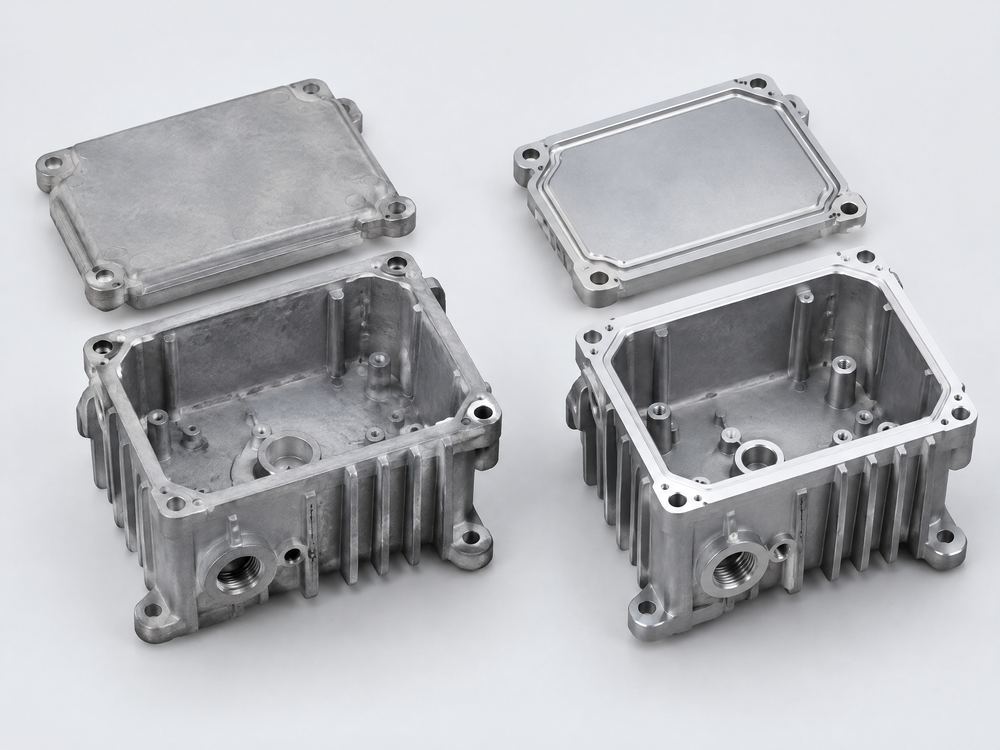
Aluminium die casting is the process of choice when you need thin-walled, dimensionally accurate housings, covers and brackets in larger series. TOP Asia Technik sources die-cast parts in aluminium, zinc and magnesium to your drawing from foundries in China – including tooling, machining, first article inspection and series monitoring, with contract and invoice from a German GmbH.
- Aluminium, zinc and magnesium die casting
- Tooling, machining and coating from a single source
- X-ray and leak testing available
- Based in Jena since 2011
- Selected partner factories in China
- One contractual partner in Germany
- Pre-shipment inspection included
When aluminium die casting pays off
In die casting (high-pressure die casting, HPDC), molten metal is injected at high speed into a split steel die, where it solidifies within seconds. The result is parts with wall thicknesses from about 1.5 mm, good dimensional accuracy and a smooth surface – without having to mill every contour.
The catch is the die: depending on size and number of slides, it costs a five-figure sum and only pays off over volume. As a rule of thumb, die casting becomes attractive from about 1,000–2,000 parts per year; below that, investment casting, sand or gravity die casting, or CNC-milled parts are usually more economical.
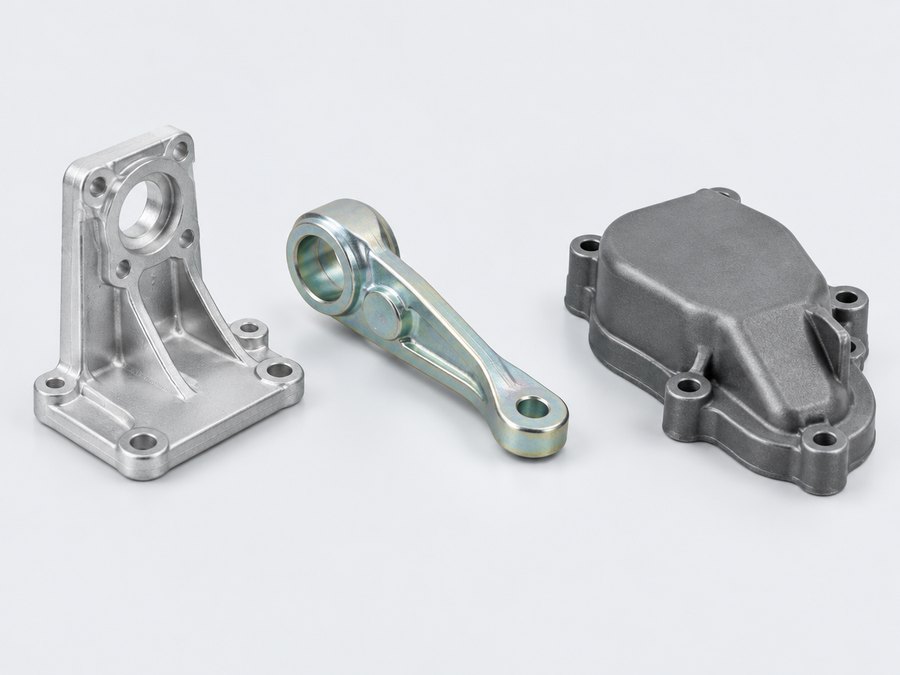
Typical die-cast parts in our enquiries are electronics and motor housings, covers, end shields, brackets, finned heat sinks, and housings for pumps and valves with low pressure loads.
Technical specifications: aluminium die casting
| Feature | Specification |
|---|---|
| Materials | Aluminium to DIN EN 1706, mainly EN AC-46000 (AlSi9Cu3(Fe)), EN AC-47100 (AlSi12Cu1(Fe)), EN AC-44300 (AlSi12(Fe)), EN AC-43400 (AlSi10Mg(Fe)); zinc to DIN EN 12844 (ZP0400/ZAMAK 3, ZP0410/ZAMAK 5); magnesium to DIN EN 1753 (EN-MC21120/AZ91, EN-MC21230/AM60) |
| Part weight / size | Guide value: from a few grams up to approx. 50 kg, larger parts on request; wall thickness 1.5–4 mm for aluminium, from approx. 0.8 mm for zinc. The upper limit depends on the machine’s clamping force – through our factory network we also find suitable foundries for large parts |
| Tolerances | General tolerances to DIN EN ISO 8062-3, typically DCTG 5–7 (aluminium, magnesium) or DCTG 4–6 (zinc); dimensions across the parting line and slides are coarser; fits and sealing faces are machined |
| Surface finish / post-processing | Deburring, vibratory finishing, blasting, CNC machining, impregnation, powder coating, cathodic e-coating (KTL), Cr(VI)-free passivation; anodising of high-silicon alloys only to a limited extent (grey, blotchy) |
| Quantities | No fixed minimum order quantity; because of the die costs typically economical from approx. 1,000–2,000 pcs/year, often 5,000 to over 100,000 – we calculate whether it pays off for your part |
| Inspections | Spectral analysis, X-ray inspection for porosity, leak testing, CMM measurement report, first article inspection report (FAIR / EMPB), coating thickness measurement |
| Lead time | First samples after approx. 3 weeks at best, usually longer – depending on complexity (including die making) up to approx. 10 weeks; series production approx. 4–8 weeks depending on quantity and complexity (production time only), plus transport (sea freight approx. 30–45 days) |
| Data for your enquiry | 3D model (STEP) and 2D drawing with tolerances, alloy, annual volume and batch size, machined and sealing faces, permissible porosity, surface finish/colour |
Aluminium, zinc or magnesium die casting?
The alloy determines weight, strength, tool life and surface finish. The following overview helps with the initial selection:
| Criterion | Aluminium (e.g. EN AC-46000) | Zinc (ZAMAK 3/5) | Magnesium (AZ91) |
|---|---|---|---|
| Density | approx. 2.7 g/cm³ | approx. 6.6–6.7 g/cm³ | approx. 1.8 g/cm³ |
| Minimum wall thickness (guide value) | 1.5–2 mm | 0.8–1 mm | 1.5–2 mm |
| Die life (guide value) | approx. 80,000–150,000 shots | 500,000 shots and more | longer than with aluminium |
| Surface / decorative finish | easy to paint and powder coat | excellent for electroplating (chrome, nickel) | conversion coating and paint required |
| Typical parts | housings, covers, brackets, heat sinks | small precision parts, handles, fittings | lightweight housings, handheld devices |
| Strengths | most cost-effective all-rounder, good thermal conductivity | very accurate, sharp contours | lowest weight |
Design guidelines for die-cast parts
Many cost and quality problems start in the drawing. We check these points with every enquiry:
Uniform wall thickness
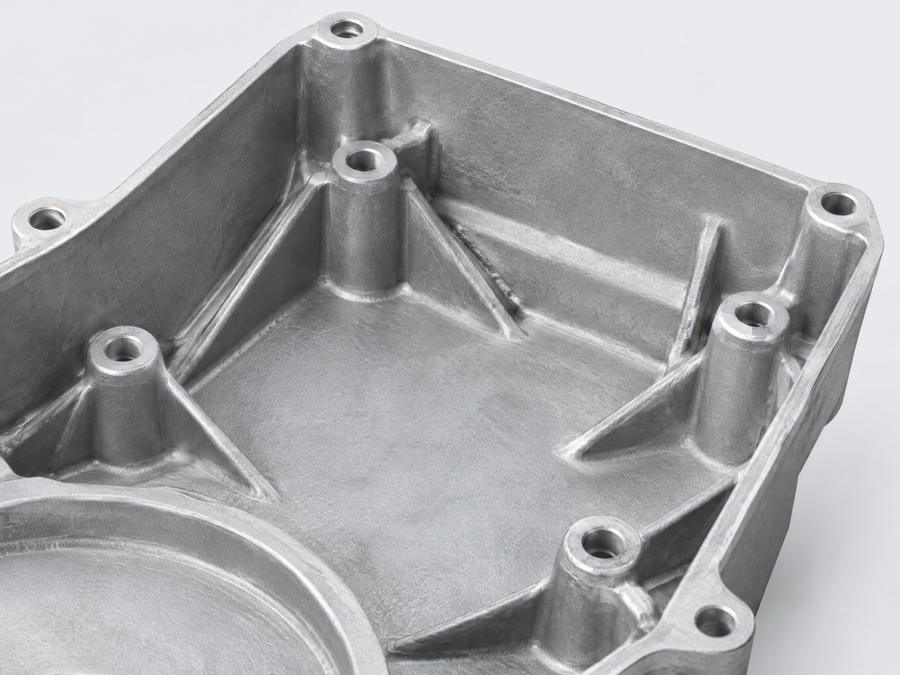
Material accumulations solidify last and form shrinkage porosity. It is better to core out thick areas and stiffen them with ribs; design changes in wall thickness with smooth transitions.
Plan for draft angles
Guide value 0.5–1° on outer walls, 1–2° on inner walls and cores. Without draft, the surface tears during ejection and the die wears faster.
Radii instead of sharp edges
Inner radii of at least 0.5–1 mm improve die filling and reduce heat checking in the die. Use sharp outer edges only where the function requires them.
Use slides sparingly
Undercuts and side holes require slides. Every slide makes the die more expensive, lengthens the cycle time and creates another flash line.
Define machining deliberately
The dense skin is only a few tenths of a millimetre thick. Machining allowances of approx. 0.3–0.5 mm are sufficient; milling deeper exposes pores. Place sealing faces and bores in low-porosity zones.
Mark porosity zones
Die castings are never completely free of pores. Mark in the drawing where pores are non-critical and where they are not – this saves X-ray effort and discussions during sampling.
Typical die casting defects and how to avoid them
Gas and shrinkage porosity
Entrapped air and solidification shrinkage. Remedy: optimise gating and venting, vacuum assistance, even out wall thicknesses. Evaluation by X-ray, e.g. based on VDG data sheet P 201.
Cold shuts and flow lines
Two melt fronts do not fuse cleanly. Causes are a die that is too cold, flow paths that are too long or walls that are too thin – often only visible after coating.
Flash and mismatch
As the die wears, flash at the parting line and slides increases. Regular die maintenance and a clear flash limit (e.g. max. 0.2 mm) in the inspection plan prevent surprises.
Distortion
Long, flat covers distort during ejection and cooling. Ribs, a symmetrical design and, if necessary, a straightening operation with flatness inspection solve the problem.
Leaking housings
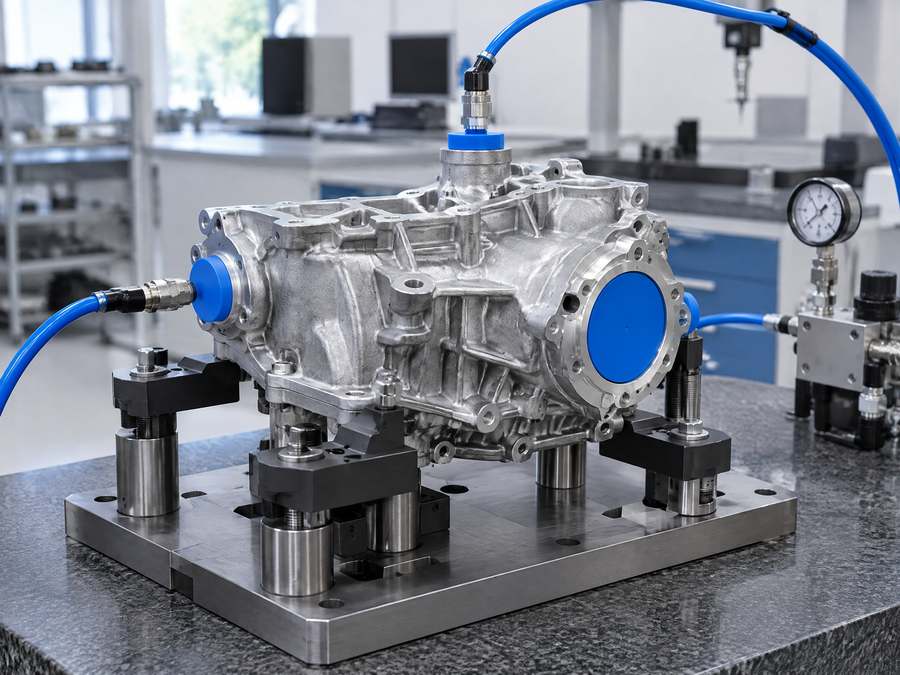
For housings carrying fluids or rated IP67, through-porosity is the main risk. Remedy: 100 % leak testing (pressure decay) and vacuum impregnation if required.
Die casting tooling: cost, die life and ownership
The die is usually made of hot-work tool steel such as 1.2343 or 1.2344 (H13). Its price depends on part size, number of cavities, slides and cooling. For several variants, a master die with interchangeable inserts is sometimes worthwhile.
Die life is important for costing: in aluminium die casting, the die surface starts to show visible heat checking after about 80,000–150,000 shots. With zinc, a die lasts many times longer. Clarify in advance who pays for maintenance and a replacement die.
The tool is paid for by the customer and becomes their property once paid in full. It remains at the foundry for production and is marked; the arrangement is set out in our quotation. On request, we organise the transfer of the die to Germany or elsewhere in Europe. More on this in the guide Tooling costs in China; we describe toolmaking itself under Toolmaking and mould making.
Cost drivers for die-cast parts – and how to save
Machining
For many die-cast parts, machining costs more than the raw casting. Every tolerance that can be achieved as-cast saves fixtures and cycle time.
Slides and cavities
A die without slides is considerably cheaper. With high annual volumes, a two- or four-cavity die can reduce the unit price, even though the die costs more.
General tolerance too tight
A blanket ±0.1 mm on all dimensions forces machining. Better: ISO 8062-3 as the general tolerance and tight tolerances only on functional dimensions.
Surface requirements
Visible parts with Class A requirements need die polishing, rework and higher scrap rates. Define visible surfaces and boundary samples early.
X-ray and leak testing
100 % inspections are expensive. Often, sampling inspection according to the inspection plan is sufficient, with 100 % leak testing only for parts where tightness matters.
Aluminium die casting from China: what to look out for
Chinese die casters have broad technical capabilities but differ widely in alloy purity, die maintenance and inspection equipment. A spectral analysis per melt batch and an agreement on whether secondary (remelted) or primary alloy is used therefore belong in every order.
Pay attention to the Chinese standard designation: ADC12 (JIS) largely corresponds to EN AC-46100, A380 (ASTM) roughly to EN AC-46500. We translate your specification into the local designation and request material certificates so that a substitute alloy is not used without notice. How we safeguard first samples and series production is described under Quality assurance.
Process: from die-cast part design to series production
Drawing review
Feasibility, demoulding, wall thicknesses and tolerances are reviewed together with the foundry; you receive suggested changes before tool release.
Quotation for die and part
Separate prices for the die, raw casting, machining and surface finish – so that you can compare alternatives.
Die making and first samples
Once the die design is approved, first shots and a measurement report follow. You receive the first samples for inspection and approval – on request with X-ray images and a first article inspection report (VDA Volume 2 or PPAP).
Process approval
After you approve the first samples, casting parameters, inspection plan and packaging are fixed before series production starts to your specifications.
Series production and monitoring
Ongoing inspections according to the inspection plan, schedule tracking and escalation in the event of deviations.
Is aluminium die casting right for your part?
A good fit if …
- recurring annual demand over which the die pays for itself
- thin-walled housings and covers with ribs and bosses
- parts with many functional surfaces that would otherwise be milled
- the same geometry over several years
Less suitable if …
- one-off parts and prototypes with no prospect of series production
- parts that have to be welded or T6 heat-treated (investment casting or gravity die casting are better suited)
- very large, thick-walled parts – sand casting is usually cheaper here
- frequent design changes during the ramp-up phase
Frequently asked questions about aluminium die casting
From what quantity does aluminium die casting pay off?
We have no fixed minimum order quantity. As a rule of thumb, because of the die costs, die casting becomes attractive from about 1,000–2,000 parts per year with demand over several years. The deciding factor is how much machining die casting saves compared with a milled part – we will be happy to calculate this for your part.
Can die-cast parts be welded or hardened?
Conventional die castings contain gas pores that blister during welding or solution heat treatment. For weldable or age-hardenable parts, vacuum die casting with a suitable alloy, gravity die casting or investment casting are the better choice.
Which alloy is best for a housing?
For most housings, EN AC-46000 (AlSi9Cu3(Fe)) is the economical standard. For higher demands on corrosion resistance or elongation, low-copper alloys such as EN AC-43400 or EN AC-44300 are suitable.
Can die-cast parts be anodised?
Only to a limited extent. High-silicon die casting alloys produce a grey, uneven anodised layer. For decorative surfaces, powder coating or wet paint is usually the better choice.
How leak-tight are die-cast housings?
That depends on design and process. For fluid-tight housings, we recommend leak testing with a defined test pressure and leak rate and, if necessary, vacuum impregnation.
Who owns the die?
You do – once paid in full, the die becomes your property. It remains at the foundry for production and is marked; ownership and maintenance are set out in our quotation. On request, we organise its transfer to Germany or elsewhere in Europe.
Is zinc die casting an alternative to aluminium?
For small parts under about 200 g, yes: zinc is more dimensionally accurate, allows thinner walls and is easy to electroplate. Because its density is almost 2.5 times higher, however, zinc quickly becomes heavy and expensive for larger parts.
Related part types
Enquiry: Aluminium die casting made to your drawing
Upload your drawing and 3D model, tell us the quantity and your deadline – we check feasibility and get back to you with questions or a quotation.
- Technical clarification before the request for quotation
- Quotations from audited partner factories
- One contact person in Germany
- Non-disclosure agreement (NDA) in advance on request
Prefer to call? 03641 9286337 · Mon–Fri 8 am–6 pm (CET)