
Home › Custom parts › Investment casting
Investment casting and aluminium investment casting to drawing – near-net-shape, in series
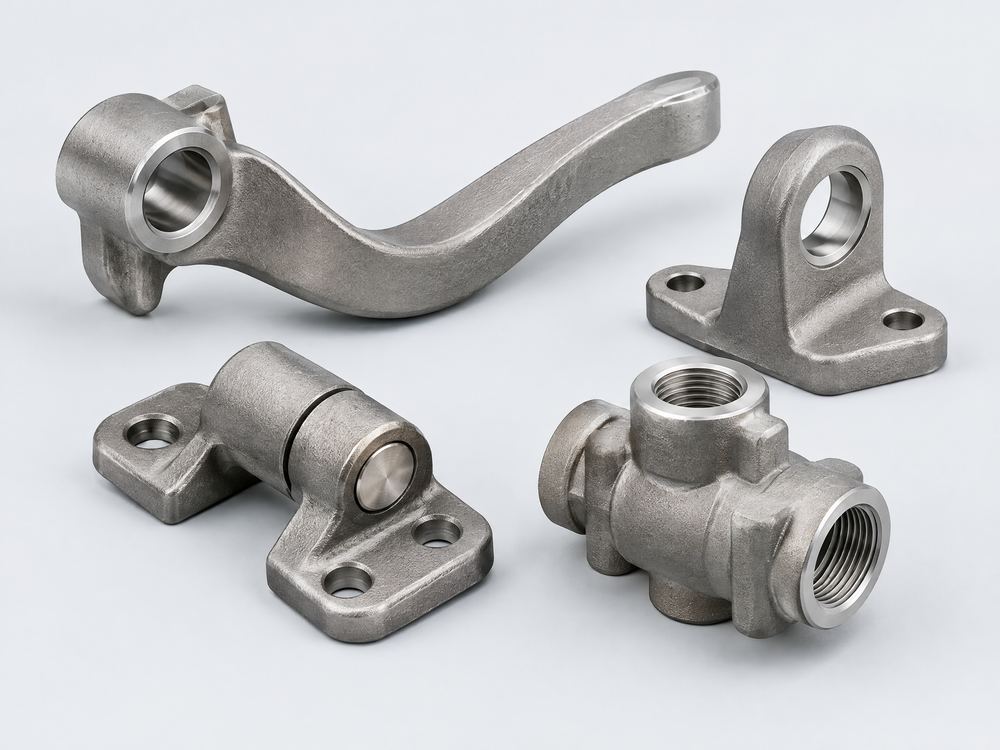
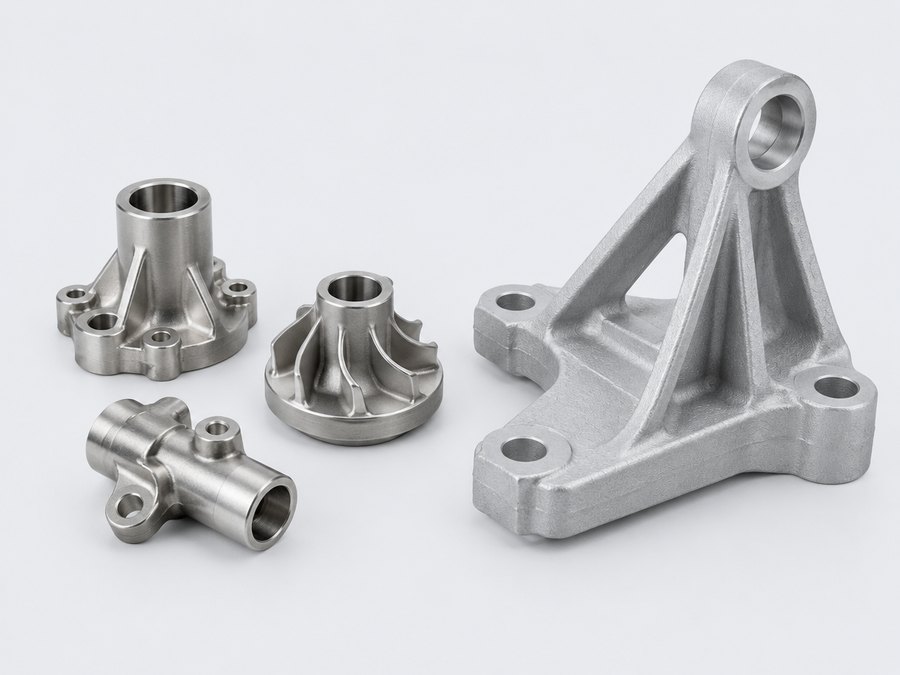
Investment casting using the lost-wax process delivers complex, near-net-shape parts with fine details that would otherwise have to be laboriously milled or welded together from several parts. TOP Asia Technik sources investment castings in aluminium, stainless steel and steel to your drawing from investment foundries in China – from the wax tool through heat treatment and machining to series inspection. Aluminium investment casting is the alternative to die casting when parts need to be heat-treated or welded, or are required in medium quantities.
- Silica sol and water glass investment casting
- Aluminium, stainless steel, steel, tool steel
- Low-cost wax tools, medium quantities
- Based in Jena since 2011
- Selected partner factories in China
- One contractual partner in Germany
- Pre-shipment inspection included
How investment casting works – and when it is the best choice
In investment casting, a wax pattern is injected for each part. Several patterns are assembled into a tree, dipped layer by layer into ceramic slurry and stuccoed with sand. After drying, the wax is melted out, the ceramic shell is fired and the metal is poured while the shell is still hot. Finally, the shell is knocked off and the parts are cut from the tree.
Because a new, one-piece mould is created for every part, undercuts, internal contours, lettering and wall thicknesses from about 1 mm are possible – without a parting line and usually without draft angles. Investment casting is particularly worthwhile where a milled part would require a lot of machining or where a welded assembly can be replaced by a single casting.
Investment casting is typically economical between a few hundred and several tens of thousands of parts per year. For very high quantities of thin-walled aluminium housings, aluminium die casting is cheaper; for large, rough parts, sand casting.
Technical specifications: investment casting
| Feature | Specification |
|---|---|
| Materials | Aluminium (EN AC-42100 AlSi7Mg0,3, EN AC-42200 AlSi7Mg0,6), cast stainless steel (1.4308 GX5CrNi19-10, 1.4408 GX5CrNiMo19-11-2, 1.4317 GX4CrNi13-4), cast steel (e.g. G20Mn5, quenched and tempered steels), tool steel, brass/bronze; Chinese factories often work with ASTM designations (CF8, CF8M, A356) |
| Part weight / size | Guide value: from a few grams up to approx. 100 kg, larger parts on request; particularly economical for small and medium-sized parts; wall thickness from approx. 1–1.5 mm (steel), from approx. 1.5–2 mm (aluminium) |
| Tolerances | To DIN EN ISO 8062-3: silica sol investment casting approx. DCTG 4–6, water glass investment casting approx. DCTG 5–9; in German-speaking countries also VDG data sheet P 690 (tolerance grades D1–D3) |
| Surface finish / post-processing | Roughness approx. Ra 1.6–3.2 µm for silica sol, approx. Ra 6.3–12.5 µm for water glass; blasting, pickling and passivation, electropolishing, heat treatment (solution annealing, quenching and tempering, aluminium T6), CNC machining |
| Quantities | No fixed minimum order quantity; thanks to the low-cost wax tools often economical even for smaller series, typically a few hundred to over 50,000 pcs/year – just get in touch |
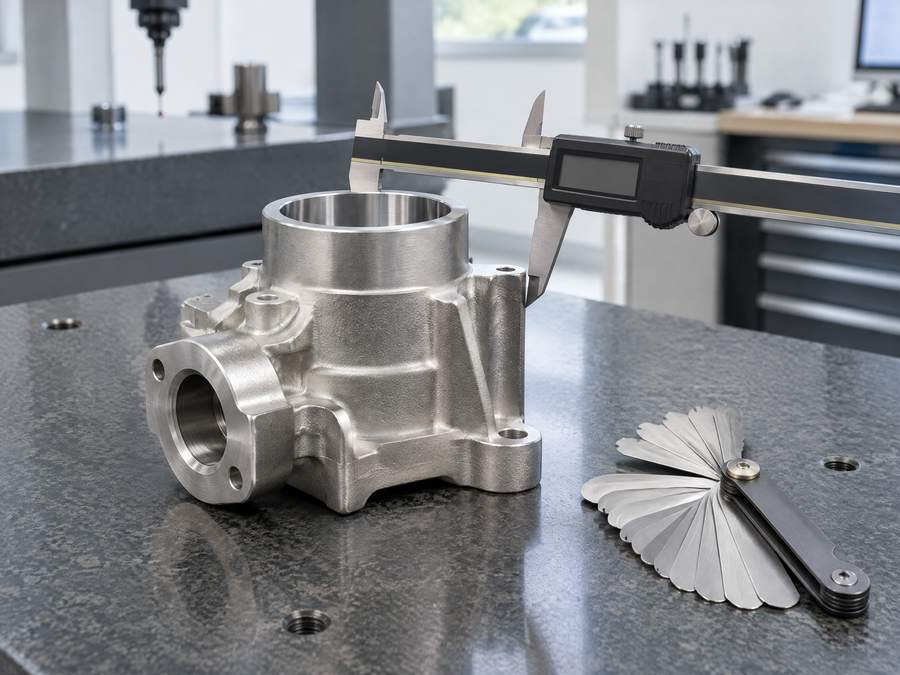
| Inspections | Spectral analysis, mechanical properties from cast-on test bars, X-ray (RT), dye penetrant testing (PT), hardness, CMM measurement report, first article inspection report (FAIR / EMPB) on request, inspection certificate 3.1 to EN 10204 |
| Lead time | First samples (including wax tool) after approx. 3 weeks at best, usually longer – depending on complexity up to approx. 10 weeks; series production approx. 4–8 weeks depending on quantity and complexity (production time only), plus transport (sea freight approx. 30–45 days) |
| Data for your enquiry | 3D model and 2D drawing, material with standard, heat treatment condition, annual volume and batch size, machined surfaces, inspection requirements (e.g. RT class), surface roughness |
Aluminium investment casting: when die casting is not the right fit
Aluminium investment casting is often underestimated. It comes into play when an aluminium part is complex but the quantity is too low for a die casting die – or when the part needs properties that die casting cannot deliver.
Typical alloys are EN AC-42100 and EN AC-42200 (AlSi7Mg). They can be age-hardened to the T6 condition, are weldable and have considerably less porosity than die castings. Aluminium investment castings are therefore found in housings for sensors and optics, brackets in vehicle and equipment manufacturing, pump parts and ribbed structural components.
Aluminium investment casting or aluminium die casting?
- Quantity: investment casting makes sense even for smaller series, die casting usually only from approx. 1,000–2,000 parts per year.
- Tooling: an aluminium wax injection tool costs only a fraction of a die casting die.
- Heat treatment and welding: possible with investment casting, hardly possible with conventional die casting.
- Unit price: higher for investment casting, because each ceramic mould is made individually.
- Thin walls over large areas: die casting is superior here.
Silica sol or water glass: two investment casting processes from China
Two shell systems are common in Chinese investment foundries. The choice has a considerable effect on price, surface finish and tolerance – so always ask which process is being quoted.
| Feature | Silica sol | Water glass |
|---|---|---|
| Tolerance grade to ISO 8062-3 (guide value) | DCTG 4–6 | DCTG 5–9 |
| Surface roughness (guide value) | Ra 1.6–3.2 µm | Ra 6.3–12.5 µm |
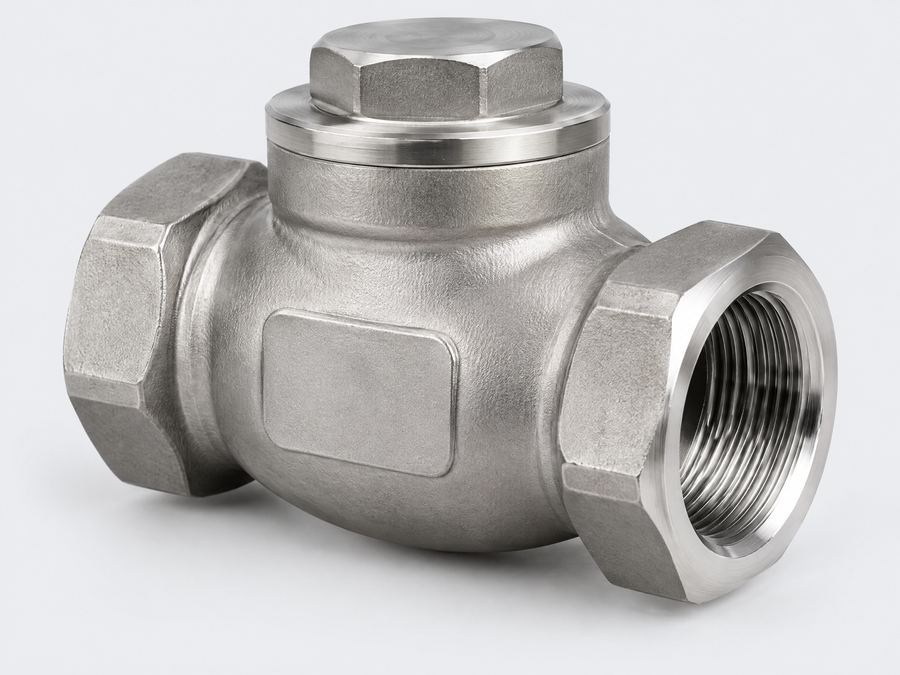
| Typical materials | stainless steel, tool steel, superalloys, aluminium | unalloyed and low-alloy steel |
| Part size | small to medium-sized precision parts | also larger, rougher parts |
| Price level | higher | considerably cheaper |
| Applications | visible and functional surfaces, stainless steel investment castings for food processing and pumps | agricultural machinery, vehicle and hardware fitting parts with machining |
Design guidelines for investment castings
Grade wall thicknesses progressively
Solidification should progress from thin to thick sections and on to the gate. Isolated masses without feeding lead to internal shrinkage cavities.
Plan holes realistically
Through holes can be cast from a diameter of approx. 2–3 mm, blind holes considerably less deep. Precision bores and threads are machined afterwards.
Avoid long, flat areas
Large flat surfaces distort during cooling. Ribs or slight curvatures stabilise them; flatness tolerances below approx. 0.1 mm per 25 mm usually require straightening or machining.
Keep machining allowance small
Investment casting is near-net-shape. For surfaces to be machined, 0.5–1 mm is usually sufficient; more allowance costs material and machining time with no benefit.
Agree the gate position
The gate leaves a visible remnant that is ground off. Specify where it must not be located, for example on sealing or visible surfaces.
Combine assemblies
Check whether a welded assembly made of sheet metal and turned parts can be produced as a single investment casting. This saves assembly, welding distortion and inspection effort.
Stainless steel and steel investment castings: quality and inspections
With steel and stainless steel investment castings, the risks lie less in dimensional accuracy than in the material. These points belong in the inspection plan:
Material verification
Spectral analysis per melt and inspection certificate 3.1 to EN 10204. With 1.4408 in particular, a molybdenum-free material is often offered as a substitute – the analysis exposes this.
Heat treatment
Austenitic cast stainless steel must be solution annealed, otherwise corrosion resistance suffers. Quenched and tempered steels require documented hardness and strength testing.
Internal defects
Shrinkage cavities and slag inclusions are not visible from the outside. For pressure-loaded parts, specify X-ray inspection with an agreed acceptance class.
Surface defects
Shell cracks and inclusions show up as fins or pitting. Dye penetrant testing to DIN EN 1371-2 for investment castings reveals cracks.
Passivation
After blasting or machining, stainless steel should be pickled and passivated so that no extraneous rust spots form.
Cost drivers in investment casting
Part weight
Weight and material determine the unit price more than complexity. Stainless steel with molybdenum is noticeably more expensive than plain cast steel.
Cores
Internal contours that the wax tool cannot form require soluble wax cores or ceramic cores – this adds cost per part.
Choice of process
Only specify silica sol where surface finish and tolerance require it. For machined steel parts, water glass is often sufficient at a considerably lower price.
Straightening and rework
Tight geometrical tolerances on as-cast surfaces mean manual straightening. It is better to have functional surfaces machined.
Scope of inspection
100 % X-ray inspection is expensive. Often, X-ray inspection during sampling followed by sampling inspections according to the inspection plan is sufficient.
How investment casting sourcing works
Feasibility and choice of process
Review of material, wall thicknesses, cores and tolerances; decision between silica sol and water glass.
Quotation
Broken down into wax tool, raw casting, heat treatment, machining and surface finish.
Wax tool and first samples
Casting of the first samples with material certificate, measurement report and, if required, X-ray findings, documented on request in a first article inspection report. You inspect and approve the first samples.
Series production
Production according to the approved process, inspection according to the series inspection plan, traceability down to the melt on request.
Frequently asked questions about investment casting and aluminium investment casting
What is the difference between investment casting and the lost-wax process?
There is none – “lost-wax process” describes the method, while “investment casting” is the usual term in industry. In German, the corresponding terms are Wachsausschmelzverfahren and Feinguss.
From what quantity does aluminium investment casting pay off?
We have no fixed minimum order quantity. Thanks to the low-cost wax tools, aluminium investment casting often pays off from just a few hundred parts. From several thousand parts per year, you should have aluminium die casting or gravity die casting assessed as an alternative.
How accurate is investment casting without machining?
With the silica sol process, tolerances in the range DCTG 4–6 to ISO 8062-3 are usual, i.e. roughly ±0.2–0.35 mm on a 50 mm dimension. Fits, bearing seats and sealing faces are still machined.
Can investment castings be welded?
Yes, generally well – provided the material is suitable for welding. This applies to most stainless and low-alloy cast steel grades as well as to AlSi7Mg alloys.
Which stainless steel investment casting grade is common for pumps and valves?
Frequently 1.4408 (GX5CrNiMo19-11-2, largely equivalent to CF8M) because of its better resistance to chlorides. For less demanding media, 1.4308 (CF8) is often sufficient.
What does a wax tool for investment casting cost?
Considerably less than a die casting die, because the tool is made of aluminium and only injects wax. The price depends on size, slides and cores; you will find guide values in the guide Tooling costs in China.
Related part types
Enquiry: Investment casting made to your drawing
Upload your drawing and 3D model, tell us the quantity and your deadline – we check feasibility and get back to you with questions or a quotation.
- Technical clarification before the request for quotation
- Quotations from audited partner factories
- One contact person in Germany
- Non-disclosure agreement (NDA) in advance on request
Prefer to call? 03641 9286337 · Mon–Fri 8 am–6 pm (CET)