
Home › Custom parts › Machine frames & steel structures
Machine frames and steel structures made to drawing
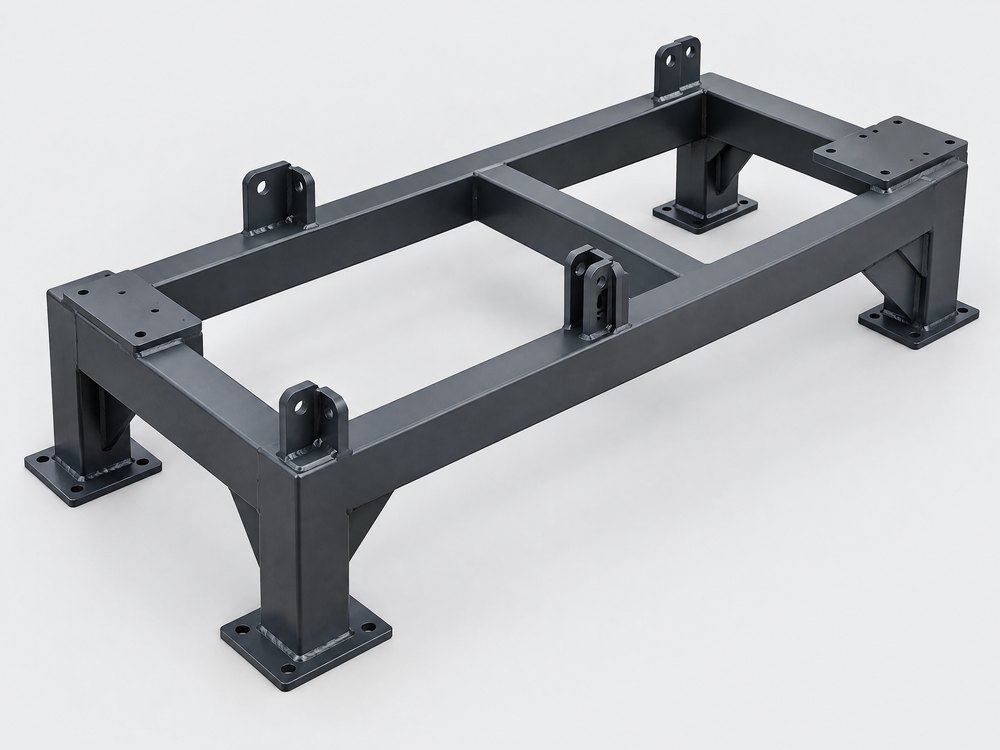
We source machine frames, base frames and welded steel structures made to your drawing – welded, stress-relieved where required, machined and protected for sea transport. For machine and plant builders with a recurring need for identical frames, where welding and machining hours drive the price.
- Welding, stress relieving and machining from a single source
- Weld quality to ISO 5817
- Container-ready, seaworthy packaging
- Based in Jena since 2011
- Selected partner factories in China
- One contractual partner in Germany
- Pre-shipment inspection included
Machine frames from the Far East: when it pays off
Much of the cost of a machine frame is labour: cutting, tacking, welding, straightening, stress relieving, milling, blasting and painting. This is exactly where manufacturing in China has its cost advantage. Material and freight offset part of it – the heavier and bulkier the frame relative to its labour content, the smaller the advantage.
Frames that are needed in series or on a regular, recurring basis and that fit into a container are a good fit. For one-off pieces with last-minute changes, a regional steel fabricator is usually the better choice.
Technical specifications: machine frames
| Feature | Specification |
|---|---|
| Materials | S235JR, S355J2 (Q235 / Q355 as Chinese equivalents with certificate), hollow sections to EN 10219, stainless steel 1.4301 for food-industry and cleanroom frames |
| Part weight / size | Frames up to approx. 20 t individual weight, larger on request; for sea transport in a container, e.g. a 40′ HC has internal dimensions of approx. 12,030 × 2,350 × 2,690 mm; larger frames go by open top, flat rack or breakbulk |
| Tolerances | Welded structures to DIN EN ISO 13920 (e.g. class B/F); machined surfaces to drawing, flatness e.g. 0.05–0.1 mm over 1 m after milling |
| Surface finish / post-processing | Blasting to Sa 2½, primer and top coat to ISO 12944, powder coating, hot-dip galvanising; preservation of machined surfaces |
| Quantities | One-off, small batch or series – no fixed minimum order quantity – whether sourcing pays off depends on the part, quantity and tooling costs; talk to us |
| Inspections | Dimensional report, visual inspection of welds to ISO 17637, MT/PT/UT if required, coating thickness measurement, material certificate 3.1 |
| Lead time | First samples in approx. 3 weeks at best, usually longer – up to approx. 10 weeks depending on complexity; series production approx. 4–8 weeks depending on quantity and complexity (production time only, plus transport) |
| Data for your enquiry | Drawing with welding symbols to ISO 2553, weld quality level, details of stress relieving and machining, corrosion protection, annual volume |
Welded structures and base frames: applying the standards correctly
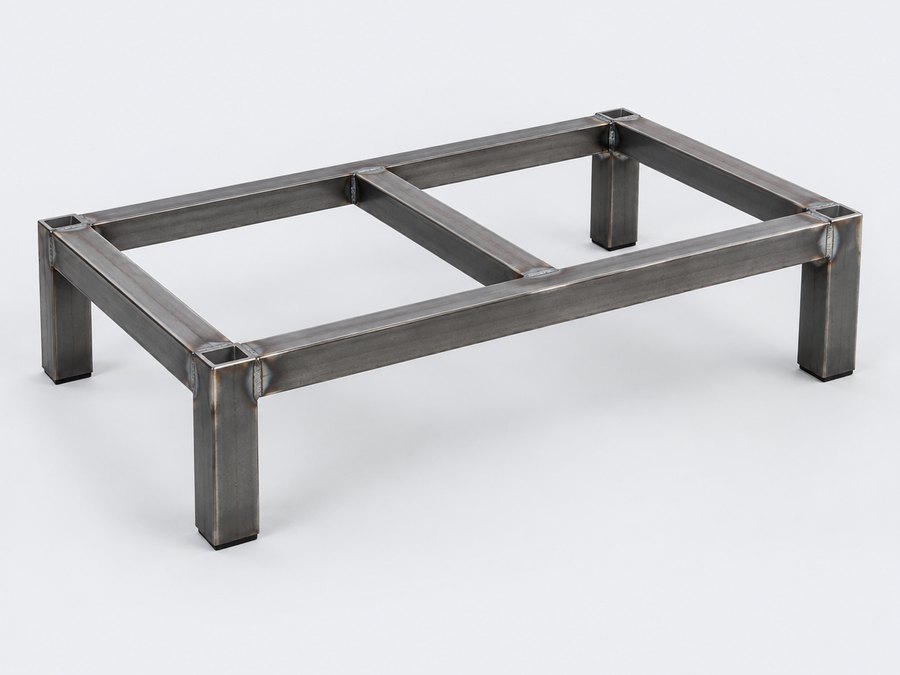
ISO 3834 defines the quality requirements for welding companies (Part 2 comprehensive, Part 3 standard, Part 4 elementary). It is the right benchmark for machine frames. It includes qualified welders to ISO 9606-1 and qualified welding procedures to ISO 15614-1.
EN 1090, by contrast, applies to load-bearing components in construction, such as platforms, stairs or hall columns, and governs their CE marking with execution classes EXC1–EXC4. A machine frame that is part of a machine is generally not covered. If your frame is used as a platform or supporting structure, however, the factory must be certified to EN 1090 – we clarify this before selecting the factory.
You define the weld quality with the quality level to ISO 5817: D (moderate), C (intermediate) or B (stringent). For most frames, C is sufficient; B only on highly stressed welds.
Design guidelines: stress relieving and machining after welding
Allow for machining stock
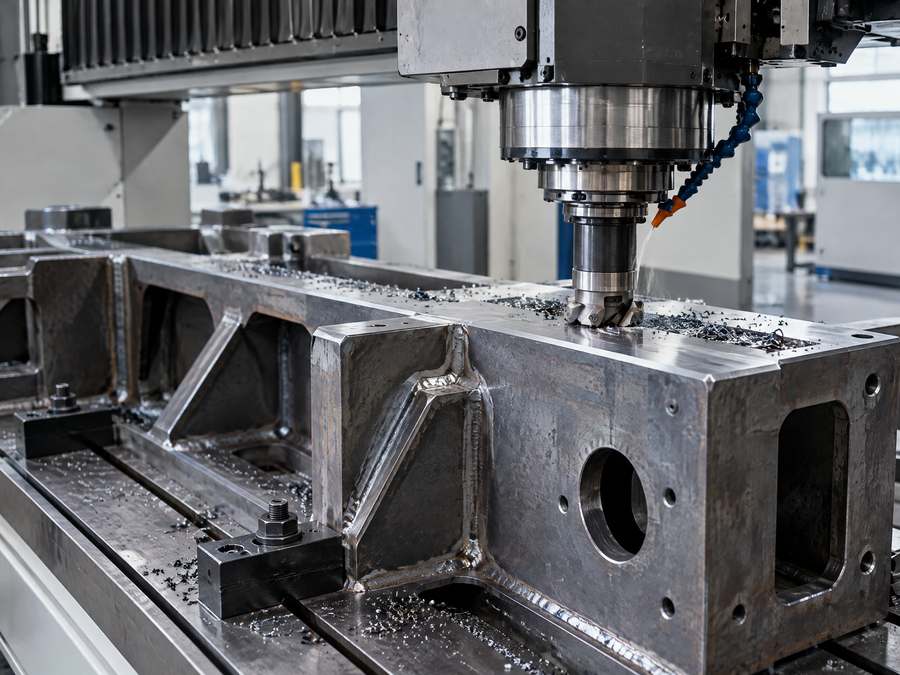
Mill functional surfaces only after welding and stress relieving. Plan 3–5 mm of machining allowance on mounting pads – weld distortion of several millimetres is normal on large frames.
Stress relieving for tight tolerances
Without stress relieving, a machined frame will distort when unclamped or later in service. Structural steel is usually stress-relieved at approx. 550–650 °C. Furnace size limits part size – clarify this in advance.
All datum surfaces in one set-up
Have mounting surfaces for guides and drives machined on a gantry milling machine in a single set-up wherever possible. This ensures parallelism and squareness better than tight individual tolerances.
Vent hollow sections
Closed sections need vent holes for hot-dip galvanising or stress relieving – otherwise they burst. At the same time, consider where moisture could get in.
Plan lifting lugs
Build lifting points for cranes and forklifts directly into the design. A frame without lifting points will be slung from anywhere at the port.
Transport sizes: container dimensions for steel structures
Internal dimensions and door opening determine what can be shipped in one piece. Guide values; they vary slightly between shipping lines.
| Container | Internal dimensions L × W × H | Door opening W × H | Payload approx. |
|---|---|---|---|
| 20′ Standard | 5,898 × 2,352 × 2,393 mm | 2,340 × 2,280 mm | 28 t |
| 40′ Standard | 12,032 × 2,352 × 2,393 mm | 2,340 × 2,280 mm | 26.5 t |
| 40′ High Cube | 12,032 × 2,352 × 2,698 mm | 2,340 × 2,585 mm | 26.5 t |
| 40′ Open Top | approx. 12,030 × 2,350 × 2,350 mm | Loading from above | 26 t |
| 40′ Flat Rack | approx. 12,000 × 2,400 mm loading area | Open at sides/top | approx. 40 t |
Corrosion protection for sea freight and weld inspection
Container rain
Temperature changes at sea cause moisture to condense inside the container. Bare steel surfaces start to rust within a few weeks. Desiccants, VCI film and covers are a must.
Preserve machined surfaces
Preserve and cover milled surfaces and bores with anti-corrosion wax or oil. Specify the preservation in the drawing or packaging specification.
Coating to ISO 12944
Specify the corrosivity category (C2 indoors to C5 coastal) and durability. These determine the blasting grade, coating system and total dry film thickness.
Define weld inspection
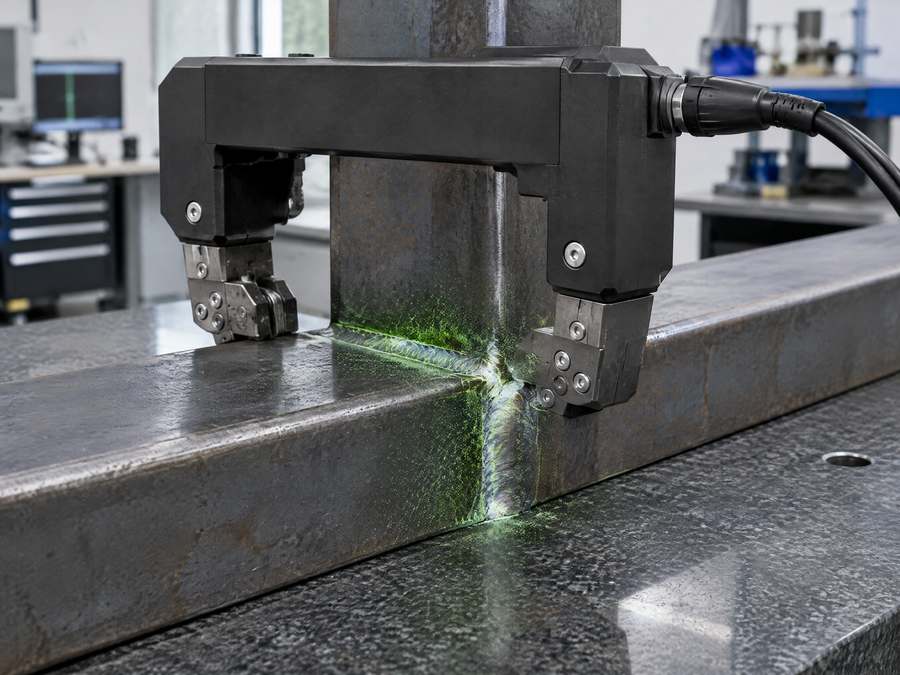
Visual inspection to ISO 17637 for all welds, surface crack testing (MT to ISO 17638 or PT to ISO 3452-1) or ultrasonic testing to ISO 17640 for load-bearing welds – with the inspection scope as a percentage.
How a machine frame project runs
Review drawing and welding plan
Clarification of weld symbols, quality level, stress relieving, machining and transport size.
Choose a factory with the right equipment
Stress-relieving furnace, gantry milling machine and blasting plant of a suitable size – in the factory itself or at audited subcontractors.
First frame with dimensional report
Full measurement, weld inspection, coating thickness, photos before packing.
Series production and loading
Inspection plan per frame, loading photos, load securing in the container.
Frequently asked questions about machine frames
Does a machine frame need EN 1090 certification?
Generally not, as long as it is part of a machine. EN 1090 covers load-bearing components in construction. For machine frames, ISO 3834 is the appropriate quality benchmark.
Does a welded frame have to be stress-relieved before milling?
Yes, if machined surfaces have tight tolerances. Without stress relieving, residual stresses are released during machining and the frame distorts.
What happens if the frame does not fit into a container?
Then open top, flat rack or breakbulk transport is required, which is considerably more expensive. It is often cheaper to design the frame in sections and bolt it together on site.
Is the frame delivered painted or primed?
Both are possible. For sea freight, at least a primer coat is recommended; final painting in Germany pays off if the colour changes from customer to customer.
Which quality level should I specify for welds?
Usually ISO 5817 C. Use quality level B only on welds with high or dynamic loads, as it significantly increases inspection and rework effort.
Related part types
Enquiry: Machine frames & steel structures made to your drawing
Upload your drawing and 3D model, tell us the quantity and your deadline – we check feasibility and get back to you with questions or a quotation.
- Technical clarification before the request for quotation
- Quotations from audited partner factories
- One contact person in Germany
- Non-disclosure agreement (NDA) in advance on request
Prefer to call? 03641 9286337 · Mon–Fri 8 am–6 pm (CET)