
Home › Custom parts › Rubber parts
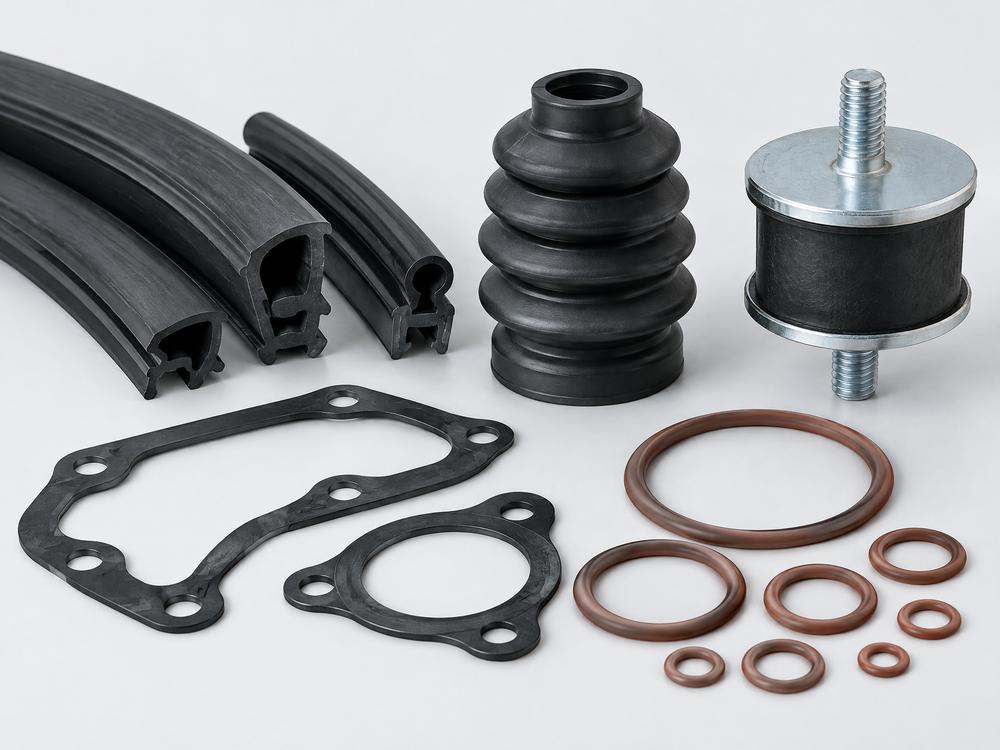
Moulded rubber parts, moulded seals and rubber-to-metal parts made to drawing
We source moulded rubber parts, moulded seals, rubber profiles and rubber-to-metal parts made to your drawing in series. The right compound is decisive for function – which is why you will find elastomer selection, tolerance classes, tests and the pitfalls of sourcing from China here.
- NBR, EPDM, FKM, silicone, CR
- Rubber-to-metal bonded by vulcanisation
- Compound verified by testing
- Based in Jena since 2011
- Selected partner factories in China
- One contractual partner in Germany
- Pre-shipment inspection included
Moulded rubber parts and seals made to drawing: applications and processes
Moulded rubber parts are used wherever something needs to be sealed, damped, protected or gripped: moulded seals, bellows, grommets, buffers, feet, diaphragms or vibration dampers. Unlike metal parts, function depends less on dimensions than on the compound – hardness, media resistance and ageing.
They are produced by compression moulding (CM), transfer moulding (TM) or injection moulding (IM). Rubber profiles and cords are extruded and cut to length or vulcanised into frames. With rubber-to-metal parts, the elastomer is vulcanised directly onto a pre-treated metal part. Soft parts made of thermoplastic elastomers (TPE), by contrast, are produced by plastic injection moulding.
Technical specifications: rubber parts
| Feature | Specification |
|---|---|
| Materials | NBR, HNBR, EPDM, FKM, VMQ (silicone), CR, NR, SBR; inserts made of steel, stainless steel, aluminium or plastic |
| Part weight / size | From small seals under 1 g to buffers and mounts weighing several kilograms, larger parts on request; profiles by the metre |
| Tolerances | Moulded parts to ISO 3302-1, classes M1–M4; extruded profiles to ISO 3302-1, classes E1–E3 |
| Surface finish / post-processing | Deflashing (mechanical or cryogenic), post-curing, coating (e.g. PTFE bonded coating), talc treatment; for rubber-to-metal parts, painting or corrosion protection of the metal |
| Quantities | No fixed minimum order quantity – whether sourcing pays off depends on the part, quantity and tooling costs; multi-cavity moulds for large quantities; profiles in rolls or cut lengths |
| Inspections | Shore A hardness, density, dimensional inspection, compression set, tensile test, adhesion test for rubber-to-metal parts, compound verification |
| Lead time | First samples (incl. tooling) in approx. 3 weeks at best, usually longer – up to approx. 10 weeks depending on complexity; series production approx. 4–8 weeks depending on quantity and complexity (production time only), plus transport (sea freight approx. 30–45 days) |
| Data for your enquiry | Drawing or STEP, elastomer and Shore A hardness, media and temperature in service, tolerance class, approvals (food contact, drinking water), colour, annual volume |
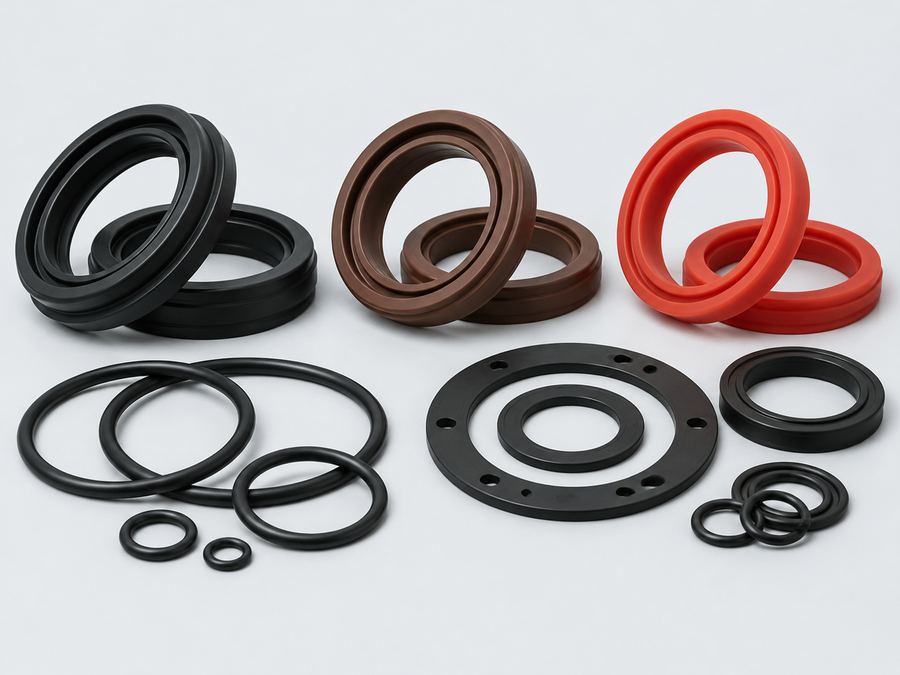
Elastomers compared: NBR, EPDM, FKM, VMQ (silicone) and CR
Temperature ranges are guide values for continuous use; they depend on the compound and curing system.
| Elastomer | Temperature approx. | Well suited for | Unsuitable for |
|---|---|---|---|
| NBR | −30 to +100 °C | Mineral oils, greases, hydraulic fluids, fuels | Ozone, weathering, glycol-based brake fluid |
| EPDM | −40 to +130 °C, peroxide-cured up to approx. +150 °C | Hot water, steam, weathering, ozone, brake fluid | Mineral oils and greases |
| FKM | −20 to +200 °C | Oils and fuels at high temperature, many chemicals | Hot water and steam (depending on type), low temperatures; high price |
| VMQ (silicone) | −60 to +200 °C | Wide temperature range, food and medical applications | Mechanical stress, abrasion, mineral oils, long-term steam exposure |
| CR | −35 to +100 °C | Weathering, moderate oil resistance, bellows, rubber-to-metal mounts | Aromatic and chlorinated hydrocarbons |
Shore A hardness and tolerances to ISO 3302-1
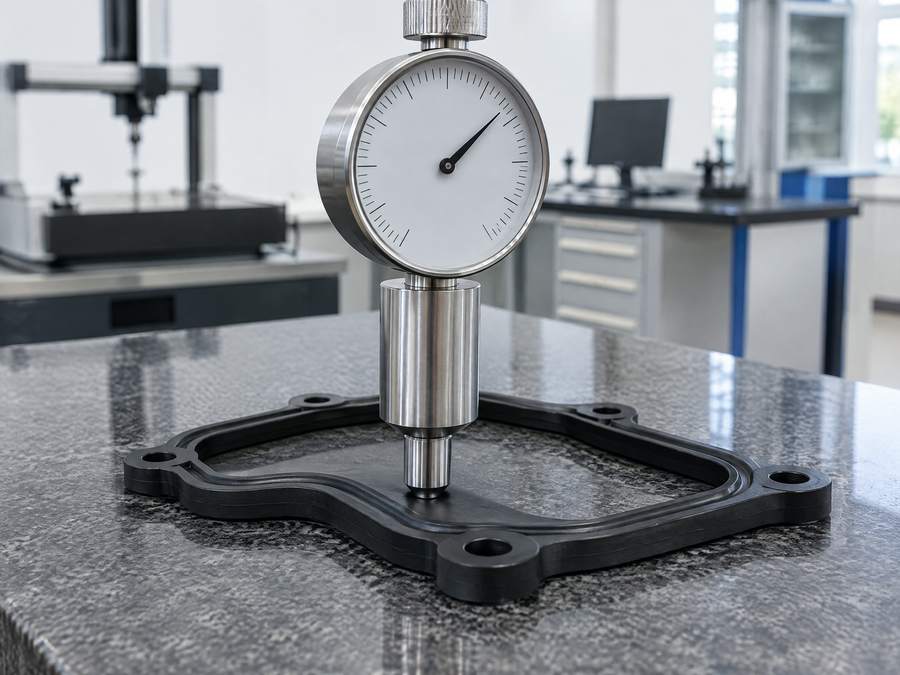
Hardness is specified in Shore A to ISO 48-4, typically between 40 and 90 Shore A. A tolerance of ±5 Shore A is usual. Softer compounds seal at low contact pressure; harder ones are more dimensionally stable and more resistant to extrusion.
ISO 3302-1 distinguishes four classes for moulded parts: M1 (precision, very demanding), M2 (high accuracy), M3 (standard for moulded parts) and M4 (non-critical dimensions). A further distinction is made between fixed dimensions (F) and closure dimensions (C, across the parting line) – the latter vary more. Please state the class on the drawing; use tight classes only where the sealing function requires them.
Design guidelines for moulded seals and rubber-to-metal parts
Define parting line and flash
Every moulded part has flash at the parting line. Mark sealing surfaces on which neither flash nor deflashing marks are permitted.
The mould only fits the compound
Depending on the compound, rubber shrinks by about 1.5–3 %, silicone sometimes more. Changing the elastomer may therefore require a new mould – define the material early.
Radii and uniform cross-sections
Sharp edges tear during demoulding and under load. Uniform wall thicknesses ensure even vulcanisation.
Design inserts correctly
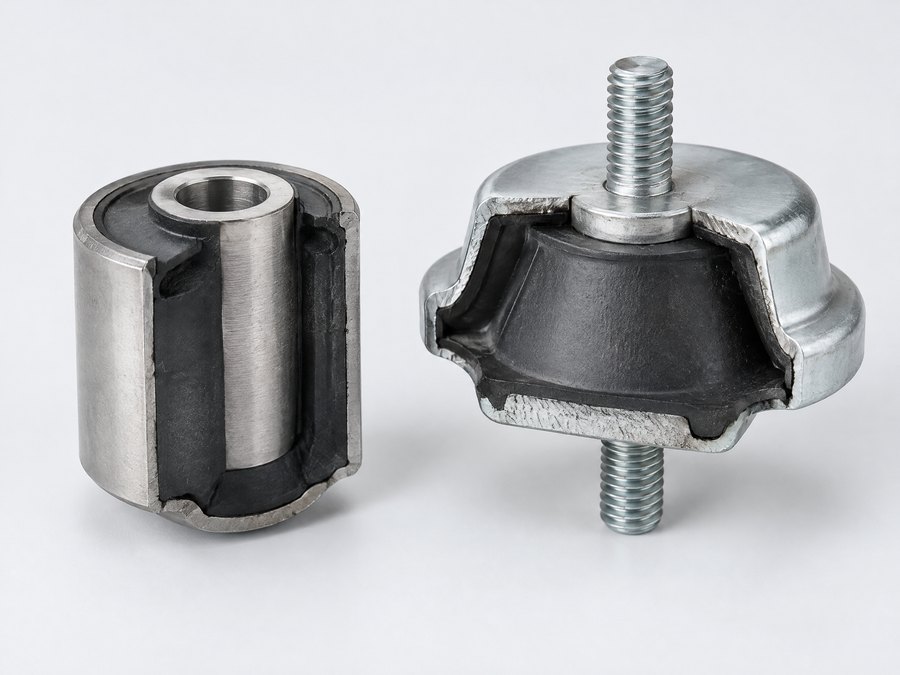
For rubber-to-metal parts, blast the bonding surfaces and coat them with bonding agent, round off edges on the metal and provide sealing-off surfaces for the mould so that no rubber flows onto functional surfaces.
Groove fill for seals
Rubber is virtually incompressible. The groove must leave room for deformation and swelling in the medium – as a guide value, approx. 75–85 % groove fill.
Specify vibration dampers by spring rate
For rubber-to-metal mounts, spring rate and load direction are more meaningful than Shore hardness alone. State the load cases and permissible deflection.
Typical defects in rubber parts from China – and how to detect them
Compound substituted
The biggest risk: more filler, a different polymer or a cheaper plasticiser. Hardness and dimensions are correct, but ageing and media resistance are not. Density, ash content and a fingerprint (TGA/FTIR) of the approved compound help with comparison.
Bonding failures in rubber-to-metal parts
Causes are inadequate pre-treatment or bonding agent past its shelf life. Test with a peel test to ISO 813 – the rubber should tear, not the bond.
Incomplete fill and air entrapment
These show up as defects on sealing lips. Agree on visual inspection with a magnifier and limit samples.
High compression set
Seals lose their recovery force due to under-curing or missing post-curing. Test to ISO 815-1 on the first samples and by random sampling in series production.
Food contact, drinking water and REACH
Rubber parts in contact with food must comply with Framework Regulation (EC) No 1935/2004. As there is no specific EU measure for rubber, BfR Recommendation XXI (XV for silicone) is usually applied in Germany; for the US market, FDA 21 CFR 177.2600 applies. For drinking water, the assessment criteria of the German Environment Agency (Umweltbundesamt) apply in Germany.
For parts with skin contact, REACH Annex XVII (entry 50) limits the PAH content. These requirements belong in the enquiry so that the factory uses a suitable, verifiable compound – and supplies a declaration of conformity with a test report.
Reducing costs for moulded rubber parts
Tooling
Compression moulds for rubber are typically much cheaper than injection moulds for plastic. Multiple cavities reduce the unit price for large quantities.
Elastomer
FKM costs several times as much as NBR or EPDM. Check whether temperature and medium really require FKM.
Deflashing
Manual deflashing drives up costs. Low-flash moulds or cryogenic deflashing pay off from medium quantities.
Tolerance class
M2 instead of M3 across the whole part increases tooling and inspection effort. Tight tolerances only on sealing and mating surfaces.
How a moulded rubber or rubber-to-metal part project runs
Clarify compound and requirements
Media, temperature, hardness, approvals and tolerance class are agreed with the factory.
Tooling and samples
Samples with measurement report, hardness and density testing, plus adhesion testing for rubber-to-metal parts; a first article inspection report (FAIR / EMPB) on request. You inspect and approve the samples.
Freeze the compound
The approved compound is documented with its designation and characteristic values; changes only after approval.
Monitor series production
Random sampling of hardness, density and dimensions for each batch, schedule tracking and packaging without crushing.
Frequently asked questions about moulded rubber parts and moulded seals
Which elastomer is right for my seal?
Medium and temperature are decisive. Usually NBR for oil, EPDM for water, steam and weathering, FKM or silicone for high temperatures. If in doubt, a media resistance test helps.
Which tolerance class should be on the drawing?
For most moulded parts, ISO 3302-1 M3 is sufficient. Use M2 or M1 only for sealing and mating dimensions, as they significantly increase tooling and inspection effort.
Can rubber-to-metal mounts and vibration dampers also be supplied?
Yes, the elastomer is vulcanised onto your metal part. The metal part can be made by the factory as well or bought in to drawing.
Are food-grade silicone parts possible?
Yes, using compounds tested for food contact. Request a declaration of conformity and a migration test report to EU 1935/2004 or FDA.
How do I make sure the series has the same compound as the samples?
Through documented compound approval and regular comparative testing of hardness, density and, where appropriate, TGA. This makes deviations visible early.
Is tooling worthwhile for rubber profiles?
For extruded profiles, a profile die (mouthpiece) is enough and is usually inexpensive. Corners and frames are moulded on with small vulcanising moulds.
Related part types
Enquiry: Rubber parts made to your drawing
Upload your drawing and 3D model, tell us the quantity and your deadline – we check feasibility and get back to you with questions or a quotation.
- Technical clarification before the request for quotation
- Quotations from audited partner factories
- One contact person in Germany
- Non-disclosure agreement (NDA) in advance on request
Prefer to call? 03641 9286337 · Mon–Fri 8 am–6 pm (CET)