Home › Guides › Customs and importing from China
Importing from China: customs duty, import VAT and anti-dumping
When importing from China, customs duty is charged according to the tariff code (approx. 0–8 % of the CIF value for many industrial parts), plus 19 % import VAT, which companies can usually deduct as input tax. It gets expensive with anti-dumping duties – for example on steel screws (up to 86.5 %) or aluminium extrusions (up to 32.1 %). Since 2026, CBAM has also applied to iron, steel and aluminium goods above 50 t per year.
- Customs value and import VAT with a worked example
- Anti-dumping: screws, aluminium profiles
- CBAM obligations from 2026
Status and liability
Information as of October 2026. Customs duty rates, anti-dumping measures and CBAM rules change frequently. This article is not legal or tax advice – all information is provided without guarantee; please check each individual case with the customs office, your freight forwarder or your tax adviser.
Importing from China: which charges apply
When importing from China into the EU, up to four types of charges arise on release for free circulation: the regular customs duty (third-country duty rate), anti-dumping or countervailing duties where applicable, import VAT and – for certain goods – obligations under the Carbon Border Adjustment Mechanism (CBAM). On top of this come costs for customs clearance, freight and port charges.
There is no free trade agreement with China; goods of Chinese origin receive no preference. The full third-country duty rate therefore always applies – a “Form A” certificate of origin or a supplier’s declaration brings no reduction in duty here.
Tariff code and TARIC: the basis for everything
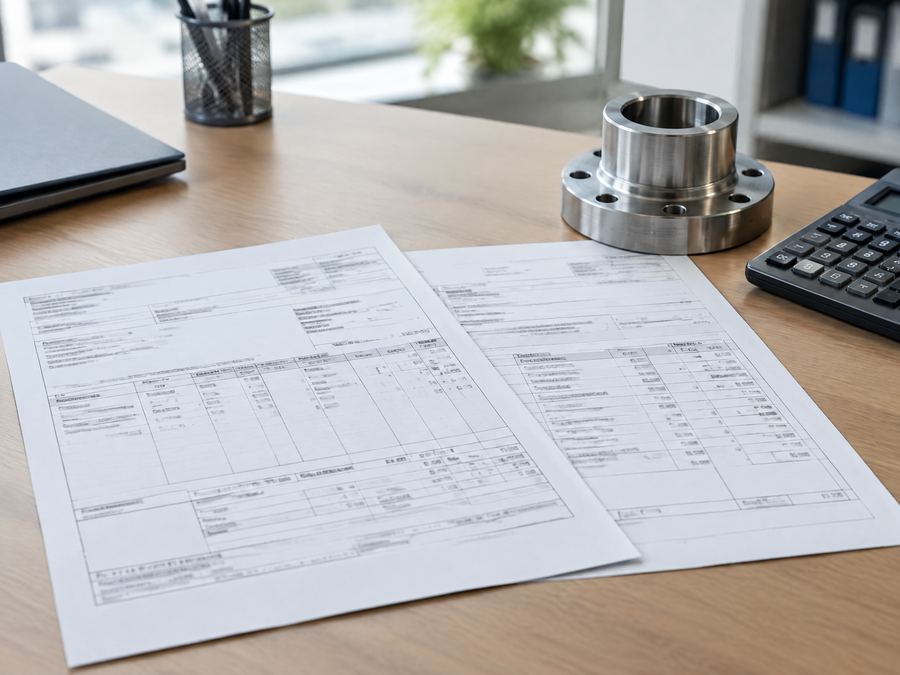
Every product is assigned a tariff code. For the import declaration in Germany, this is the 11-digit code number: 8 digits of the Combined Nomenclature (CN), 2 TARIC digits and 1 national digit. This number determines the duty rate, anti-dumping measures, CBAM obligations and licensing requirements.
You can look it up in the European Commission’s TARIC or in German customs’ Electronic Customs Tariff (EZT-Online). In case of doubt – for example whether a machined casting is to be classified as an “article of cast iron” or as a “machine part” – it is worth applying for binding tariff information (BTI, German: vZTA): free of charge, binding throughout the EU and valid for three years.
- Steel screws (e.g. CN 7318 15 88): duty rate 3.7 %
- Aluminium alloy profiles (CN 7604 29): duty rate 7.5 %
- Other articles of plastics (CN 3926 90 97): duty rate 6.5 %
- Many machine parts in Chapters 84 and 85: approx. 0–4 %
Customs value: CIF basis and additions
The basis for assessing customs duty is the customs value. In the EU this is usually the transaction value (invoice price) plus all transport and insurance costs up to the place of entry into the EU – i.e. a CIF basis up to the EU border, regardless of the agreed Incoterm. For delivery FOB Shanghai, you add sea freight and insurance up to Hamburg.
Under Article 71 of the Union Customs Code, certain contributions by the buyer that are not included in the price must also be added – of particular practical importance: tools, moulds and casting patterns that you pay for separately or provide, as well as licence fees that are a condition of the sale. The article Tooling costs in China explains how tooling is paid for.
Import VAT: 19 % and input tax deduction
Import VAT (EUSt) on industrial parts is 19 %. The basis of assessment is the customs value plus customs duty, anti-dumping duty and transport costs to the first place of destination in Germany (Section 11 UStG, German VAT Act).
Businesses can deduct the import VAT incurred as input tax (Section 15(1) sentence 1 no. 2 UStG) if the goods were imported for their business. It still ties up liquidity until it is refunded via the advance VAT return – a deferment account with customs lets you spread the payment over time. Customs duty itself and anti-dumping duties, on the other hand, are real costs.
Worked example: screws from China
Fictitious example, delivery FOB Shanghai, values rounded. Right-hand column: if the manufacturer falls under the anti-dumping rate for “all other companies”.
| Item | Without anti-dumping | With 86.5 % anti-dumping |
|---|---|---|
| Goods value FOB Shanghai | €20,000 | €20,000 |
| + Sea freight and insurance to Hamburg | €1,500 | €1,500 |
| = Customs value (CIF EU border) | €21,500 | €21,500 |
| Customs duty 3.7 % | €796 | €796 |
| Anti-dumping duty | – | €18,598 |
| + Onward carriage Hamburg–plant | €400 | €400 |
| Basis of assessment for import VAT | €22,696 | €41,294 |
| Import VAT 19 % (deductible as input tax) | €4,312 | €7,846 |
| Final cost burden from charges | €796 | €19,394 |
Anti-dumping duties: where they hit custom parts
The EU imposes anti-dumping duties on goods that, according to its findings, are sold below normal value. They usually apply for five years, remain in force during an expiry review and vary in amount from manufacturer to manufacturer. The decisive factor is non-preferential origin – routing goods via third countries changes nothing; circumvention is prosecuted and can lead to the duties being extended.
Fasteners of iron or steel
Implementing Regulation (EU) 2022/191, in force since 18 February 2022: screws, bolts and washers of iron or steel, other than stainless steel (including CN 7318 12 90, 7318 14, 7318 15, parts of 7318 21/22). Rates of 22.1–48.8 % for named manufacturers, 39.6 % for other cooperating companies and 86.5 % for all others. The regular term ends in February 2027; you should follow whether an expiry review is initiated. Also relevant for special screws made to drawing.
Aluminium extrusions
Implementing Regulation (EU) 2021/546: bars, rods, profiles and tubes of aluminium, including those cut to length, drilled, bent or threaded (including CN 7604, 7608, parts of 7610 90 90). Rates of 21.2–32.1 %. The measures were scheduled to run until 31 March 2026; since 27 March 2026 an expiry review has been under way, during which the duties continue to be levied. Exemptions include products already assembled into assemblies – relevant for extruded profiles and heat sinks.
CBAM: carbon border adjustment for iron, steel and aluminium (as of 2026)
The definitive phase of the Carbon Border Adjustment Mechanism (CBAM) has applied since 1 January 2026. It covers, among others, goods of iron and steel (e.g. screws of heading 7318, structures, other steel articles) and of aluminium (e.g. profiles, structures, other aluminium articles) – the exact list is in Annex I to the CBAM Regulation.
The obligations only apply once an importer imports a total of more than 50 t of CBAM goods in a calendar year. Importers above this threshold must be authorised CBAM declarants (in Germany via the German Emissions Trading Authority, DEHSt), determine the embedded emissions and surrender CBAM certificates for them. Sales of certificates start on 1 February 2027, and the first annual declaration for 2026 is due by 30 September 2027. An extension to around 180 downstream steel and aluminium products from 2028 has been proposed but not yet adopted.
In addition, since 1 July 2026 a new, permanent EU safeguard measure has applied to steel products such as sheets, bars and tubes, with tariff quotas and a 50 % duty outside the quotas; from 1 October 2026, the place of melting (“melt and pour”) must be proven. For finished, machined parts, the tariff classification usually determines whether they are affected.
EORI and who is the importer under DDP
Anyone declaring goods in the EU needs an EORI number; in Germany it is applied for free of charge from customs. In practice, the declaration is usually handled by a freight forwarder acting as representative.
Who the importer is depends on the Incoterm: with EXW, FOB or CIF it is you – you pay customs duty and import VAT and deduct the import VAT as input tax. With DDP, the seller handles the import. A Chinese supplier needs an EU EORI number for this and usually has to register for VAT in Germany, because the delivery then counts as a domestic supply. If the supplier cannot deduct the import VAT, it is often hidden in the price. More on this in the article Incoterms for imports from China.
If a German GmbH delivers DDP, it is itself the importer and issues you a normal invoice with German VAT. At TOP Asia Technik GmbH, delivery to your door, duty paid (DDP) is the standard: TOP Asia Technik GmbH acts as importer, clears customs, pays customs duty and import VAT, and you receive a German invoice in euros with 19 % VAT. EXW or other Incoterms are also possible on request.
Frequently asked questions about customs and importing from China
Is the customs value the invoice amount?
Not quite. Freight and insurance up to the EU border are added to the invoice amount, as well as certain additions such as tooling that is provided by you or paid for separately.
Are there customs preferences for goods from China?
No. There is no free trade agreement between the EU and China, and China no longer benefits from the EU’s Generalised Scheme of Preferences.
How do I find out whether an anti-dumping duty applies?
In TARIC, under the 10-digit code number with China as the country of origin. The manufacturer also matters: lower rates often apply to named companies if a proper commercial invoice with the prescribed declaration is presented.
Does CBAM also affect small importers?
Since 2026, the obligations no longer apply below 50 t of CBAM goods per year and importer. The quantity is added up across all CBAM goods in a year – heavy castings or steel structures can also reach the threshold quickly.
Send your drawing – get a quotation
Upload your drawing and 3D model, tell us the quantity and your deadline – we check feasibility and get back to you with questions or a quotation.
- Technical clarification before the request for quotation
- Quotations from audited partner factories
- One contact person in Germany
- Non-disclosure agreement (NDA) in advance on request
Prefer to call? 03641 9286337 · Mon–Fri 8 am–6 pm (CET)