Home › Guides › Tooling costs in China
Tooling costs in China: what injection moulds, die-casting dies and stamping tools cost
Tooling costs in China for comparable tools are typically about 30–60 % of European price levels – a simple injection mould starts at a few thousand euros, while die-casting dies for larger housings quickly reach five figures. What matters, however, is not the tool price alone, but who owns the tool, how long it lasts and how the costs are spread over the quantity.
- Guide values per tool type
- Amortisation with a worked example
- Securing ownership and transfer
Why tooling costs are lower in China – and where the limits are
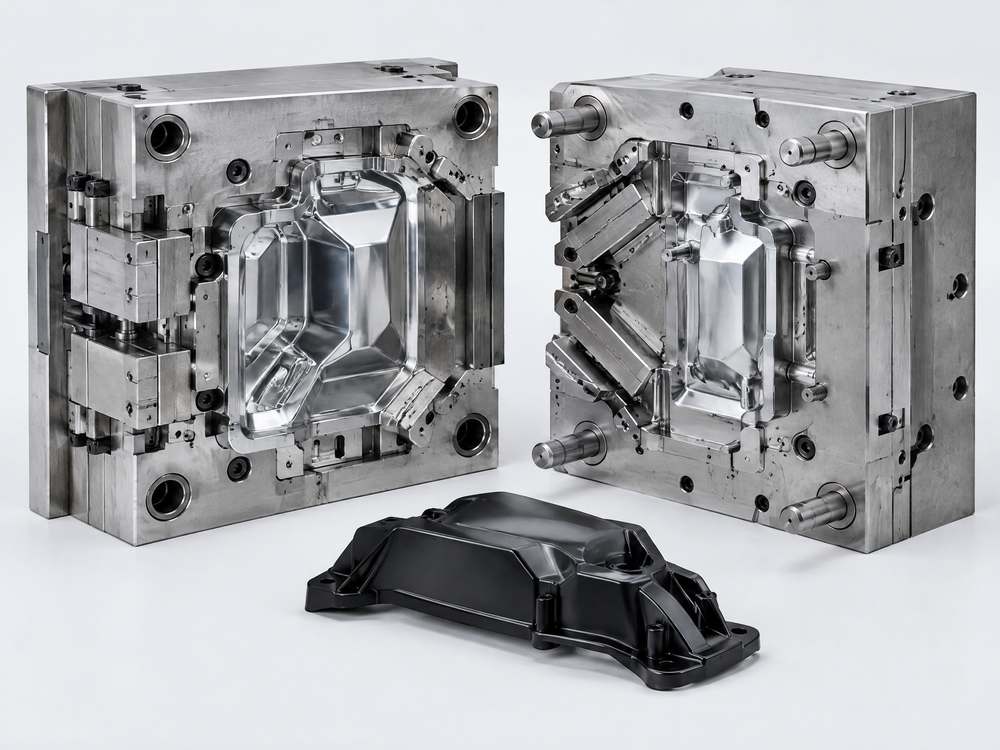
Tooling costs in China are lower mainly because design and manufacturing hours in toolmaking are cheaper and many toolmakers work closely with the series manufacturers. The material itself – tool steel such as 1.2311 (P20), 1.2344 (H13) or 1.2379 (D2) – costs much the same worldwide.
The savings shrink as requirements rise: hot runner systems from European brands, standard components from Hasco or Meusburger, hardened mould inserts and tight tolerances bring prices closer together. In addition, a Chinese tool is not automatically designed for a machine in Europe – this becomes important at the latest when the tool is transferred.
We describe how toolmaking and series production fit together in detail on the page Toolmaking and mould making.
Guide values: what tools typically cost in China
The ranges are rough guide values for China (as of October 2026, net, excluding samples and freight). They are typical, but depend heavily on part size, geometry, number of cavities, steel grade, tolerances and required tool life.
| Tool type | Simple / small | Medium | Large / complex | Typical tool life |
|---|---|---|---|---|
| Injection mould (plastic) | approx. €2,000–6,000 | approx. €6,000–25,000 | from approx. €30,000 to over €100,000 | approx. 100,000 to over 1 million shots, depending on steel |
| Die-casting die (aluminium, zinc) | approx. €6,000–15,000 | approx. €15,000–50,000 | from approx. €60,000 | Al: approx. 80,000–150,000 shots; zinc considerably more |
| Investment casting wax tool | approx. €1,000–4,000 | approx. €4,000–10,000 | from approx. €10,000 | very high (wax, hardly any wear) |
| Cutting/bending tool (single-stage tool) | approx. €800–3,000 | approx. €3,000–8,000 | from approx. €8,000 | approx. 100,000–500,000 strokes until regrinding |
| Progressive die (stamping) | approx. €6,000–15,000 | approx. €15,000–40,000 | from approx. €50,000 | several million strokes with regrinding |
| Deep-drawing tool (multi-stage) | approx. €5,000–12,000 | approx. €12,000–35,000 | from approx. €40,000 | strongly dependent on material |
Cost drivers: what makes a tool expensive
For the same part size, the tool price can vary by a factor of three. These points decide it:
Slides, cores, undercuts
Every side slide in an injection mould or die-casting die adds design, manufacturing and maintenance costs. Check whether an undercut can be avoided with a different demoulding direction or by drilling afterwards.
Number of cavities
A 4-cavity tool does not cost four times as much, but often two to three times as much as a single-cavity tool. It only pays off if the annual volume noticeably reduces machine hours.
Steel grade and hardness
Pre-hardened steel (e.g. 1.2311/P20) is inexpensive, but unsuitable for glass-fibre-reinforced plastics or high quantities. Hardened inserts made of 1.2344 or 1.2343 increase the price but extend tool life considerably.
Hot runner instead of cold runner
A hot runner system saves sprue material and cycle time, but costs a few thousand euros more depending on the number of nozzles and the brand – and ties you to the system manufacturer for spare parts.
Tolerances and surfaces
Tight tolerances require more sampling loops and tool corrections. High-gloss polishing, specified texturing (e.g. VDI 3400) or EDM texture are charged extra.
Part size and clamping force
Large parts need large mould plates and machines. From about 800–1,000 t clamping force (die casting), tooling and unit costs rise sharply, because fewer factories have such equipment.
Tool ownership: whoever pays should also own
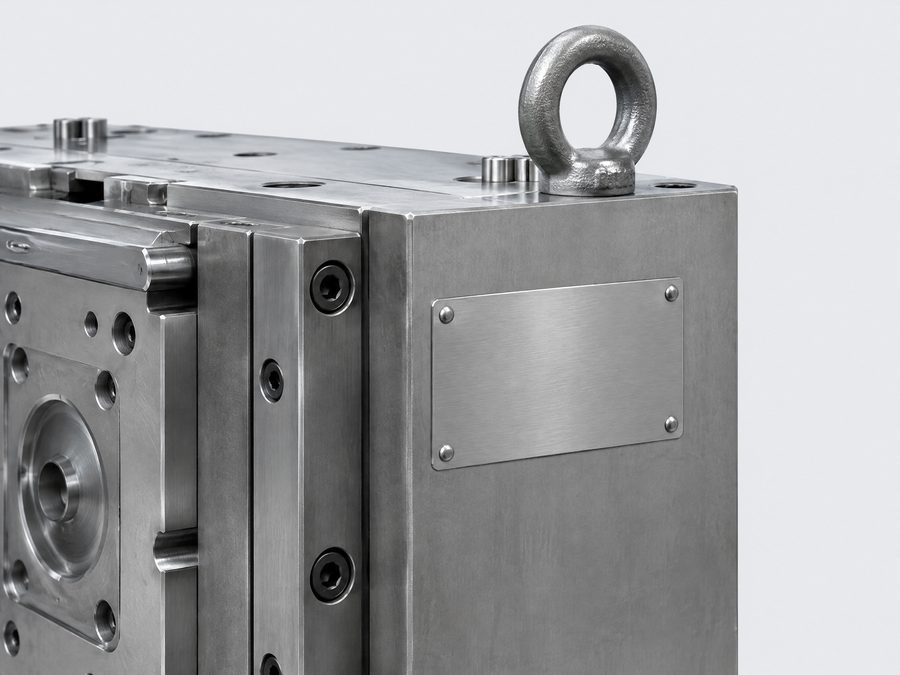
In China, it is common for the customer to pay for the tool in full or in part. Without a clear agreement, however, it remains open who owns it, whether it may be used for other customers and whether you can withdraw it. This quickly becomes a problem, especially when changing supplier or in the event of insolvency.
Agree at least the following points in writing – in the contract or in a separate tooling agreement:
- Ownership of the tool passes to the customer on payment; the supplier is only the holder (loan agreement).
- Marking with an ownership plate and tool number; photos of the tool on completion.
- Guaranteed tool life (number of shots or strokes); until then, the supplier bears the maintenance.
- Prohibition of use for parts for third parties; confidentiality of the drawings.
- Obligation to hand over including tool drawings, steel certificates and spare parts, with a deadline.
- Payment schedule linked to milestones, e.g. 50 % on order, 50 % after approval of the first samples.
Tooling costs and customs
If you pay for the tool separately and it stays in China, its value is generally still part of the customs value of the parts made with it (addition under Art. 71 of the Union Customs Code). The allocation to the imports must be documented. More on this in the article Customs duty and import VAT – without guarantee; check individual cases with a customs adviser or the customs office.
Amortisation over the quantity: a worked example
Whether a cheaper tool from China pays off only becomes clear when you calculate over the entire lifetime. Example: a plastic housing, annual requirement 20,000 pieces, planned lifetime three years (60,000 parts). All figures are fictitious guide values for illustration.
Europe option: tool €32,000, unit price delivered €1.10. Tooling share per part: €32,000 / 60,000 = €0.53. Total cost per part: €1.63.
China option: tool €13,000, unit price €0.70 plus approx. €0.18 for sea freight, customs duty, customs clearance and tied-up capital (landed cost €0.88). Tooling share: €13,000 / 60,000 = €0.22. Total cost per part: €1.10.
Over three years, this gives a difference of around €32,200. With only 2,000 pieces a year, the picture would be different: the tooling share would then be €5.33 (Europe) or €2.17 (China), plus higher logistics costs per part due to small shipments. For such quantities, a simpler tool, a different process or supply from Europe is often more economical.
What belongs in the calculation
- Tool price incl. sampling and correction loops
- Landed cost per part: unit price, freight, customs duty, customs clearance, insurance
- Tied-up capital due to longer transport time and safety stock
- Costs for first article inspection and travel or audits
- Risk: replacement tool if the tool life is not sufficient
Tool transfer: from China to Europe or vice versa
Tools are transferred when the supplier changes, a second source is set up or production is to move closer to the customer. Technically this is often possible, but it does not always make economic sense.
Chinese tools are often matched to local standard components and machines. Clamping dimensions, locating ring, ejector connection, cooling connections and hot runner connectors do not automatically fit European machines. Expect adaptation work and new sampling, i.e. a new first article inspection report.
- Document the condition beforehand: shot count, maintenance history, known damage.
- Request tool drawings, 3D data and steel certificates as well.
- Measure the last parts before dismantling – they serve as a reference.
- Preserve the tool and pack it seaworthy; have the export declared in China.
- Build up safety stock before the tool is in transit (sea freight approx. 5–7 weeks).
Tips for reducing tooling costs
Agree the design early
A design for manufacturability (DFM) analysis before toolmaking reveals undercuts, abrupt changes in wall thickness and demoulding problems. Changes to the data set are cheaper than changes to hardened steel.
Consider a family mould
Two small parts with the same material and similar quantities can often be made in one tool. Drawback: both parts are always produced together.
Use interchangeable inserts
For variants (e.g. different lettering or hole pattern), a master tool with interchangeable inserts is often sufficient.
Choose a suitable tool life
A tool for 1 million shots is oversized for a total requirement of 30,000 parts. State the realistic lifetime quantity in your RFQ.
Ordering tooling through a German contact
At TOP Asia Technik GmbH, the tooling order is also placed through the German GmbH: you receive the quotation and invoice in euros from Jena, and the technical clarification takes place before toolmaking starts. Once paid in full, the tool becomes your property, stays at the factory for production and is marked; the arrangement is set out in the quotation. If a tool is later to be transferred to Germany or another European country, we can organise this on request.
For a cost calculation, send us your drawing via the enquiry form; suitable processes can be found under plastic injection moulding, aluminium die casting and stamped and deep-drawn parts.
Frequently asked questions about tooling costs in China
How long does toolmaking take in China?
That depends on size and complexity. For projects through TOP Asia Technik GmbH, first samples are available after about 3 weeks at best; usually it takes longer – up to about 10 weeks depending on complexity (production time only, excluding transport). Correction loops and shipping of the samples come on top.
Is a cheap tool from China a risk?
Not in principle. The risk lies in unclear specifications: steel grade, hardness, standard components and guaranteed tool life should be stated in the quotation. Then quotations can be compared and defects can be claimed.
Do I have to pay for the whole tool?
No. Tooling cost contributions are also common, with the remainder amortised through the unit price. In that case, ownership and handover after purchase of an agreed total quantity should be settled.
Who pays for tool repairs?
Up to the agreed tool life, usually the supplier; after that, the owner. Without an agreement, disputes often arise here – which is why the number of shots or strokes belongs in the contract.
Send your drawing – get a quotation
Upload your drawing and 3D model, tell us the quantity and your deadline – we check feasibility and get back to you with questions or a quotation.
- Technical clarification before the request for quotation
- Quotations from audited partner factories
- One contact person in Germany
- Non-disclosure agreement (NDA) in advance on request
Prefer to call? 03641 9286337 · Mon–Fri 8 am–6 pm (CET)