
Home › Custom parts › CNC precision parts
CNC parts from China made to drawing – turned and milled parts in series
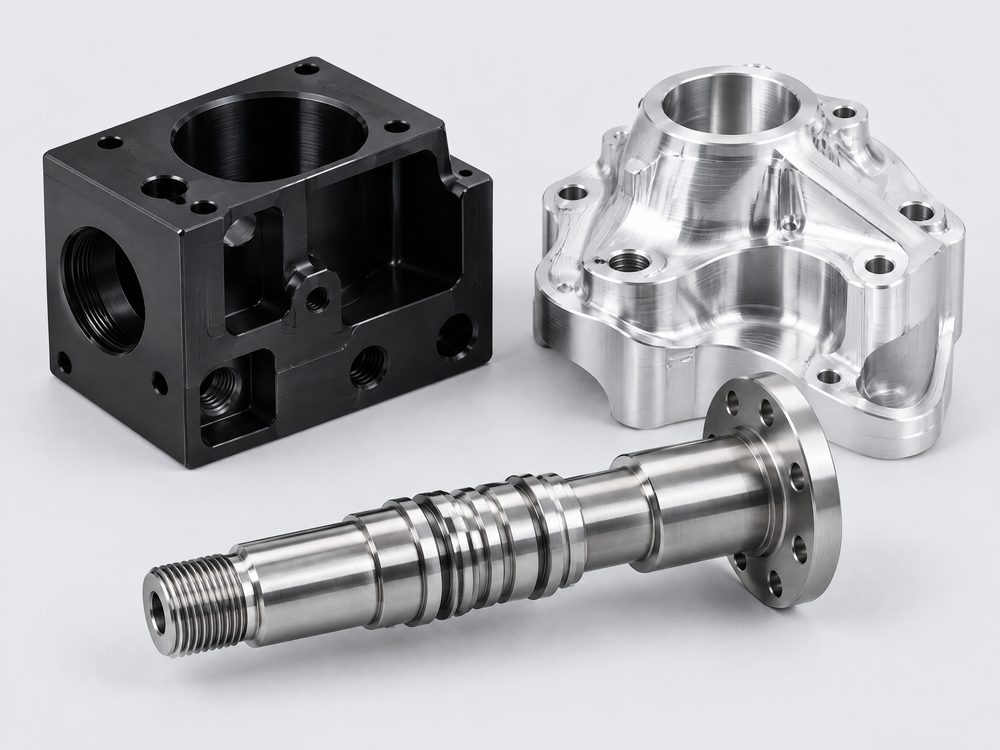
We source CNC precision parts made to your drawing – turned parts, milled parts and 5-axis parts in aluminium, steel, stainless steel and plastics – in series from vetted factories in China. You receive precision parts with a measurement report, first article inspection and a German contractual partner who manages the drawing, the factory and the schedule.
- Turning, milling, 5-axis machining
- Aluminium, stainless steel, steel, plastics
- Measurement report per part, first article inspection report (FAIR / EMPB) on request
- Based in Jena since 2011
- Selected partner factories in China
- One contractual partner in Germany
- Pre-shipment inspection included
When CNC precision parts from China pay off
Machined parts carry a high share of machine and labour costs. That is exactly where the cost advantage of contract manufacturing in Asia lies – provided the series is predictable and the drawing is unambiguous. Typical cases are recurring call-offs of flanges, housings, bushings, shafts, adapter plates or brackets in series – from smaller batch sizes up to several tens of thousands of pieces per year.
For one-off parts, prototypes with no series prospect, or parts you need within a few days, a local machine shop is usually the better choice. With approx. 30–45 days of sea freight, sourcing from China mainly pays off for predictable demand with call-off orders or safety stock.
- CNC contract manufacturing in series: stable drawing, recurring demand
- High machining content: many set-ups, long cycle times, finishing such as anodising or vibratory finishing
- Combined with blanks: if cast, forged or extruded blanks already come from China, one transport leg is eliminated
Technical specifications: CNC precision parts
| Feature | Specification |
|---|---|
| Materials | Aluminium (EN AW-6061, 6082, 7075, 5083, 2017A), stainless steel (1.4301, 1.4305, 1.4404, 1.4057, 1.4542), free-cutting and quenched-and-tempered steel (11SMnPb30, C45, 42CrMo4), brass (CuZn39Pb3), plastics (POM, PA6, PEEK, PTFE, PE-UHMW) |
| Part weight / size | From small parts (turned parts from approx. Ø 3 mm) up to large parts several metres long (approx. 6,000 mm) – large-scale milling and turning is also available through the factory network; larger parts on request |
| Tolerances | General tolerances ISO 2768-mK as standard, ISO 2768-fH if required; fits up to IT6 to ISO 286, geometrical tolerances (GD&T) to ISO 1101 |
| Surface finish / post-processing | Ra 3.2 µm standard, Ra 0.8 µm milled/turned, Ra 0.4 µm and finer ground; anodising (natural, black, hard anodised), passivation, zinc plating, black oxide, electroless nickel, powder coating |
| Quantities | No fixed minimum order quantity – whether sourcing pays off depends on the part, quantity and machining effort; talk to us |
| Inspection | Measurement report from a coordinate measuring machine (CMM), first article inspection report on request (VDA Volume 2 or PPAP), roughness measurement, coating thickness measurement, 3.1 material certificate to EN 10204 |
| Lead time | First samples in approx. 3 weeks at best, usually longer – up to approx. 10 weeks depending on complexity; series production approx. 4–8 weeks depending on quantity and complexity (production time only), plus transport (sea freight approx. 30–45 days) |
| Data for your enquiry | 2D drawing (PDF) with tolerances and surface finish callouts, 3D model (STEP), material, annual volume and batch size, surface treatment, inspection requirements |
Materials for milled and turned parts compared
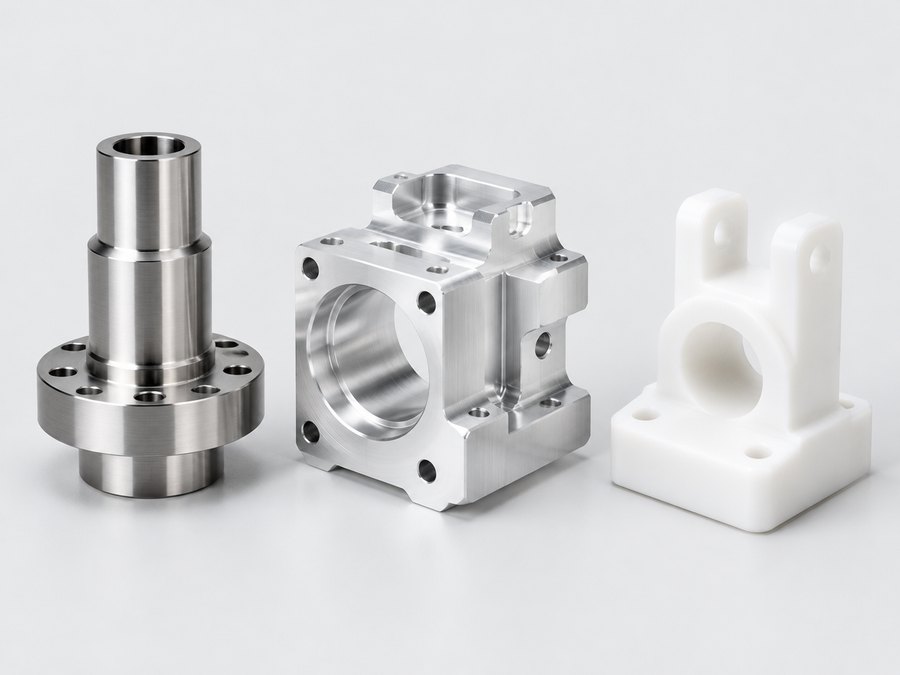
The material often has a greater effect on price and lead time than the geometry. The Chinese designations help when checking mill certificates.
| Material | Typical parts | Machinability | Chinese equivalent | Note |
|---|---|---|---|---|
| EN AW-6082 / 6061 | Aluminium milled parts, housings, plates | very good | 6061 (GB/T 3190) | Standard for anodised parts |
| EN AW-7075 | High-strength holders, fixtures | very good | 7075 | Not weldable, anodised finish slightly yellowish |
| 1.4305 (X8CrNiS18-9) | Stainless steel turned parts, bushings | good | SUS303 / Y12Cr18Ni9 | Lower corrosion resistance than 1.4301 |
| 1.4404 (316L) | Stainless steel milled parts for food and medical technology | moderate | SUS316L / 022Cr17Ni12Mo2 | Tough – allow for tool wear |
| 11SMnPb30 | High-volume turned parts, hydraulic fittings | very good | Y15Pb | Contains lead – observe RoHS exemptions |
| C45 / 42CrMo4 | Shafts, pins, flanges | good (medium when quenched and tempered) | 45# / 42CrMo | Specify heat treatment on the drawing |
| POM, PA6, PEEK | Plastic milled parts, sliding elements, insulators | good, but sensitive to stress | POM / PA6 / PEEK | Consider thermal expansion with tight tolerances |
Design guidelines for cost-effective precision parts
Many costs are created at the drawing board. These points lower the price without changing the function.
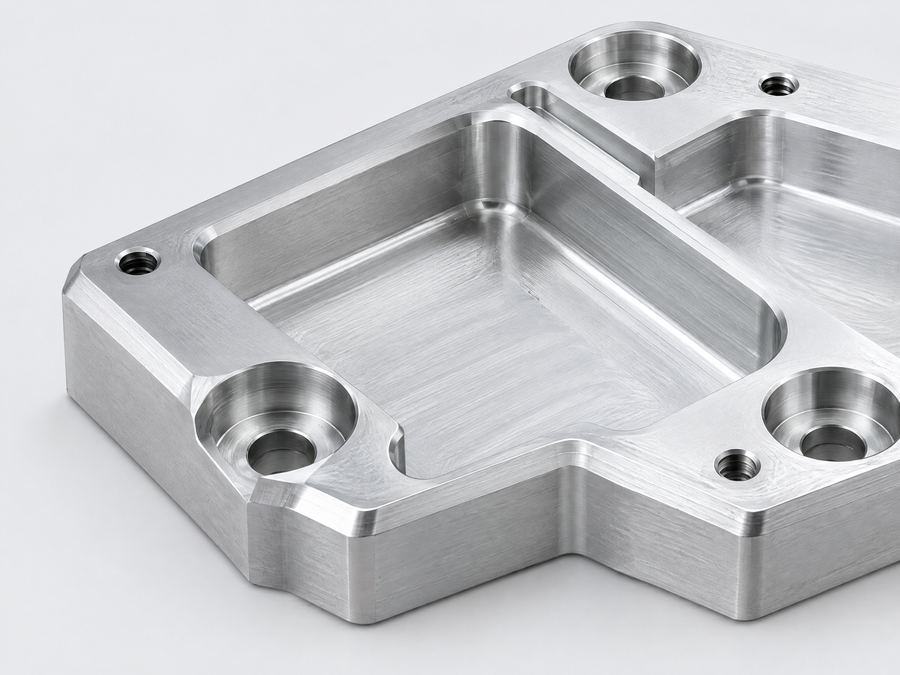
Internal radii larger than the cutter radius
Internal corners with R 0.5 mm require small cutters and long cycle times. An internal radius of at least one third of the pocket depth allows rigid tools.
Limit pocket depth
Pockets deeper than about 4 times the cutter diameter require long tools that are prone to chatter. Where possible, design them shallower or accessible from two sides.
Apply tolerances selectively
Tolerance only functional dimensions tightly and cover the rest with ISO 2768-mK. Every fit tighter than IT7 means extra measuring effort and often an additional machining step.
Reduce set-ups
Place holes and faces on as few sides as possible. Every additional set-up brings positional deviations and cost; complex parts with many sides are suited to 5-axis milling.
Standard threads
Metric coarse threads with a thread depth of about 1.5 × d are sufficient in aluminium and steel. Special threads and very deep blind-hole threads drive up tooling costs.
Dimensions before/after coating
State whether dimensions apply before or after anodising. A 25 µm hard anodised layer grows about half outwards – decisive for fits.
Typical defects in turned and milled parts from the Far East
Most complaints are not caused by a lack of machines but by misunderstandings. This is how we prevent them:
Wrong material substitution
“SUS304 instead of 1.4404” or 6063 instead of 6082 saves the factory money. Countermeasure: 3.1 material certificate with heat number and, if required, spectral analysis on the first samples.
Burrs and edge condition
Without a callout to ISO 13715, edges often remain sharp or burred. We define edge breaks and burr-free requirements before series production starts.
Anodising colour varies
Black anodised CNC blocks from different batches can differ in shade. Limit samples or colour measurement in the inspection plan prevent disputes.
Measuring only the first samples
Good first samples do not guarantee a good series. Series inspection plans with fixed sample sizes and dimensions ensure that tool wear is detected early.
Scratches caused by packaging
Visible surfaces of aluminium housings suffer during sea transport. Individual packaging, interlayers and corrosion protection for steel belong in the purchase order.
Inspecting CNC precision parts: what we measure
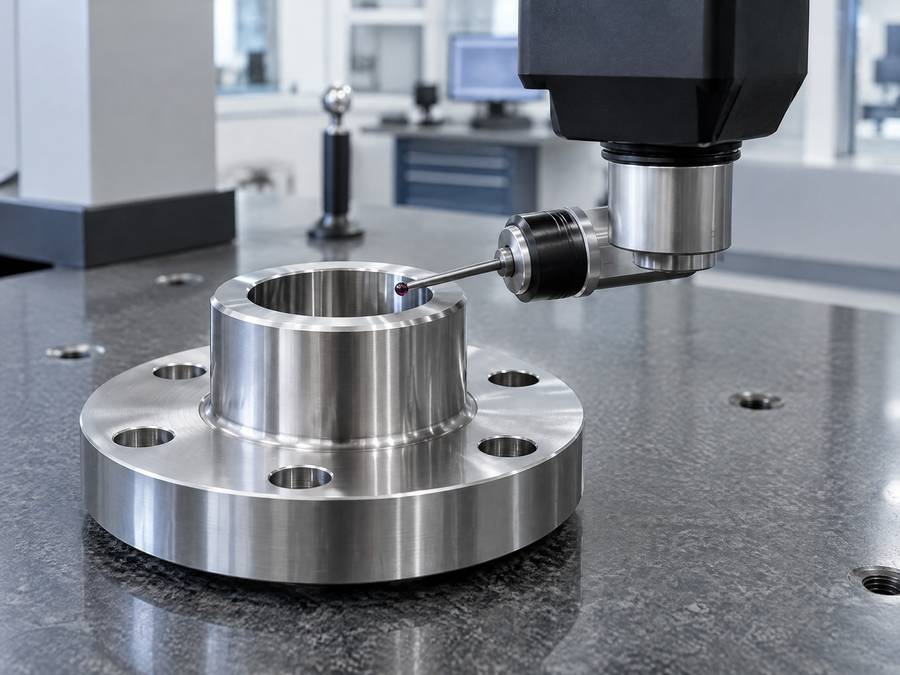
For every new part we agree an inspection scope that matches your drawing. The basis is the first article inspection – on request with a first article inspection report (VDA Volume 2 or PPAP) covering all drawing dimensions – followed by a reduced series inspection plan for the function-critical features.
For fits, runout and flatness, tactile measurement on the coordinate measuring machine is standard. Roughness is checked with a stylus instrument to ISO 21920 (formerly ISO 4287), anodised layers with eddy-current coating thickness measurement. On request, 100 % inspection of critical dimensions, inspection gauges and SPC with Cpk verification are possible.
Stainless steel milled and turned parts
With stainless steel, passivation and cleanliness also come into play. For parts used in food or medical technology, we specify whether pickling and passivation to ASTM A967 or equivalent is required and how the parts are packed free of coolant.
Plastic milled parts
Plastics such as POM or PA6 absorb moisture and expand considerably when warm. Dimensions should be checked at 23 °C; for PA6, conditioning before measurement makes sense, otherwise the factory’s and your incoming inspection results will differ.
Cost drivers in CNC contract manufacturing – and how to save
Machine time
The biggest item. Fewer set-ups, larger radii and open pockets directly reduce the cycle time.
Raw material
Parts milled from solid produce a lot of chips. At higher quantities, extruded profiles or cast blanks are worthwhile as semi-finished products.
Tight tolerances
IT6 instead of IT8 can mean grinding, measurement in a climate-controlled room and higher scrap. Check which dimensions are truly functional – see our guide to tolerances.
Batch size
Set-up costs are spread over the batch size. An order covering the annual volume with partial call-offs is usually cheaper than many small individual orders.
Surface treatment
Multiple coatings or masking (e.g. threads bare, rest anodised) mean manual work. Specify uniform surface finishes where possible.
Process: from custom part to series production
Review the drawing
We clarify unclear dimensions, material equivalents and surface finishes before requesting quotes. You will find tips under Preparing your enquiry and drawing.
Factory selection and quotation
Based on size, material and tolerance, we select factories with suitable turning, milling or 5-axis machines and obtain quotations.
Samples and first article inspection
The factory produces samples with a complete measurement report; you check and approve them.
Series with inspection plan
Series production to the approved process, inspection to the series inspection plan, schedule tracking and escalation in case of deviations.
Delivery
The standard is delivered to your door, duty paid (DDP), customs-cleared with a German invoice; EXW, FOB or other Incoterms on request. Optionally with safety stock or warehousing (storage costs are borne by the customer).
Are your precision parts a good fit for sourcing from China?
A good fit if …
- Series parts with a stable drawing and predictable annual volume
- Anodised aluminium milled parts, stainless steel turned parts, flanges and housings
- Parts with a high share of machine time or many set-ups
- As a complement to cast or forged blanks from the same region
Less suitable if …
- One-off parts and prototypes with no series prospect
- Parts needed within a few days
- Drawings that are still changing constantly
- Very small turned parts in quantities of millions that a local Swiss-type lathe shop produces more cheaply
Frequently asked questions about CNC precision parts
What tolerances are realistic for CNC precision parts from China?
General tolerances to ISO 2768-mK are standard, and ISO 2768-fH is no problem for most factories. Fits up to IT6 to ISO 286 are feasible but often require grinding or fine boring and should only be applied to functional dimensions.
Can 5-axis milled parts be sourced as well?
Yes. Parts with many machined sides or angled holes are produced on 5-axis machines in a single set-up. This reduces positional errors and set-up time, but the machine hour is more expensive than for 3-axis milling.
How do you make sure the right material is used?
With a 3.1 material certificate to EN 10204 that is traceable to the heat, and for critical parts a material test on the first samples. Material equivalents such as SUS316L for 1.4404 are agreed in writing in advance.
Do the dimensions apply before or after anodising?
This must be stated on the drawing. If nothing is specified, the dimensions apply to the finished condition, i.e. after coating. With hard anodising, the layer grows about half outwards, so fits are often machined with an allowance or masked.
Is it worth sourcing plastic milled parts from China?
Yes, for series with a high machining content. At very high quantities, plastic injection moulding is often cheaper – we compare both routes if the geometry allows.
How much does a turned or milled part from China cost?
That depends on machine time, material, tolerances and batch size. Flat-rate prices would not be serious; with a drawing, material and annual volume you will receive a specific quotation.
Related part types
Enquiry: CNC precision parts made to your drawing
Upload your drawing and 3D model, tell us the quantity and your deadline – we check feasibility and get back to you with questions or a quotation.
- Technical clarification before the request for quotation
- Quotations from audited partner factories
- One contact person in Germany
- Non-disclosure agreement (NDA) in advance on request
Prefer to call? 03641 9286337 · Mon–Fri 8 am–6 pm (CET)