
Home › Custom parts › Castings (sand, ductile iron, cast steel)
Castings made to drawing – sand castings, ductile iron and cast steel in series
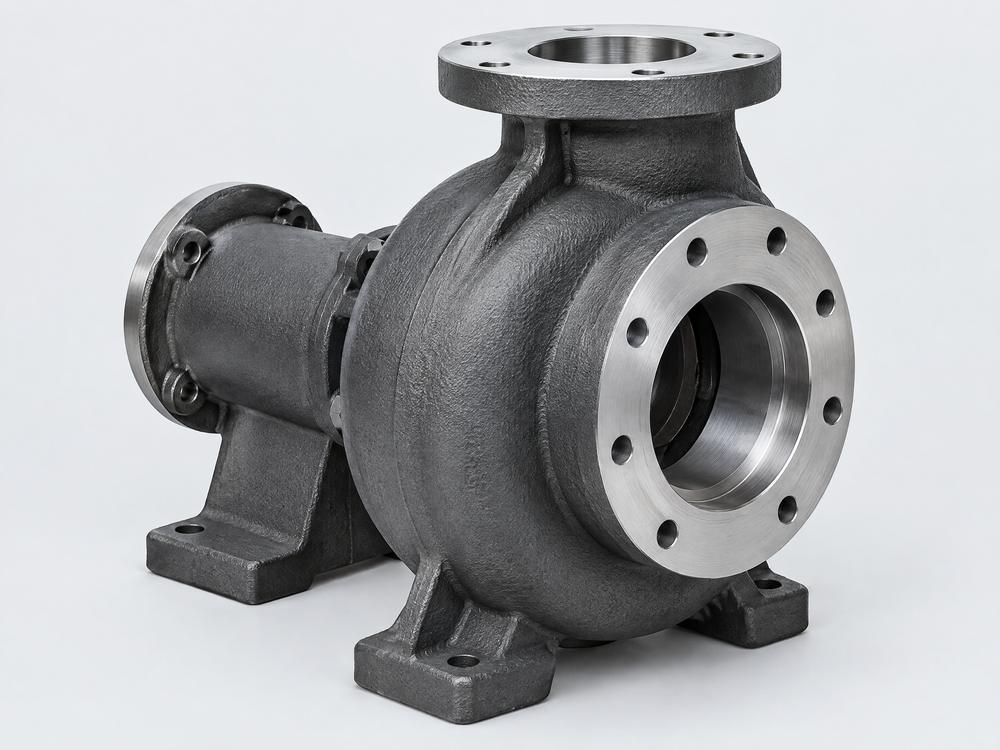
Iron and steel castings are the backbone of many machines: pump, valve and gearbox housings, bearing blocks, hubs and brackets. TOP Asia Technik sources castings in grey cast iron, ductile iron, cast steel and cast stainless steel as well as aluminium sand castings to your drawing from foundries in China – machined ready for installation, pressure-tested and painted on request.
- GJL, GJS, cast steel and cast stainless steel
- Raw castings or machined ready for installation
- Pressure testing and non-destructive testing
- Based in Jena since 2011
- Selected partner factories in China
- One contractual partner in Germany
- Pre-shipment inspection included
Which castings we source
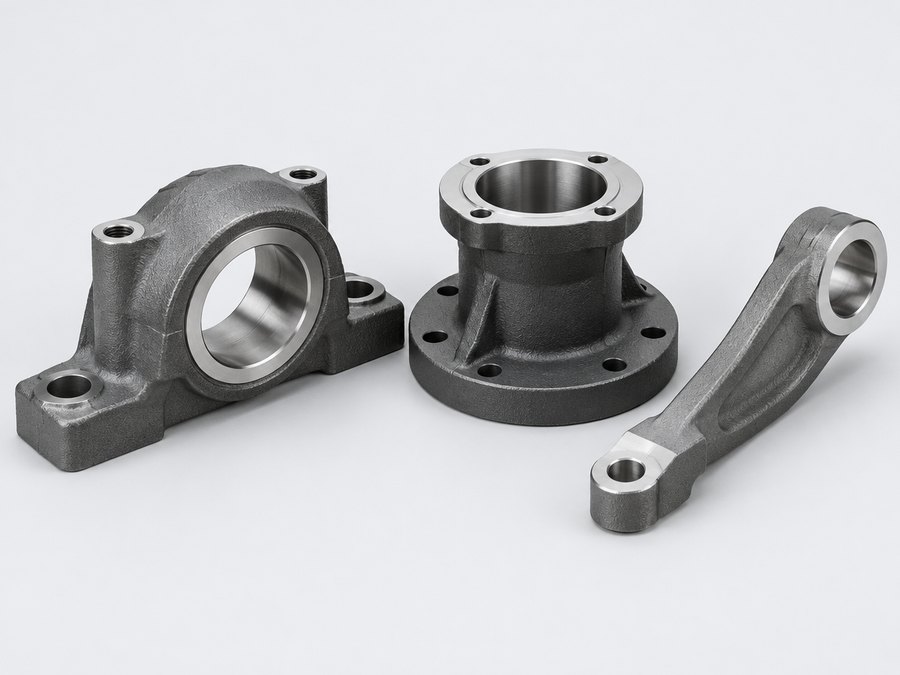
Our focus is on cast housings and structural parts for mechanical and plant engineering: pump housings, valve bodies, gearbox housings, bearing covers, flanges, impellers, pulleys and machine feet. Parts are sand cast, machine moulded or gravity die cast for suitable quantities, and centrifugally cast for rotationally symmetrical parts.
For small, intricate parts, investment casting is often the better choice; for thin-walled aluminium housings in large quantities, aluminium die casting. We cover heavy ballast parts separately under Counterweights.
Technical specifications: sand castings and steel castings
| Feature | Specification |
|---|---|
| Materials | Grey cast iron EN-GJL-200/-250 (DIN EN 1561), ductile iron EN-GJS-400-15/-500-7/-600-3 (DIN EN 1563), cast steel e.g. G20Mn5 (DIN EN 10293), GP240GH (DIN EN 10213), cast stainless steel 1.4308/1.4408, aluminium sand castings EN AC-42100, bronze and brass |
| Part weight / size | Guide value: from approx. 0.5 kg up to approx. 20 t per piece (sand castings, ductile iron and cast steel), larger parts on request; minimum wall thickness approx. 3–4 mm for grey cast iron, approx. 5–6 mm for cast steel |
| Tolerances | DIN EN ISO 8062-3: hand moulding approx. DCTG 11–13, machine moulding approx. DCTG 8–12, gravity die casting approx. DCTG 7–9; machining allowances according to the RMAG grades of the same standard |
| Surface finish / post-processing | Fettling, blasting, annealing or quenching and tempering, CNC machining, primer, wet paint, powder coating, cathodic e-coating (KTL) |
| Quantities | No fixed minimum order quantity – whether sourcing pays off depends on the part, quantity and pattern costs; hand moulding is also suitable for small batches, machine moulding for large series |
| Inspections | Spectral analysis, tensile test on test bars, microstructure (graphite form in GJS), hardness, pressure test, MT/PT/UT/RT, measurement report, inspection certificate 3.1 to EN 10204 |
| Lead time | First samples (including pattern) after approx. 3 weeks at best, usually longer – depending on complexity up to approx. 10 weeks; series production approx. 4–8 weeks depending on quantity and complexity (production time only), plus transport (sea freight approx. 30–45 days) |
| Data for your enquiry | Raw casting and finished part drawing (or finished part with marked machined surfaces), 3D model, material with standard, annual volume, test pressure, NDT requirements, painting |
Grey cast iron, ductile iron, cast steel or cast stainless steel?
The choice of material determines strength, damping, weldability and price. Guide values for the initial selection:
| Material | Tensile strength (min.) | Strengths | Typical castings |
|---|---|---|---|
| Grey cast iron EN-GJL-250 | 250 MPa | very good damping and machinability, low cost | machine beds, gearbox housings, brake discs, counterweights |
| Ductile iron EN-GJS-400-15 | 400 MPa, 15 % elongation | tough, impact-resistant, good castability | pump and valve housings, hubs, brackets |
| Ductile iron EN-GJS-600-3 | 600 MPa, 3 % elongation | high strength and wear resistance | gears, crank parts, highly loaded brackets |
| Cast steel G20Mn5 | approx. 480 MPa (normalised) | weldable, tough even at low temperatures | parts for welded structures, crane parts, axle parts |
| Cast stainless steel 1.4408 | approx. 440 MPa | corrosion-resistant, chloride-resistant | pump and valve housings for water and chemicals |
Casting processes for cast housings compared
Sand casting (hand and machine moulding)
The most flexible process: the mould is formed from sand around a pattern, and cavities are created with sand cores. Hand moulding with resin-bonded sand is suitable for large parts and small batches, machine moulding in green sand for high quantities of small and medium-sized parts.
Gravity die casting (permanent mould casting)
The metal is poured into a permanent mould made of steel or cast iron, mainly for aluminium. Gravity die casting produces a finer microstructure and tighter tolerances than sand casting, but needs a more expensive mould.
Centrifugal casting
The melt is poured into a rotating mould and densified by centrifugal force. Ideal for bushings, rings, tubes and cylinder liners with a dense, low-porosity microstructure.
Design guidelines for castings
Agree a raw casting drawing
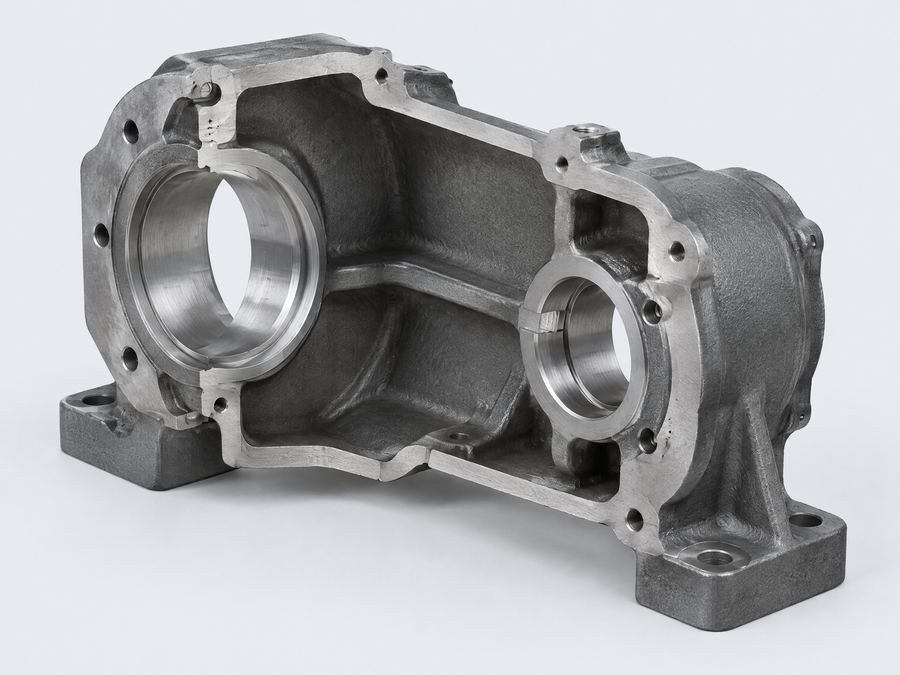
For machined castings, there should be a raw casting drawing with machining allowances and datum points for the first clamping. If there is none, the foundry will create one – and it must be approved.
Machining allowances to standard
The RMAG grades to ISO 8062-3 define how much stock remains. Too little stock leads to unmachined black spots, too much to exposed porosity and unnecessary machining.
Wall thickness transitions
Design transitions with a ratio of at most about 1:2 and with large radii. Junctions where walls intersect are classic locations for shrinkage cavities.
Cores and core prints
The internal cavities of pump and valve housings are created with sand cores. Sufficiently large core prints and cleaning openings make it easier to remove the core sand – sand residues in hydraulic chambers are a common reason for complaints.
Draft angles and parting line
Draft angles of 1–3° (guide value) and a well-chosen parting plane reduce cores and flash. The foundry proposes the parting line; the drawing should allow it.
Foundry marking
Specify where the foundry mark, date, batch number and part number are cast in. This provides traceability down to the melt at no extra effort.
Typical casting defects and inspections
Shrinkage cavities and porosity
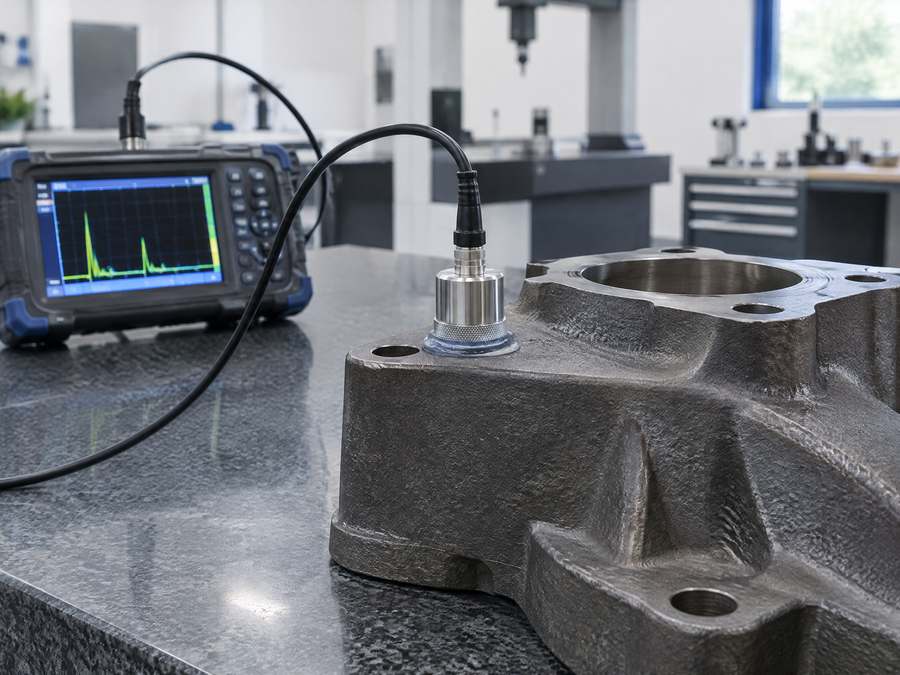
These form in thick sections without adequate feeding. In pressure-bearing housings they are revealed by pressure testing or X-ray (DIN EN 12681), in thick-walled parts by ultrasonic testing (DIN EN 12680).
Sand inclusions and core shift
These lead to wall thickness deviations and surface scars. Remedy: check wall thicknesses at defined measuring points on the first samples.
Wrong microstructure in ductile iron
Inadequate magnesium treatment results in flake instead of spheroidal graphite – the part looks the same but is brittle. A metallographic section and a test bar per melt provide certainty.
Surface cracks
Possible in cast steel after welding or torch-cutting the feeders. Specify magnetic particle testing (DIN EN 1369) or dye penetrant testing (DIN EN 1371-1) on critical areas.
Leaking housings
Pump and valve housings are tested with water or air, typically at 1.5 times the nominal pressure. Test pressure, holding time and medium belong in the drawing.
Cost drivers for castings
Pattern and core boxes
Wooden patterns are inexpensive but prone to wear; plastic or metal patterns cost more and withstand series quantities. Every additional core means another core box.
Material and weight
Casting prices are usually calculated per kilogram. Grey cast iron is the cheapest, ductile iron slightly more expensive, cast steel and cast stainless steel considerably more expensive – partly because of the greater feeding effort.
Machining and clamping
For housings, a large part of the cost lies in machining. Good clamping surfaces on the raw casting and grouping machining operations on fewer sides reduce set-up time.
Scope of inspection
X-ray, ultrasonic testing and 100 % pressure testing are costly. Specify inspections according to function, not as a blanket requirement for all castings.
Batch size
Small batches are possible with hand moulding, but every melt and every moulding run costs set-up time. Call-offs with larger production batches reduce the unit price.
Process for cast housings made to drawing
Drawing review
Castability, material, raw casting allowances and inspection requirements are clarified.
Quotation
Pattern costs, raw casting, machining, inspection and painting shown separately.
Pattern and first casting
Approval of the raw casting drawing, first casting with material certificate and wall thickness measurement.
Fully machined first samples
Measurement report and pressure test for the ready-to-install part, with a first article inspection report on request. You inspect and approve the first sample.
Series approval and delivery
Inspection plan, packaging and traceability defined; delivery by sea freight or via an EU second source in the Czech Republic.
Frequently asked questions about castings
Ductile iron or cast steel – which is better for a housing?
Ductile iron (GJS) is usually cheaper, casts better and is easy to machine. Cast steel is chosen when the part has to be welded, must remain tough at very low temperatures, or when regulations such as the Pressure Equipment Directive require specific materials.
Can I have a part supplied as a casting that is currently welded?
Often, yes. From medium quantities, a casting is usually cheaper than a welded construction because cutting, welding and straightening are no longer needed. The design should be adapted to suit casting, however.
Who pays for the casting pattern and who owns it?
The pattern is paid for once by the customer and becomes their property once paid in full. It remains at the foundry for production, is marked and maintained there; the arrangement is set out in our quotation. On request, we organise its transfer to Germany or elsewhere in Europe.
How are pump and valve housings tested for leak-tightness?
Usually by hydrostatic pressure testing with a defined test pressure and holding time; smaller housings are also tested with air under water or by pressure decay measurement. The test is carried out on the machined part.
What tolerances can I expect for sand castings?
For unmachined surfaces in hand moulding, approx. DCTG 11–13 to ISO 8062-3, which is roughly ±2.5–5 mm at 200 mm. Anything that has to be more accurate is machined.
Is centrifugal casting worthwhile for bushings and rings?
Yes, when a dense microstructure and wear resistance are required, for example for bronze bushings or liners. For small quantities, turning from semi-finished stock can be cheaper.
Related part types
Enquiry: Castings (sand, ductile iron, cast steel) made to your drawing
Upload your drawing and 3D model, tell us the quantity and your deadline – we check feasibility and get back to you with questions or a quotation.
- Technical clarification before the request for quotation
- Quotations from audited partner factories
- One contact person in Germany
- Non-disclosure agreement (NDA) in advance on request
Prefer to call? 03641 9286337 · Mon–Fri 8 am–6 pm (CET)