
Home › Custom parts › Counterweights
Counterweights for forklifts, cranes and construction machinery – made to drawing, in series
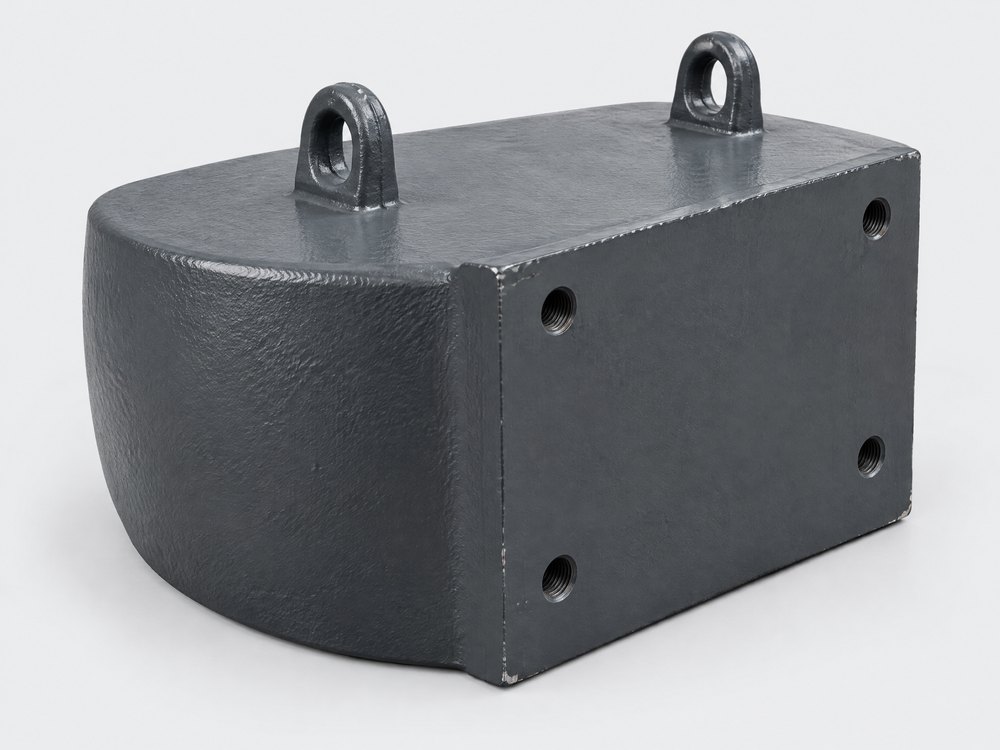
A counterweight for forklifts, cranes or aerial work platforms is a simple part – as long as weight, centre of gravity and supply chain are right. TOP Asia Technik sources counterweights and ballast weights to your drawing in grey cast iron, as a steel plate construction or as a filled steel shell, painted and packed for transport.
- Grey cast iron, steel plate or filled
- Weight and centre of gravity documented
- Logistics for heavy parts
- Based in Jena since 2011
- Selected partner factories in China
- One contractual partner in Germany
- Pre-shipment inspection included
Where counterweights and ballast weights are used
Counterweights – also known as ballast weights – ensure the stability of machines that move loads outside their footprint. On a forklift truck, the counterweight usually forms the entire rear end and also carries the towing coupling, lights and covers.
Other typical applications are ballast plates for mobile and tower cranes, rear counterweights for excavators and wheel loaders, ballast in aerial work platforms, and front and wheel weights for tractors and agricultural machinery. What they all have in common: high unit weight, a low price per kilogram – and therefore a large share of painting, packaging and freight in the total cost.
Technical specifications: counterweights
| Feature | Specification |
|---|---|
| Materials | Grey cast iron (e.g. EN-GJL-150 or EN-GJL-200 to DIN EN 1561), structural steel plates (e.g. S235JR/S355J2 to DIN EN 10025-2), sheet steel shell filled with concrete, heavyweight concrete or steel scrap |
| Part weight / size | Guide value: from approx. 20 kg (wheel weights) up to approx. 20 t per piece (forklift and crane ballast); heavier weights on request |
| Tolerances | Cast dimensions to DIN EN ISO 8062-3, usually DCTG 11–13; weight tolerance and centre of gravity position to be specified separately (guide value ±1–2 % of weight); mounting faces and hole patterns machined |
| Surface finish / post-processing | Blasting, filling of visible surfaces, primer and topcoat in a RAL colour to DIN EN ISO 12944, machining of contact faces, threads and mountings |
| Quantities | No fixed minimum order quantity – whether sourcing pays off depends on the part, quantity, pattern costs and freight; steel plate constructions need no casting pattern and are also suitable for small quantities |
| Inspections | Weighing of every part with record, centre of gravity verification on the first sample, dimensional inspection of interfaces, coating thickness measurement, adhesion test (cross-cut) |
| Lead time | First samples (including pattern) after approx. 3 weeks at best, usually longer – depending on complexity up to approx. 10 weeks; series production approx. 4–8 weeks depending on quantity and complexity (production time only), plus transport (sea freight approx. 30–45 days) |
| Data for your enquiry | Drawing or 3D model, target weight with tolerance, centre of gravity position, visible surfaces and paint system, lifting points, annual volume and call-off quantities, delivery location |
Grey cast iron, steel plates or filled: types of counterweight
The type of construction depends mainly on installation space, quantity and appearance. The less space is available, the higher the density has to be.
| Type | Density (guide value) | Advantages | Limitations |
|---|---|---|---|
| Grey cast iron (cast weight) | approx. 7.1–7.2 g/cm³ | free shaping, integrated mountings, low price per kg in series | casting pattern required, rough surface, weight variation due to core shift |
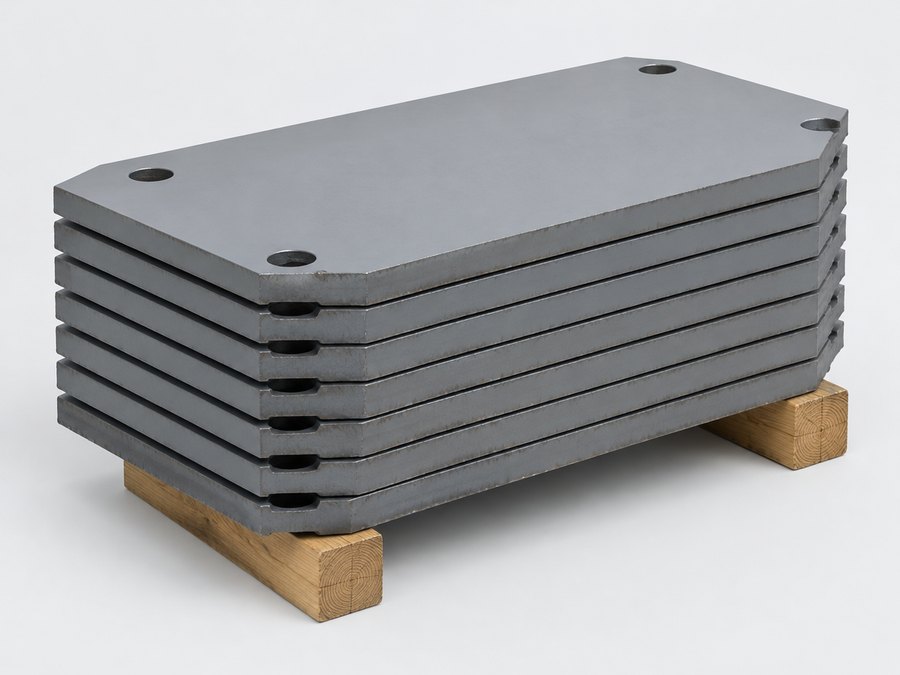
| Steel plates, welded or bolted | approx. 7.85 g/cm³ | highest density, no pattern, small quantities possible, weight adjustable via number of plates | angular shape, welding distortion, flame-cut edges need finishing |
| Steel shell with concrete filling | approx. 2.3–2.5 g/cm³ | very low cost, large volumes possible | needs about three times as much space as a casting |
| Steel shell with heavyweight concrete or steel scrap | approx. 3.5–5 g/cm³ | compromise between price and installation space | voids and moisture inside, greater weight variation |
Design guidelines for cast and steel counterweights
Put the centre of gravity in the drawing
For the stability calculation, the position of the centre of gravity counts as well as the weight. Specify it with a tolerance and have it verified on the first sample – for example by weighing at three points.
Provide for weight adjustment
Cast weights vary by a few per cent. Adjustment pockets into which steel plates are bolted, or defined milling surfaces, allow the part to be set to the target weight.
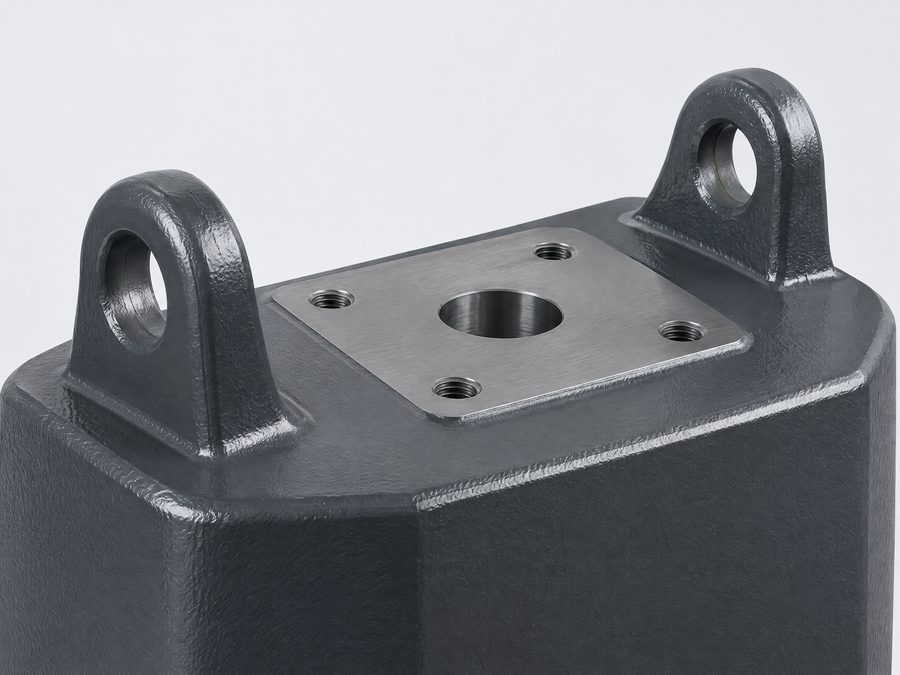
Plan lifting points
Threads for eyebolts or cast-in lugs must be designed for the full weight and for angled lifting. Their position also determines how the part can be lashed in the container.
Solid cross-sections in castings
Counterweights are deliberately thick-walled. Internal shrinkage cavities are often functionally non-critical but shift weight and centre of gravity. Clearly specify tolerances and limits for shrinkage cavities at threads.
Define visible surfaces
On a forklift, the counterweight is part of the design. Mark visible surfaces that need to be filled and sanded – all other surfaces are just blasted and painted.
Painting and corrosion protection
The cast surface is blasted and then primed. Visible surfaces are then filled, sanded and topcoated; two-coat systems with a total dry film thickness of approx. 120–160 µm are common. The best way to define the right system is via the corrosivity category (e.g. C3 or C4) and the durability to DIN EN ISO 12944.
For long sea voyages, fully cured paint is important: freshly painted parts stacked closely together stick to each other or are damaged at the supports. Unpainted holes and threads should be protected with corrosion protection oil or plugs.
Transport and logistics for heavy parts
With counterweights, freight per part often costs more than with any other custom part. These points determine the cost:
Weight, not volume
A container of counterweights is already full while it still looks half empty. For heavy cargo, the 20-foot container is usually used; for inland haulage, road regulations often limit the payload to about 20–25 t (guide value).
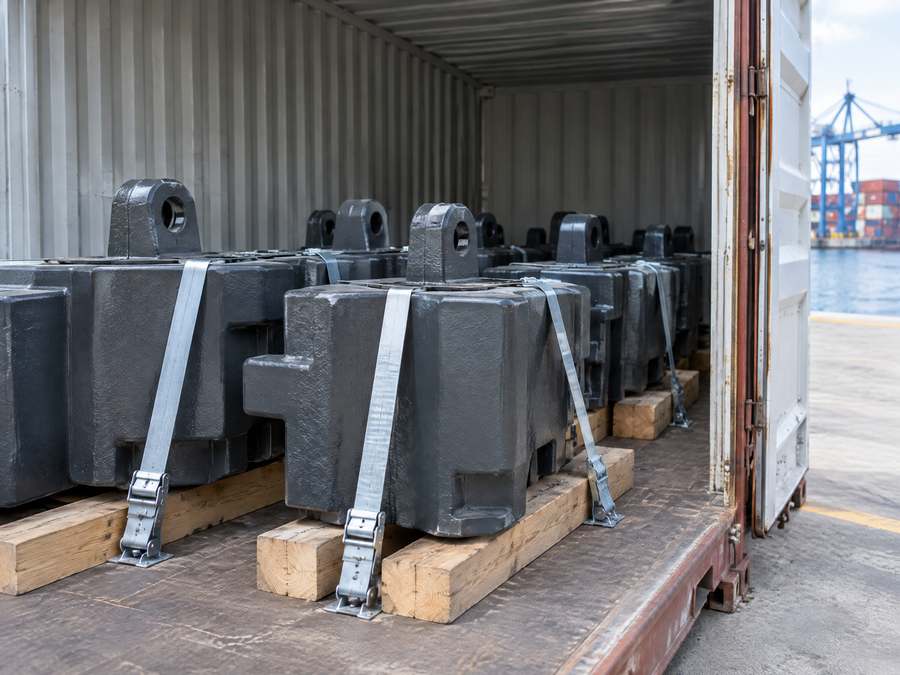
Distribute point loads
The container floor cannot take high point loads. Heavy parts must stand on timber bearers or support frames that distribute the load, and be secured in accordance with the CTU Code.
Packaging
Sturdy pallets or racks made of ISPM 15 timber, secured against slipping. For forklift counterweights, racks that your goods receiving can unload directly with a forklift have proven effective.
Plan call-offs
Because the container load dictates a fixed number of pieces, it pays to align order and call-off quantities with full containers. Safety stocks or scheduled call-offs smooth out supply.
Delivery terms
With heavy parts, the freight share is high. Our standard is delivery to your door, duty paid (DDP); on request we also deliver EXW or on other Incoterms – then no freight buffer needs to be priced in. Always compare quotations on the same basis – more on this under Incoterms: DDP or FOB.
Cost drivers for counterweights
Raw material price
Cast weights are effectively paid for by the kilogram; scrap and pig iron prices feed straight through. For longer-term demand, a material price adjustment clause in the quotation can make sense.
Appearance
Filling and sanding visible surfaces can cost more than the casting itself. A clear definition of visible surfaces saves a lot of money.
Tight weight tolerance
A tolerance of ±0.5 % requires rework or balancing weights on every part. Check which tolerance the stability calculation really requires.
Machining
Only have mounting faces and hole patterns machined. Large flat faces on several tonnes of casting tie up expensive large machine tools.
How counterweight sourcing works
Clarify the type of construction
Joint assessment of casting, steel plate or filled design based on installation space, quantity and appearance.
Quotation including freight
Price per part including pattern, painting, packaging and transport to the agreed delivery location.
First sample with weighing record
Weight, centre of gravity, interface dimensions and paint system are documented; you inspect and approve the first sample.
Series production in container loads
Production and shipment in full container loads, every part weighed and marked.
Frequently asked questions about counterweights
Why are forklift counterweights usually made of grey cast iron?
Grey cast iron combines high density, free shaping and a low material price. The rear of a forklift with its curves, mountings and openings can be cast in one piece – as a welded construction this would be considerably more complex.
How accurate does the weight of a counterweight have to be?
That is determined by the stability calculation for your machine. Tolerances in the range of ±1–2 % of the target weight are common, supplemented by a specification for the centre of gravity position.
Can I replace a cast weight with a concrete filling?
Only if there is enough installation space: concrete has about a third of the density of grey cast iron. Heavyweight concrete with steel aggregate lies in between but varies more in weight.
Is importing heavy parts from China worthwhile despite the freight?
That depends on the ratio of part price, painting and freight costs. Because the freight share for weights is high, we always calculate counterweights including delivery to your plant and make an honest comparison with European sources.
How are ballast plates for cranes delivered?
Usually as stackable plates with centring features and lifting points, secured on timber racks. Each plate should be marked with its weight and part number so that no mix-ups occur on the construction site.
What is the difference between a counterweight and a ballast weight?
In everyday use, the terms are often used interchangeably. Counterweight usually refers to a fixed part integrated into the machine, ballast weight more to additional, removable weights such as crane ballast or front weights.
Related part types
Enquiry: Counterweights made to your drawing
Upload your drawing and 3D model, tell us the quantity and your deadline – we check feasibility and get back to you with questions or a quotation.
- Technical clarification before the request for quotation
- Quotations from audited partner factories
- One contact person in Germany
- Non-disclosure agreement (NDA) in advance on request
Prefer to call? 03641 9286337 · Mon–Fri 8 am–6 pm (CET)