
Home › Custom parts › Magnets
Custom Magnets – Neodymium, Ferrite and SmCo Magnets Made to Your Drawing
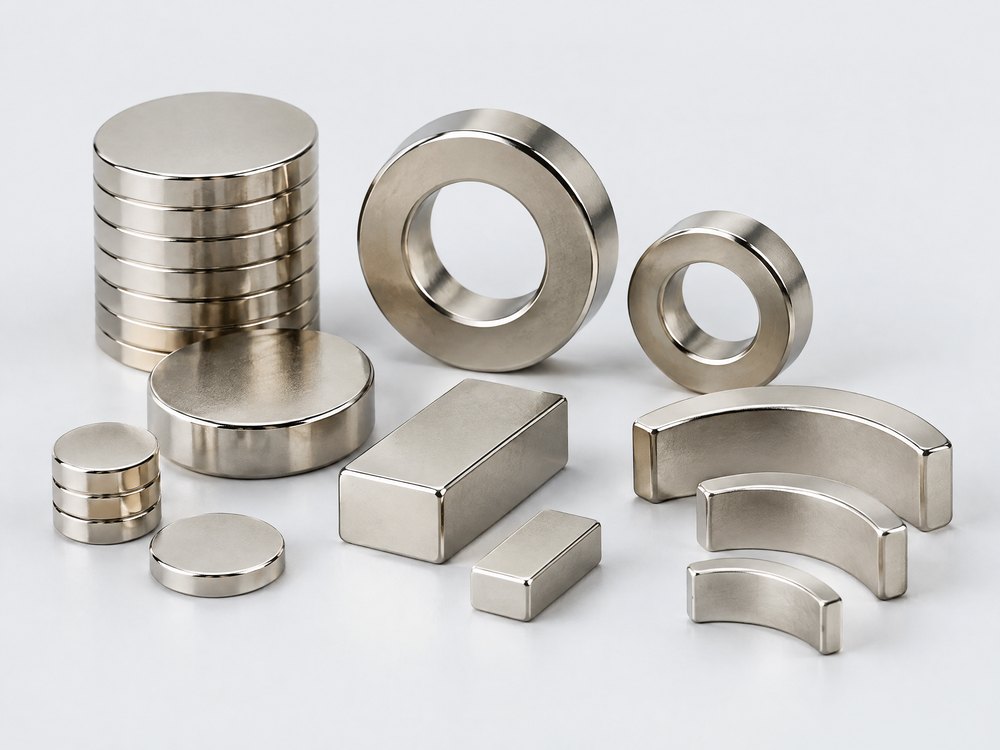
We source custom magnets in series from China – NdFeB, hard ferrite, SmCo and complete magnetic assemblies, made exactly to your drawing with the specified grade, magnetisation direction and coating. Not catalogue goods, but parts for your motor, sensor or holding fixture. China processes most of the world’s rare earths – so the choice of magnet factories is correspondingly wide.
- Grades N35 to N52, up to UH
- Axial, diametral or multipole magnetisation
- Coating to suit operating conditions
- Based in Jena since 2011
- Selected partner factories in China
- One contractual partner in Germany
- Pre-shipment inspection included
When custom magnets pay off
Standard catalogue magnets work as long as size, grade and coating happen to match your design. As soon as you need segments for a rotor, holes with countersinks, a specific temperature class or multipole magnetisation, magnets made to drawing are the better choice.
For recurring series demand, custom dimensions usually pay off quickly, because many shapes are cut and ground from blocks without a dedicated tool. For a few pieces with no follow-up demand, catalogue goods are usually cheaper.
Technical specifications: magnets made to drawing
| Feature | Specification |
|---|---|
| Materials | Sintered and polymer-bonded NdFeB, hard ferrite (Sr/Ba), SmCo5 and Sm2Co17; magnetic assemblies with steel pot or rubber coating |
| Part weight / size | From a few millimetres up to blocks of approx. 100 mm edge length (NdFeB, guide value); larger formats segmented, larger parts on request |
| Tolerances | Ground: typically ±0.05 mm, tight down to ±0.02 mm; unground ferrite surfaces approx. ±2 % of the dimension |
| Surface finishes / post-processing | NiCuNi, zinc, epoxy, Parylene, phosphating; chamfers against edge chipping |
| Quantities | No fixed minimum order quantity – whether sourcing pays off depends on the part, quantity and tooling costs; talk to us; sample quantities in advance |
| Inspections | Dimensions, flux measurement with Helmholtz coil, gaussmeter, BH curve on a sample basis, coating thickness, salt spray test to DIN EN ISO 9227 |
| Lead time | First samples in approx. 3 weeks at best, usually longer – up to approx. 10 weeks depending on complexity; series production approx. 4–8 weeks depending on quantity and complexity (production time only, plus transport) |
| Data for your enquiry | Drawing, grade, magnetisation direction, coating, operating temperature, annual volume, magnetised or unmagnetised |
Neodymium, ferrite, SmCo: materials compared
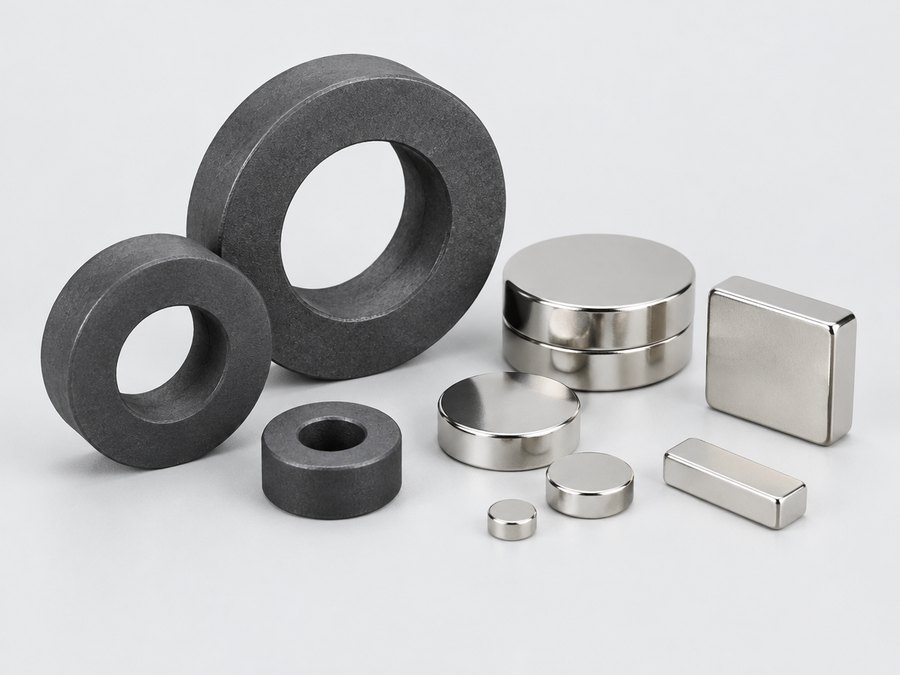
Remanence Br determines the strength; coercivity HcJ determines resistance to demagnetisation by opposing fields and heat.
| Material | Remanence Br | Coercivity HcJ | Max. operating temperature | Corrosion | Typical use |
|---|---|---|---|---|---|
| Sintered NdFeB | 1.17–1.48 T | 955–2,800 kA/m | 80–230 °C depending on class | Poor without coating | Motors, sensors, holding systems |
| Polymer-bonded NdFeB | 0.6–0.75 T | approx. 700–900 kA/m | approx. 120–150 °C | Moderate | Complex shapes, sensor rings |
| SmCo (SmCo5, Sm2Co17) | 0.85–1.15 T | 1,200–2,400 kA/m | 250–350 °C | Good | High temperature, pumps, sensor technology |
| Hard ferrite | 0.2–0.45 T | 200–400 kA/m | approx. 250 °C | Very good | Small motors, loudspeakers, holding magnets |
Neodymium magnets made to drawing: grades and temperature classes
The number in the grade stands for the maximum energy product in MGOe: N35 has a remanence of about 1.17–1.22 T, N42 1.28–1.32 T, N52 1.43–1.48 T. The letter after it indicates the temperature class.
Important: the maximum operating temperature only applies to favourable geometry. Flat discs magnetised through the thickness lose flux sooner than long rods. High grades such as N52 are usually only available in classes N and M – if you need both heat resistance and strength, you are more likely to end up with N45SH or N42UH.
- N: up to approx. 80 °C, HcJ ≥ 955 kA/m
- M: up to approx. 100 °C, HcJ ≥ 1,114 kA/m
- H: up to approx. 120 °C, HcJ ≥ 1,353 kA/m
- SH: up to approx. 150 °C, HcJ ≥ 1,592 kA/m
- UH: up to approx. 180 °C, HcJ ≥ 1,990 kA/m
- EH / AH: up to approx. 200 and 220 °C respectively, for drives with high thermal load
Design guidelines for magnets and magnetic assemblies
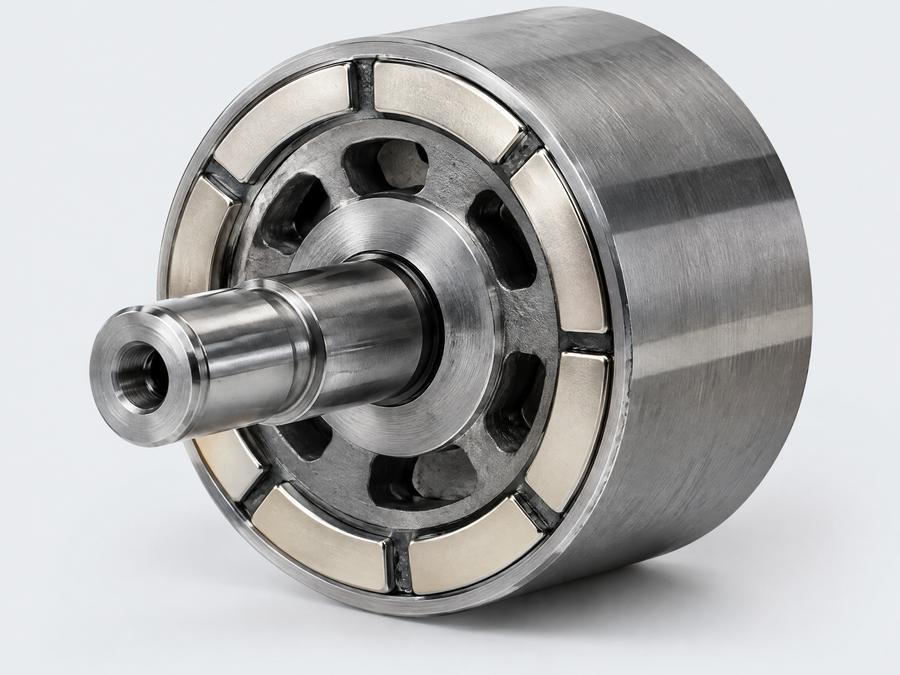
Specify the magnetisation direction clearly
Axial, diametral, radial, multipole or as a Halbach array – mark the north and south poles with an arrow. For rotor segments, the pole sequence belongs in the assembly drawing.
Allow for brittle material
NdFeB, SmCo and ferrite are as brittle as ceramics. Chamfers of 0.2–0.5 mm reduce edge chipping; threads are not possible – countersunk holes are.
Pot magnets with steel pot
A steel pot concentrates the flux on one side and significantly increases the holding force compared with a bare magnet of the same size. The holding force only applies to thick, bare counter steel with no air gap.
Match bonding and coating
For bonded rotor magnets, phosphating or epoxy is better suited than nickel. Agree the adhesive with the factory in advance.
Coatings for NdFeB magnets
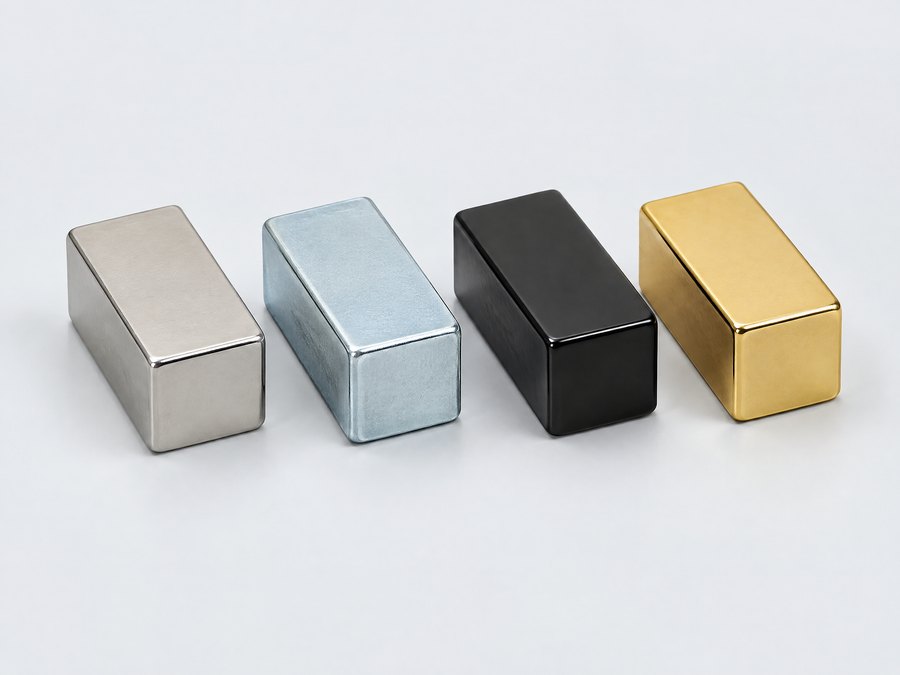
Sintered NdFeB corrodes quickly without a protective coating. Salt spray test hours vary by manufacturer – specify your minimum value in the quotation.
| Coating | Coating thickness (guide value) | Suitable for |
|---|---|---|
| NiCuNi | 10–20 µm | Standard, dry indoor environments |
| Zinc | 8–15 µm | Low cost, moderate protection, bonds well |
| Epoxy (black) | 15–25 µm | Humid environments, better corrosion resistance |
| Parylene | 5–20 µm | Electronics and sensor applications, thin and pore-free |
| Phosphating | A few µm | Temporary protection, parts to be bonded or potted |
Export restrictions on rare earths from China
As of October 2026, without guarantee: since April 2025, Chinese exporters have needed an individual licence for seven medium and heavy rare earths – samarium, gadolinium, terbium, dysprosium, lutetium, scandium and yttrium – including magnet materials containing these elements. This mainly affects SmCo magnets and high-coercivity NdFeB grades (SH, UH, EH) containing dysprosium or terbium.
The extended controls announced in October 2025 have been suspended for one year; the suspension expires on 10 November 2026. Expect end-use declarations and longer lead times. Check whether a grade without heavy rare earths, or hard ferrite, is technically sufficient.
Transporting magnetised parts
In sea freight, magnets are not classed as dangerous goods. In air freight they fall under IATA Packing Instruction PI 953 (UN 2807, Class 9): if the field 2.1 m from the package exceeds the limit, it must be declared as “Magnetized Material”; above 0.418 A/m at a distance of 4.6 m, approval from the authorities is required.
Solutions include shielding plates, keepers and an arrangement in which the fields cancel each other out. Alternatively, parts are delivered unmagnetised and magnetised at your site – this requires a magnetising fixture.
Process: from drawing to series magnet
Clarify requirements
Define grade, operating temperature, magnetisation, coating and transport route.
Quotation and samples
Samples with dimensional report and flux measurements for approval.
Fix limit values
Agree flux window, coating thickness and salt spray test duration as acceptance criteria.
Series production and shipping
Series inspection per batch, magnet-appropriate packaging and shipping by sea or air freight.
Frequently asked questions about custom magnets
Which grade do I need for my neodymium magnet?
The decisive factors are the required flux or holding force and the maximum operating temperature. Higher numbers mean more strength, higher letters mean more temperature resistance. We agree the grade with you and the factory.
When does ferrite make more sense than neodymium?
When installation space is not an issue, the environment is humid or warm, or cost is the priority. Ferrite is much cheaper, corrosion-resistant and free of rare earths.
How is magnet strength tested?
In series production, flux measurement with a Helmholtz coil against an approved reference part is standard. On a sample basis, the BH curve is recorded with a hysteresisgraph.
Can magnets be supplied bonded into assemblies?
Yes, for example as a holding system in a steel pot, as a rotor or overmoulded. We treat such parts as an assembly with its own inspection.
Do neodymium magnets lose strength over time?
When operated within their temperature class, the loss over the years is very small. Overheating, strong opposing fields and corrosion of a damaged coating are critical.
Related part types
Enquiry: Magnets made to your drawing
Upload your drawing and 3D model, tell us the quantity and your deadline – we check feasibility and get back to you with questions or a quotation.
- Technical clarification before the request for quotation
- Quotations from audited partner factories
- One contact person in Germany
- Non-disclosure agreement (NDA) in advance on request
Prefer to call? 03641 9286337 · Mon–Fri 8 am–6 pm (CET)