
Home › Custom parts › Electronic Assemblies
PCB Assembly from China – Electronic Assemblies for Your Series Production
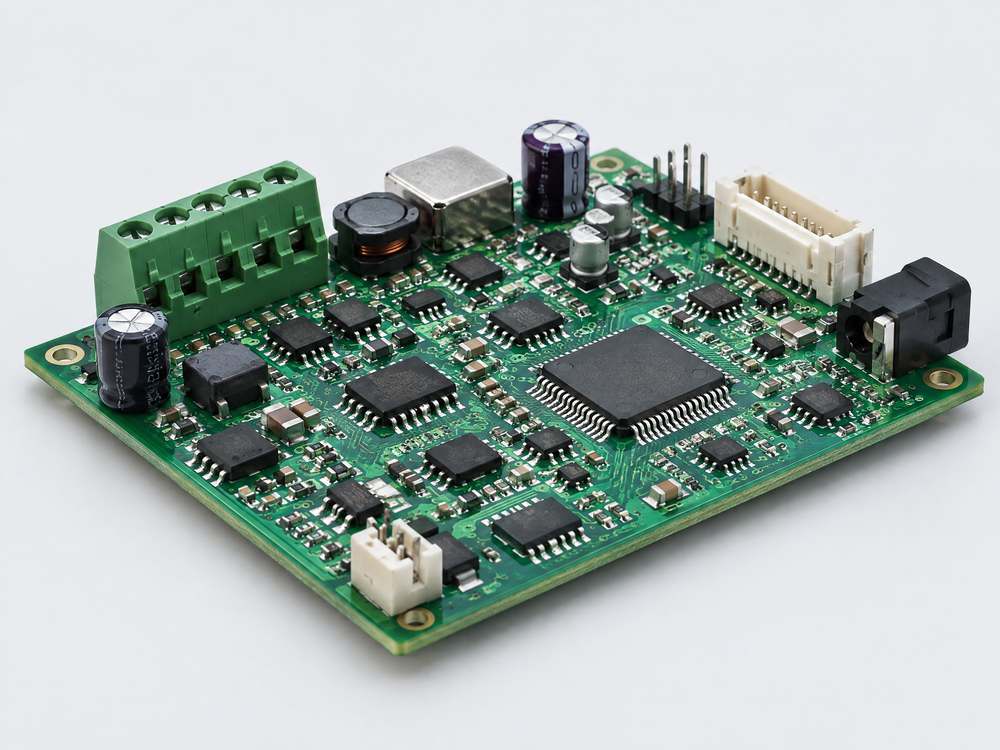
Through our partner network in China, we also organise PCB assembly and simple electronics manufacturing – mainly for customers who already source mechanical parts through us. This makes sense above all for fully developed control, sensor and power supply boards in series that are supplied together with a housing, cable set or assembly.
- SMD and THT assembly
- Inspection to IPC-A-610
- Component sourcing with approved parts list
- Based in Jena since 2011
- Selected partner factories in China
- One contractual partner in Germany
- Pre-shipment inspection included
Electronics manufacturing in China: when it fits
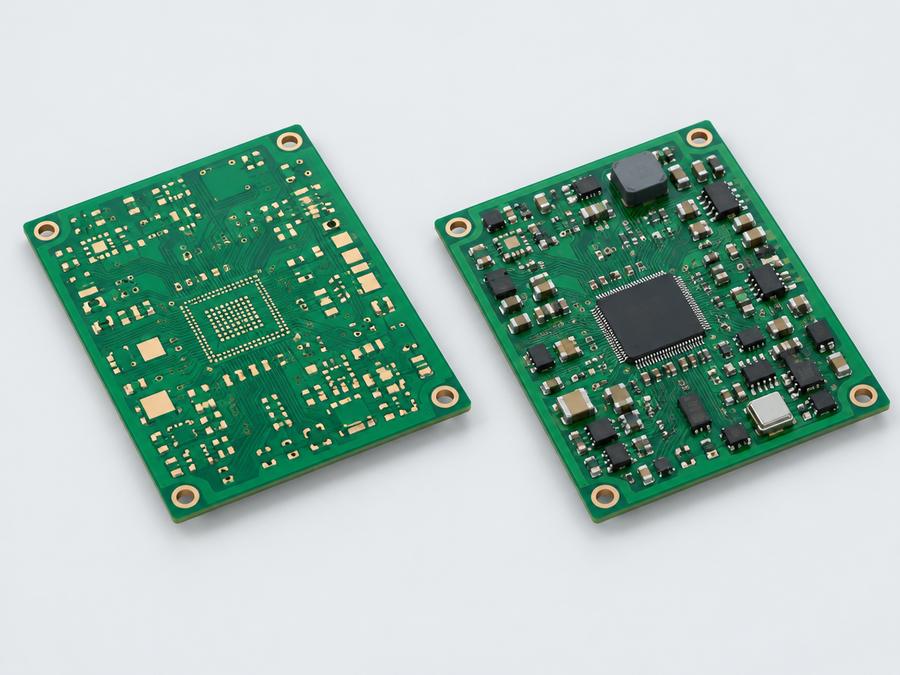
Electronics manufacturing in Shenzhen and the Pearl River Delta is broad-based and very experienced. However, the price advantage there arises less from the placement itself – which is highly automated – than from PCBs, passive components, hand soldering, assembly and testing.
Well suited are fully developed boards with a stable bill of materials (BOM) and plannable demand. Less suited are development samples, boards with many allocation-critical components, or products whose approval is tied to a specific manufacturing site.
Important to note up front: we are not a development service provider. Circuit design, layout and firmware come from you; we take care of manufacturing, testing and delivery according to your documents.
Technical specifications: PCB assembly (PCBA)
| Feature | Specification |
|---|---|
| Materials | PCBs made of FR-4 (standard and high-Tg), aluminium core (IMS) for LED and power electronics; surface finishes lead-free HASL, ENIG, OSP |
| Part weight / size | Common SMD and THT package types; smallest package, board size and layer count depend on the partner factory – we clarify the limits on request with your data |
| Tolerances | PCB to IPC-6012, assembly and solder joints to IPC-A-610 Class 2; higher requirements on request |
| Surface finish / secondary operations | Conformal coating, potting, selective soldering, press-fit, assembly into the housing |
| Quantities | No fixed minimum order quantity – whether production in China makes sense depends on the board, the quantity and the one-off costs (stencils, test adapters); talk to us |
| Inspections | SPI (solder paste inspection), AOI, X-ray for BGA/QFN, ICT or flying probe, functional test (FCT) with your test concept |
| Lead time | First samples in approx. 3 weeks at best, usually longer – up to approx. 10 weeks depending on complexity; series production approx. 4–8 weeks depending on quantity and complexity (production time only), plus transport; strongly dependent on component availability |
| Data for your enquiry | Gerber or ODB++ data, BOM with manufacturer part numbers and approved alternatives, placement data (pick-and-place), assembly drawing, test specification, firmware process, annual volume |
SMD and THT assembly: inspection methods at a glance
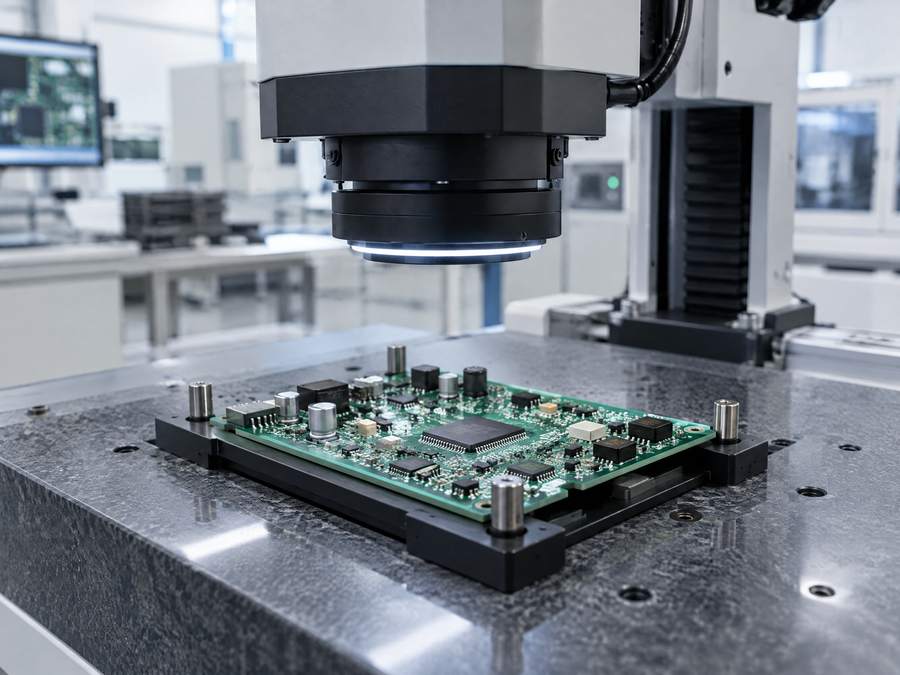
AOI
Automated optical inspection after reflow soldering: detects missing, rotated or misaligned components and visible solder defects. Standard for SMD series.
X-ray (AXI)
Essential for BGA, QFN and other components with hidden solder joints: shows bridges, open joints and voids. Require it at least for first samples and on a sampling basis in series production.
ICT / flying probe
Electrical test of the assembly (values, short circuits, open circuits). ICT needs a bed-of-nails fixture and pays off in large series; flying probe works without a fixture for smaller ones.
Functional test (FCT)
Checks whether the board does what it is supposed to do. Test fixture, test software and limit values should be defined by you or agreed jointly – without FCT, the biggest risk remains undetected.
Component sourcing and counterfeit risk
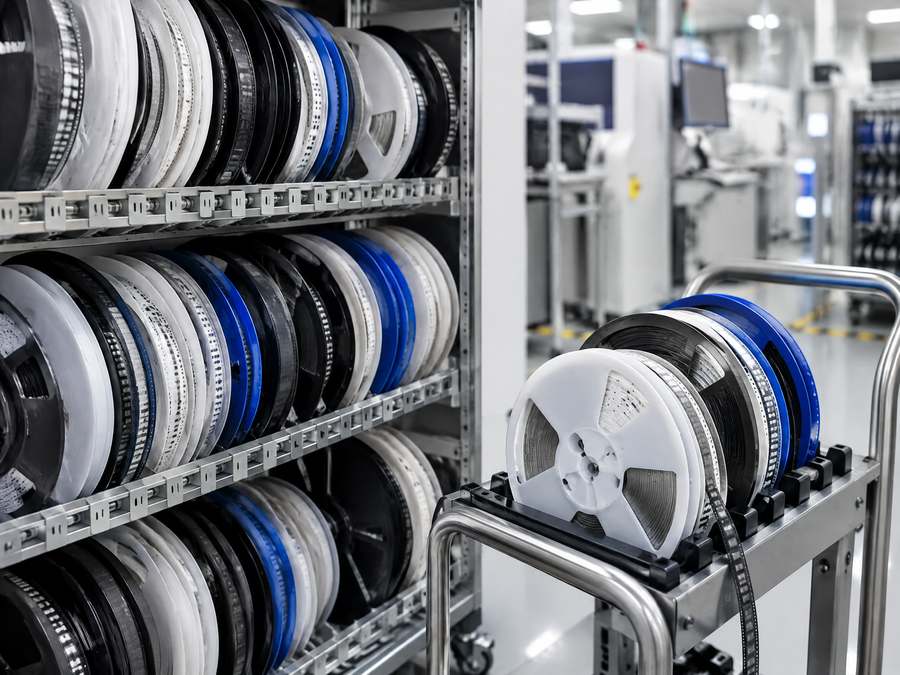
With electronic assemblies, the biggest risk often lies not in manufacturing but in the components. During shortages, relabelled, recycled or counterfeit ICs appear on the grey market. They can look perfect and still fail prematurely.
These rules have proven effective:
- BOM with manufacturer part numbers and a list of approved alternatives – any other substitution only after written approval
- Critical components (microcontrollers, memory, power semiconductors) only through authorised distribution, with proof of origin
- Store and process moisture-sensitive components to J-STD-033 (MSL)
- ESD protection in production to IEC 61340-5-1
- Traceability: document date codes and lots of critical components per production lot
CE conformity is the responsibility of whoever places the product on the market
A manufacturer in China assembles according to your documents – responsibility for CE marking, the EMC Directive 2014/30/EU, the Low Voltage Directive 2014/35/EU or the Radio Equipment Directive 2014/53/EU and for RoHS conformity under 2011/65/EU lies with whoever places the product on the market in the EU. So plan EMC measurements and technical documentation yourself, and request RoHS evidence for the materials used from the manufacturer.
Cost drivers in electronics manufacturing
Component costs
Often make up the largest part of the price. Shortage components and mandatory brands increase costs; approved alternatives reduce them.
THT and hand-soldering share
Through-hole components and hand-soldered joints take time. Where possible, use SMD variants or selective soldering.
One-off costs
Stencils, test adapters for ICT and FCT, programming fixture. With small batches they carry a lot of weight.
PCB
Layer count, microvias, tight track spacing and special surface finishes drive the price. A design-for-manufacturing check before ordering pays off.
Frequently asked questions about PCB assembly
Which IPC-A-610 class do I need?
Class 2 is customary for industrial electronics. Class 3 is intended for applications with very high reliability requirements and increases testing effort and costs.
Who purchases the electronic components?
A turnkey model is customary, in which the manufacturer sources all components according to your BOM. You can also supply critical components yourself. In both cases: only approved manufacturers and alternatives, with proof of origin.
How is the firmware loaded?
Usually at the manufacturer via a programming fixture or during the functional test. Version status, release process and protection of your intellectual property should be agreed in writing in advance.
Is X-ray inspection necessary for every board?
No. X-ray inspection makes sense for BGA, QFN and LGA components whose solder joints are not visible. For boards with standard SMD components only, AOI and a functional test are usually sufficient.
Related part types
Enquiry: Electronic Assemblies made to your drawing
Upload your drawing and 3D model, tell us the quantity and your deadline – we check feasibility and get back to you with questions or a quotation.
- Technical clarification before the request for quotation
- Quotations from audited partner factories
- One contact person in Germany
- Non-disclosure agreement (NDA) in advance on request
Prefer to call? 03641 9286337 · Mon–Fri 8 am–6 pm (CET)