Home › Custom parts › Extruded profiles & heat sinks
Aluminium extruded profiles and heat sinks made to drawing
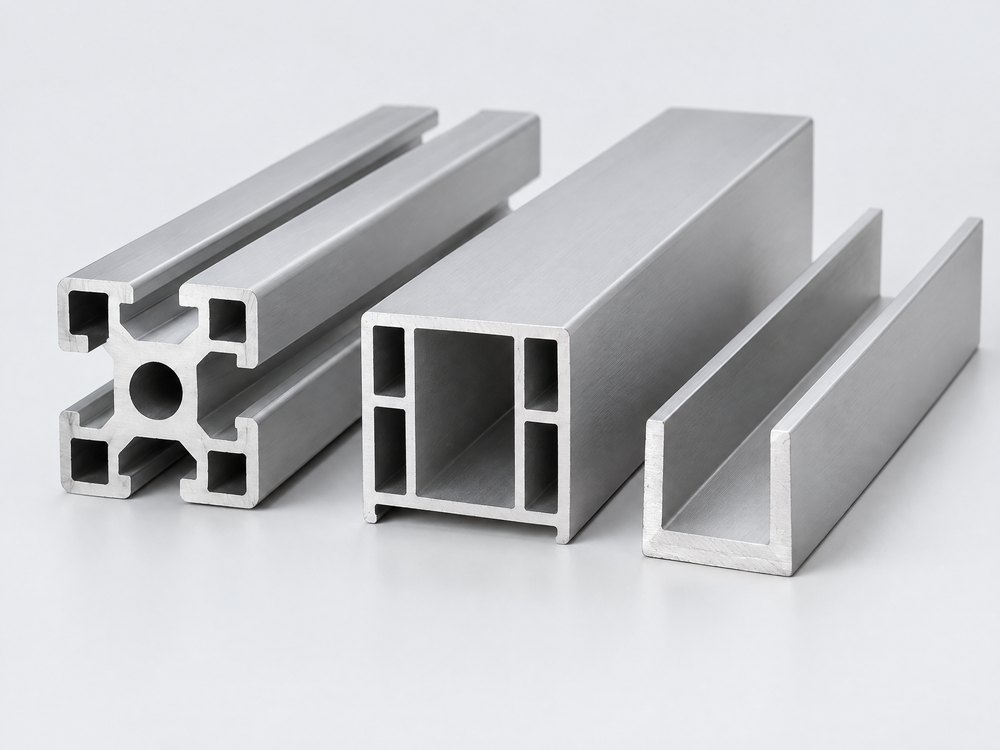
We source aluminium extruded profiles and heat sinks made to your drawing in series – as mill lengths, cut to length or machined ready for assembly and anodised. On this page you will find alloy selection, tolerance standards, design rules and the points to watch when costing profiles from China.
- Profiles with your own die
- Sawing, milling, anodising
- Heat sinks machined ready for assembly
- Based in Jena since 2011
- Selected partner factories in China
- One contractual partner in Germany
- Pre-shipment inspection included
Aluminium extruded profiles: when does a custom profile pay off?
In extrusion, an aluminium billet heated to approx. 450–500 °C is pressed through a die. This produces extruded profiles with an almost unlimited cross-section that remains constant along the length – grooves, screw channels, snap-fit lugs and cooling fins are formed in the same step.
A custom profile pays off as soon as milling work or assembly parts can be eliminated: a housing profile with integrated screw channels often replaces a milled part plus brackets. The die is inexpensive compared with casting or injection moulds; very small extrusion quantities, however, increase the price per kilogram because set-up and start-up costs apply to every order.
Technical specifications: extruded profiles and heat sinks
| Feature | Specification |
|---|---|
| Materials | EN AW-6060, EN AW-6063, EN AW-6082, on request EN AW-6005A and 6061; tempers T5, T6, T66 |
| Part weight / size | Circumscribing circle typically up to approx. 350 mm, larger profiles on request; wall thicknesses from approx. 1.0–1.2 mm depending on the profile; bar lengths usually up to 6 m, cut to any length |
| Tolerances | Cross-section to DIN EN 755-9, or for precision profiles in 6060/6063 to DIN EN 12020-2; machined dimensions to drawing |
| Surface finish / post-processing | Anodising (natural or coloured) to DIN 17611, powder coating, chromating or chrome-free conversion coating; sawing, CNC milling, drilling, threads, bending |
| Quantities | No fixed minimum order quantity – whether sourcing pays off depends on the part, quantity and tooling costs; talk to us; call-offs from larger extrusion runs possible |
| Inspections | Cross-section via profile section and gauge, hardness (Webster/HB), anodising layer thickness, flatness of the mounting surface, material certificate 3.1 |
| Lead time | First samples in approx. 3 weeks at best, usually longer – up to approx. 10 weeks depending on complexity; series production approx. 4–8 weeks depending on quantity and complexity (production time only, plus transport); die making included in the first sample lead time |
| Data for your enquiry | Profile cross-section as DXF/DWG and PDF, alloy and temper, length and machining (STEP), surface finish, visible surfaces, annual volume in metres or pieces |
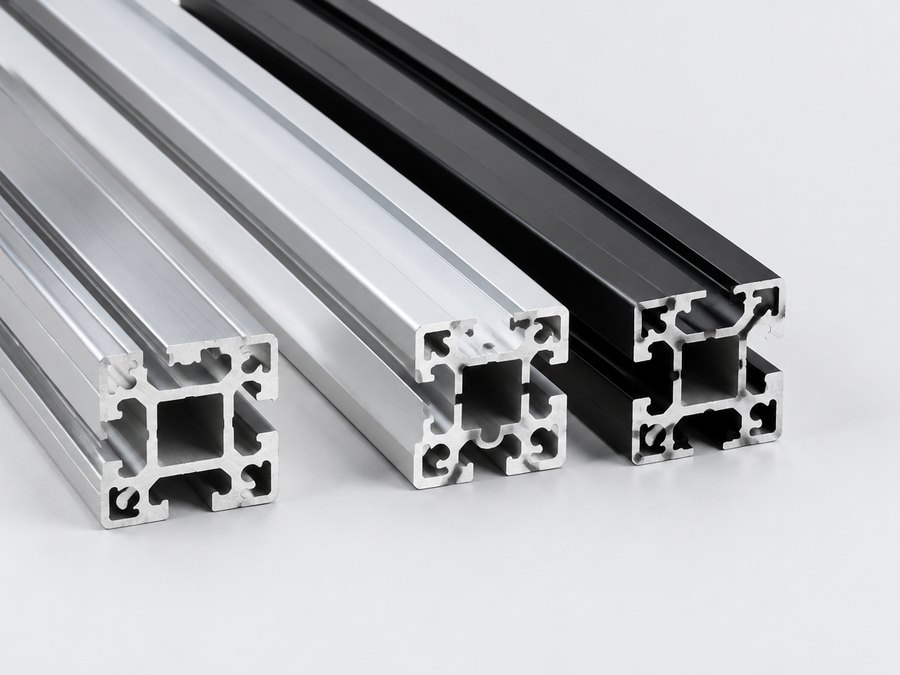
Alloys for extruded profiles: EN AW-6060, 6063 and 6082
Minimum values to DIN EN 755-2, depending on temper and wall thickness; thermal conductivity as a guide value.
| Alloy | Rm / Rp0.2 (approx.) | Thermal conductivity | Suitability |
|---|---|---|---|
| EN AW-6060 T66 | 215 / 160 MPa | approx. 200–210 W/(m·K) | Standard for complex, thin-walled profiles; excellent anodised surface; first choice for heat sinks |
| EN AW-6063 T6 | 215 / 170 MPa | approx. 200 W/(m·K) | Similar to 6060, slightly stronger; good decorative surface |
| EN AW-6082 T6 | 290–310 / 250–260 MPa | approx. 170–180 W/(m·K) | Load-bearing profiles in mechanical engineering; harder to extrude, anodised finish tends to be grey and uneven |
Design guidelines for aluminium profiles made to drawing
Uniform wall thicknesses
Large jumps in wall thickness cause uneven material flow, distortion and differences in gloss after anodising. Guide value: ratio of adjacent walls no more than approx. 1 : 2.
Open rather than hollow chambers
Hollow profiles need a multi-part porthole (bridge) die. Where the function allows, an open profile is cheaper and can be held to tighter tolerances.
Radii instead of sharp edges
Inside radii of at least 0.5 mm improve tool life and material flow. Use sharp edges only where functionally necessary.
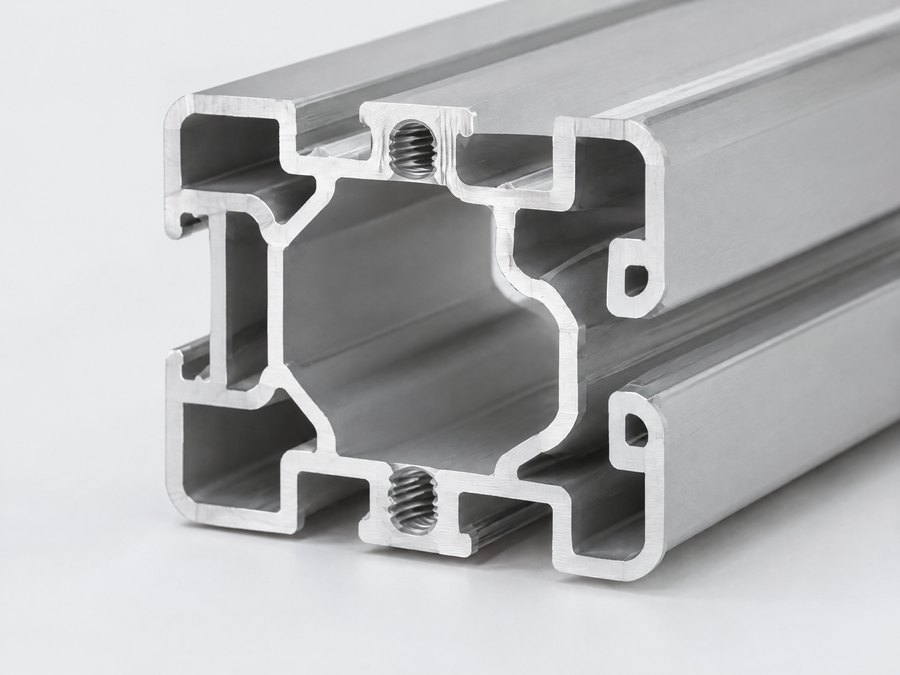
Integrate screw channels and grooves
Screw channels for self-tapping screws save thread cutting. Keep the tongue ratio (depth to width) of grooves moderate; otherwise the die will break.
Mark visible surfaces
Weld seams in hollow profiles and die lines cannot be completely avoided. Mark visible surfaces on the drawing so that the factory and inspector know where it matters.
Choose the tolerance class deliberately
DIN EN 12020-2 applies only to 6060/6063 and is tighter than DIN EN 755-9. Functional dimensions that need to be tighter are better milled afterwards.
Aluminium heat sinks: what matters
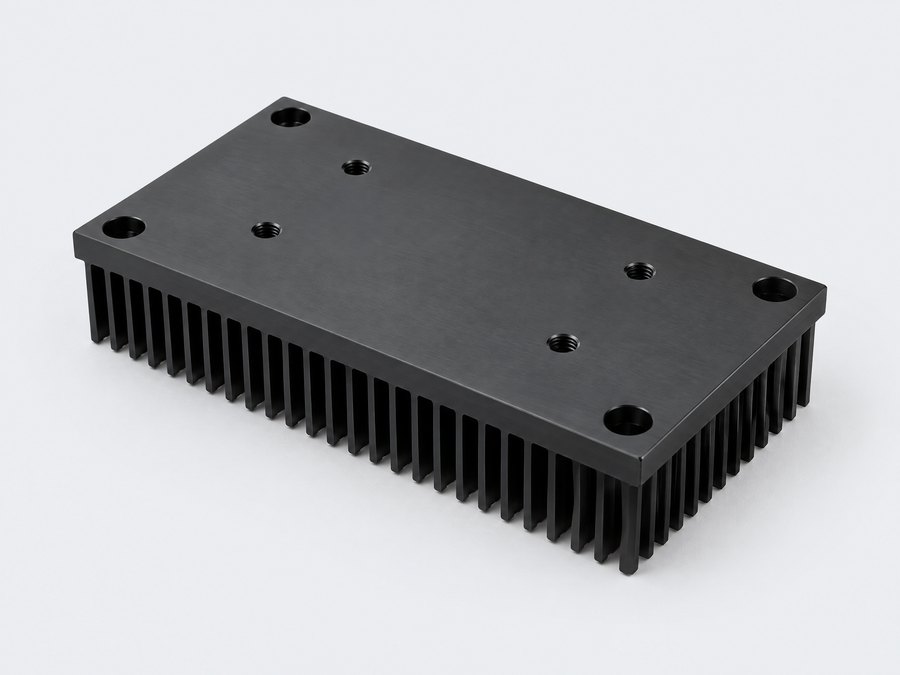
Extruded aluminium heat sinks are the most cost-effective solution for medium heat loads. Thermal resistance depends on fin height, fin spacing, base thickness and airflow – not just on the material.
The limit is the fin aspect ratio: as a guide value, a fin height to gap width of up to about 10 : 1 can be extruded. For denser fins, there are skived fins or bonded fins – more expensive, but with considerably more surface area.
- Mill the mounting surface for semiconductors and tolerance its flatness, e.g. 0.05–0.1 mm over 100 mm
- Anodising improves heat radiation, but mask or mill off the anodising on the contact surface
- Have tapped holes and countersinks milled in the same set-up
- Choose 6060 rather than 6082 for thermal conductivity
Die costs, extrusion quantities and cost drivers
Die
In China, dies for solid profiles typically cost a few hundred euros; for hollow profiles or large heat sinks typically €1,000–3,000 (guide value, without guarantee). They are wear parts and are replaced after a certain extrusion quantity.
Extrusion quantity per order
Set-up and start-up of the press are incurred per order. We have no fixed minimum order quantity, but very small quantities make the price per kilogram considerably higher – we show you from which quantity the price per kilo drops noticeably.
Machining
For short heat sinks and housing profiles, milling often accounts for the largest share of costs. Fewer set-ups reduce the price more than thinner walls.
Surface finish
Anodising with E6 pre-treatment and tight colour tolerance is more complex than standard natural anodising. Agree colour consistency across several batches separately.
Customs duties
Profiles of Chinese origin may be subject to anti-dumping duties – see the note below. These costs change the costing considerably.
Anti-dumping duty on aluminium extrusions from China (as of October 2026, without guarantee)
Under Implementing Regulation (EU) 2021/546, the EU has imposed anti-dumping duties of 21.2–32.1 % on aluminium bars, profiles and tubes originating in China since 31 March 2021 – in addition to the regular customs duty. Profiles that are cut, drilled or bent are also covered; exemptions include goods assembled into sub-assemblies and complete kits. The measures would have expired on 31 March 2026; on 27 March 2026 the European Commission initiated an expiry review, during which the duties continue to apply. A result is expected no later than 15 months after initiation. Whether a machined profile or a heat sink is covered depends on the customs tariff number – if in doubt, a binding tariff information (BTI) ruling helps. These duties must be taken into account in every costing; as an alternative, an EU source, e.g. via our partner in the Czech Republic, may make sense. More on importing in our guide Customs and importing from China.
Process: from profile cross-section to series production
Review the cross-section
We clarify extrudability, wall thicknesses, tolerance class and surface finish with the extrusion plant – including the customs question regarding origin.
Die and quotation
Quotation with die costs, price per kilo or price per piece after machining, and economical extrusion quantity.
First extrusion and samples
Profile sections and machined samples with measurement report, hardness testing and coating thickness measurement; on request a first article inspection report (FAIR / EMPB).
Series production
Series approval, inspection plan, material certificates and packaging with protective film or interlayers against transport damage.
Frequently asked questions about aluminium extrusions and heat sinks
Who owns the extrusion die?
Once paid in full, the die becomes your property; it remains at the factory for production and is marked accordingly. This is set out in the quotation. As dies wear, the quotation also specifies who bears the cost of replacement after which extrusion quantity.
Which tolerances apply if none are given on the drawing?
In that case DIN EN 755-9 for profiles is usual. For precision profiles in 6060 and 6063, DIN EN 12020-2 can be agreed. Tighter dimensions are achieved by post-machining.
Which alloy is suitable for heat sinks?
Usually EN AW-6060 or 6063: easy to extrude for fine fins, high thermal conductivity and good anodising properties.
Can I also obtain milled heat sinks ready for assembly?
Yes – sawn, milled, drilled, tapped and anodised. Flatness and roughness of the mounting surface should be stated on the drawing.
Are heat sinks from China subject to anti-dumping duties?
That depends on the tariff classification. Profiles and machined profile sections may be covered. We clarify the question before quoting; only customs can give a binding ruling.
Why is 6082 grey after anodising?
Because of the higher silicon and manganese content, the anodised layer looks darker and less uniform. 6060 or 6063 is better suited for decorative parts.
Related part types
Enquiry: Extruded profiles & heat sinks made to your drawing
Upload your drawing and 3D model, tell us the quantity and your deadline – we check feasibility and get back to you with questions or a quotation.
- Technical clarification before the request for quotation
- Quotations from audited partner factories
- One contact person in Germany
- Non-disclosure agreement (NDA) in advance on request
Prefer to call? 03641 9286337 · Mon–Fri 8 am–6 pm (CET)