
Home › Custom parts › Plastic injection moulding
Injection moulded parts made to drawing – plastic injection moulding in series from China
We source injection moulded parts in engineering and commodity plastics made to your drawing – including the injection mould, first samples and series monitoring. Here you will find what really matters in material selection, design and inspection of plastic parts from China.
- Thermoplastics from PP to PA-GF
- Tooling, samples and series production
- Granulate and colour documented
- Based in Jena since 2011
- Selected partner factories in China
- One contractual partner in Germany
- Pre-shipment inspection included
Plastic injection moulding in China: which plastic parts it suits
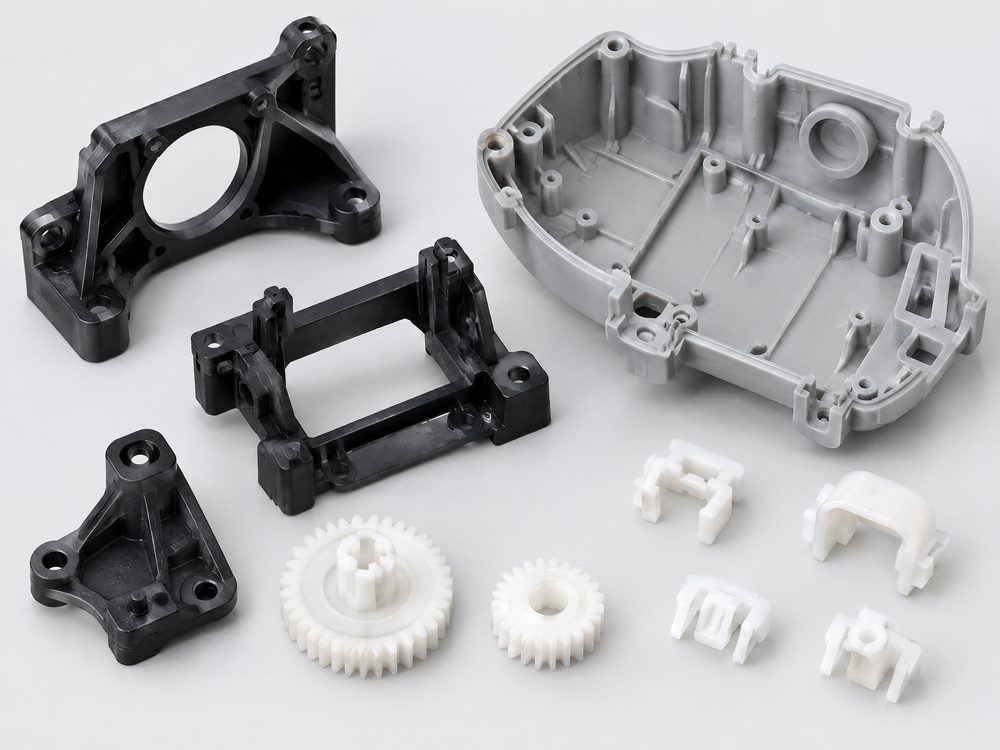
Plastic injection moulding is the process for dimensionally accurate plastic parts in large quantities: covers, housing shells, frames, clips, bearing bushes, gears or handles. The mould is expensive, but each individual part is very cheap – so the annual volume is the deciding factor.
Injection moulding in China pays off above all when the tooling accounts for a large share of the total cost, or when the parts are fitted into an assembly made in the Far East anyway. For small annual volumes, an aluminium prototype mould or a different process is often more economical – but we have no fixed minimum order quantity.
Technical specifications: injection moulded parts
| Feature | Specification |
|---|---|
| Materials | PP, PE, ABS, PC, PC/ABS, PA6, PA66, PA6-GF30, POM, PBT, PMMA, TPE; branded granulate or approved alternatives |
| Part weight / size | From small parts under 1 g to large housing and frame parts weighing several kilograms, depending on machine size; larger parts on request |
| Tolerances | To DIN ISO 20457 (successor to DIN 16742); achievable accuracy depends on material, wall thickness and mould quality |
| Surface finish / post-processing | Polished, EDM-textured or grained (e.g. to VDI 3400), pad printing, painting, ultrasonic welding, pressing in threaded inserts |
| Quantities | No fixed minimum order quantity – whether sourcing pays off depends on the part, quantity and tooling costs; talk to us; multi-cavity moulds for high volumes |
| Inspections | Dimensional inspection, part weight, colour matching (ΔE), visual inspection for sink marks and flash, functional test, granulate verification |
| Lead time | First samples in approx. 3 weeks at best, usually longer – up to approx. 10 weeks depending on complexity; series production approx. 4–8 weeks depending on quantity and complexity (production time only, plus transport); mould making is included in the first sample lead time |
| Data for your enquiry | 3D model (STEP), drawing with tolerances, material (type or trade name), colour, surface finish, visible sides, annual volume, batch size |
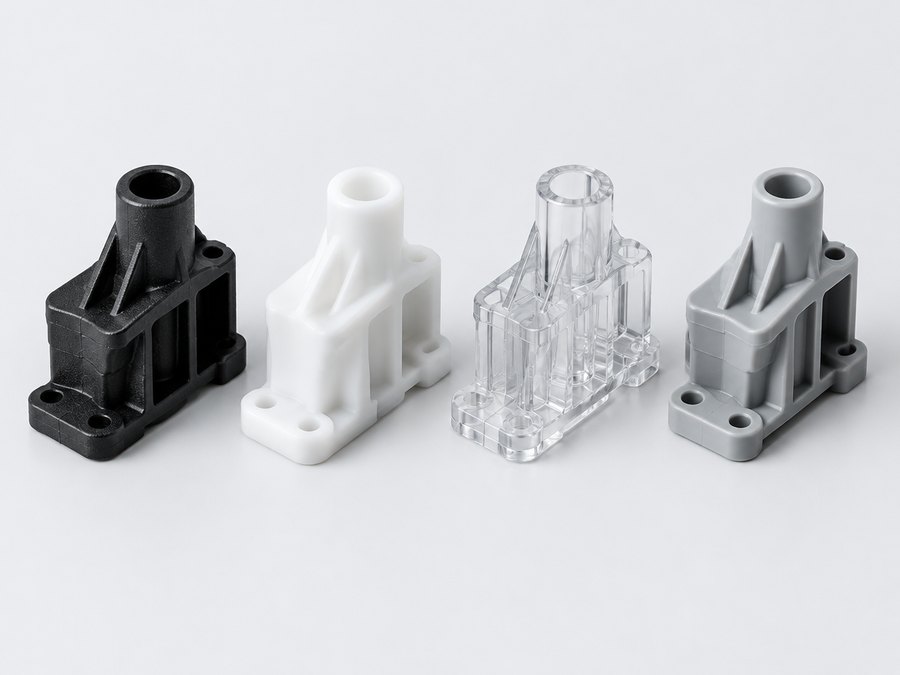
Plastics compared: PA6-GF30, POM, PP, ABS and PC
Moulding shrinkage as a guide value; exact values are given in the data sheet of the respective granulate.
| Material | Shrinkage | Strengths | What to watch |
|---|---|---|---|
| PP | approx. 1.2–2.5 % | Inexpensive, chemical-resistant, living hinges possible | High shrinkage, warpage on large surfaces, difficult to bond |
| ABS | approx. 0.4–0.7 % | Dimensionally stable, good surface, can be painted and electroplated | Limited heat and UV resistance |
| PC | approx. 0.5–0.7 % | Transparent, impact-resistant, dimensionally stable | Prone to stress cracking, must be dried before processing |
| POM | approx. 1.8–2.5 % | Stiff, low-friction, wear-resistant – for gears and clips | Tends to form sink marks with thick walls |
| PA6-GF30 | approx. 0.3–0.8 %, different along and across the flow | High strength and stiffness, temperature-resistant | Fibre orientation causes warpage; moisture absorption changes dimensions and toughness |
Design guidelines: wall thickness, draft angles, ribs
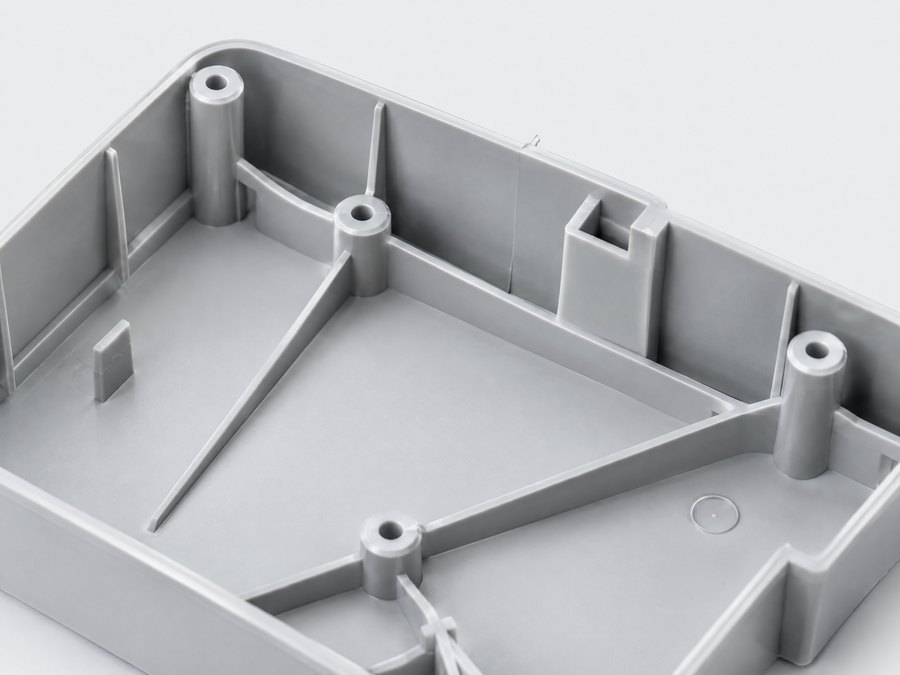
Uniform wall thickness
Guide value 1–4 mm, kept as constant as possible across the part. Cooling time rises roughly with the square of the wall thickness – thick walls cost cycle time and cause sink marks.
Provide draft angles
At least 0.5–1° on polished surfaces. For textured surfaces, add about 1° per 0.025 mm of texture depth; otherwise drag marks appear during ejection.
Ribs instead of wall thickness
Rib thickness approx. 50–60 % of the nominal wall, height no more than approx. 3 times the wall thickness. This makes the part stiff without sink marks on the visible side.
Avoid undercuts
Every undercut needs a slide or core pull and makes the mould more expensive. A snap-fit lug can often be demoulded through an opening in the wall.
Plan gate and weld lines
Specify where gate vestiges and weld lines must not be located. Pin-point, tunnel or hot runner gating affect appearance, tooling costs and rework.
Radii on inside edges
Inside radii of at least 0.5 × wall thickness reduce notch stresses – particularly important with PC and glass-fibre-reinforced materials.
Typical defects in injection moulded parts and their causes
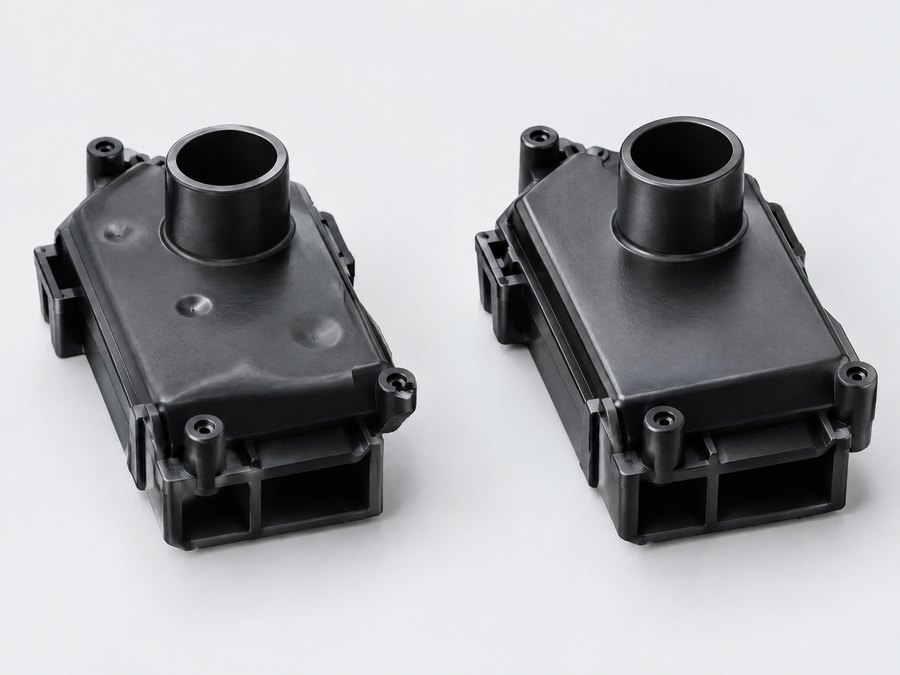
Sink marks
Depressions opposite ribs and bosses caused by material accumulation. Remedy: reduce wall thickness, adjust holding pressure, core out bosses.
Warpage
Uneven shrinkage due to jumps in wall thickness, fibre orientation or uneven mould cooling. Common with PP and PA-GF.
Flash
Material escapes at the parting line. Causes are worn moulds, insufficient clamping force or excessive pressure.
Streaks and silver streaks
Usually caused by moisture in the granulate. PA, PC and PBT must be dried before processing.
Granulate substitution
The biggest sourcing risk: a cheaper granulate instead of the approved grade. Countermeasures are specifying the material by trade name, the granulate delivery note for each batch and random checks (e.g. density, ash content for GF content).
Injection moulding costs: what determines the part price
The part price is made up of granulate, machine hourly rate times cycle time, and rework. Cycle time is the biggest lever: a 4 mm wall instead of 2 mm can multiply the cooling time.
Tooling costs depend on the number of cavities, slides, runner system and tool steel. For details, see our page toolmaking and mould making and the guide Tooling costs in China.
- Multi-cavity mould from an annual volume that justifies the extra cost
- Colour via masterbatch instead of pre-coloured granulate if no tight colour tolerance is needed
- Only set tight tolerances where the function requires them – see Tolerances on the drawing
- Award assembly steps such as pressing in bushes directly to the moulder
Blow moulded parts, thermoformed parts and plastic profiles
Not every plastic part is an injection moulded part. Blow moulding is suitable for hollow bodies such as containers, canisters or air ducts; thermoforming, with much cheaper moulds, suits large-area covers and packaging inserts. Continuous cross-sections such as sealing strips, edge protectors or tubes are produced by profile extrusion.
We also source these processes to drawing. On request, we check with the factory which process is most economical for your quantity.
How a plastic injection moulding project runs
Check feasibility
Review of 3D model and drawing: demoulding, wall thicknesses, gate location, material availability.
Tooling quotation
Quotation for mould and part with number of cavities, tool steel and cycle time.
T1 samples
First samples with measurement report, and a first article inspection report (FAIR / EMPB) on request; correction loops until approval.
Series production
Series inspection plan with limit samples for appearance, granulate verification and schedule tracking.
Frequently asked questions about injection moulded parts
Can the factory use the branded granulate I specify?
Generally yes; many branded granulates are available in China. If the drawing only states a type without a trade name, the factory will choose an equivalent material – which you should approve.
Which tolerances are realistic for injection moulded parts?
That depends on dimension, material and wall thickness. DIN ISO 20457 gives guide values; semi-crystalline materials such as POM and PP shrink more than ABS or PC and are harder to hold to tight tolerances.
How is the colour matched?
Via a RAL or Pantone reference or a physical colour sample. For visible parts, an approved limit sample and a tolerance as a ΔE value are recommended.
Why do PA6 parts change dimensions after delivery?
Polyamide absorbs moisture and swells. Dimensions should therefore be agreed and inspected in a defined moisture condition (dry or conditioned).
Is injection moulding worthwhile for small annual volumes?
There is no fixed minimum order quantity – it depends on the part, quantity and tooling costs. For small, simple parts with an inexpensive mould, it can pay off even at low quantities; otherwise CNC machining, vacuum casting or an aluminium mould are often the better choice. Talk to us and we will compare the options for your part.
Can threaded inserts be moulded in?
Yes, as inserts placed in the mould, or installed afterwards by heat or ultrasonic insertion. Post-moulding insertion is usually cheaper and more flexible.
Related part types
Enquiry: Plastic injection moulding made to your drawing
Upload your drawing and 3D model, tell us the quantity and your deadline – we check feasibility and get back to you with questions or a quotation.
- Technical clarification before the request for quotation
- Quotations from audited partner factories
- One contact person in Germany
- Non-disclosure agreement (NDA) in advance on request
Prefer to call? 03641 9286337 · Mon–Fri 8 am–6 pm (CET)