Home › Guides › Finding suppliers in China
Finding and vetting suppliers in China
You can find suppliers in China through B2B platforms, trade fairs, agents or sourcing service providers – but you only identify suitable manufacturers of custom parts for series production through systematic vetting. The key steps are: check the business licence and business scope, audit the factory, measure samples and obtain references. Skip these steps and you often end up with a trading company instead of the manufacturer.
- Four routes to a supplier
- Vetting steps from licence to audit
- Spotting warning signs early
Finding suppliers in China: four routes compared
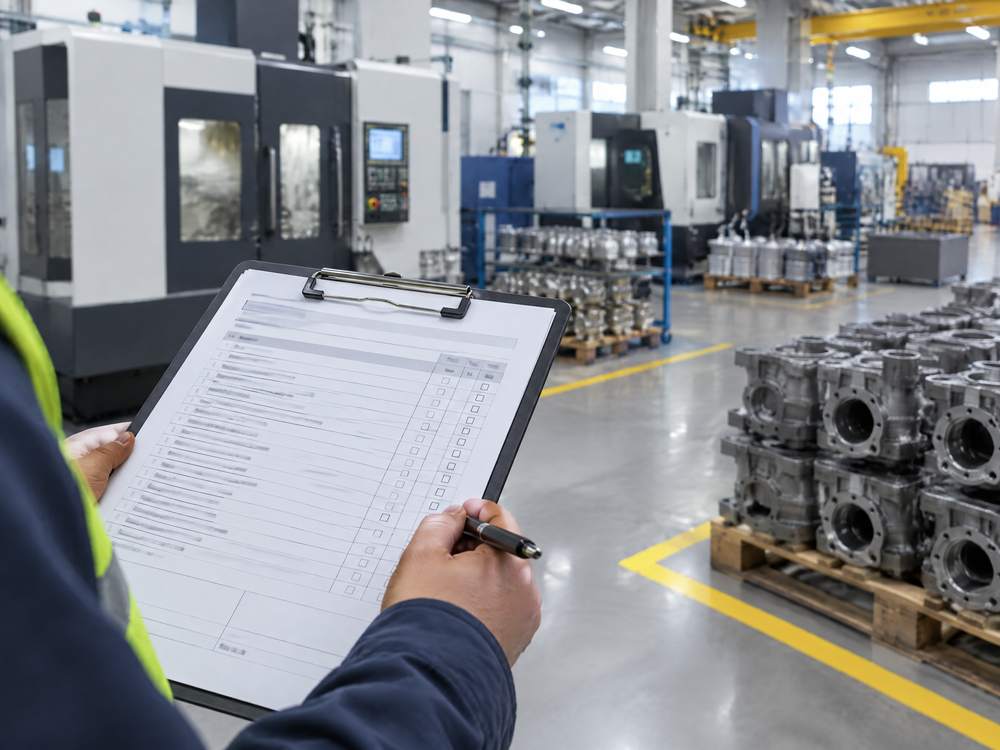
For catalogue goods, a platform search is often enough. If you want to find suppliers in China that make parts to your own drawing in series, you need more: manufacturing depth, the right machines, measuring equipment, experience with European standards and a contact person who understands technical questions.
The four routes below are not mutually exclusive – many buyers combine them.
Platforms, trade fairs, agents, service providers
| Route | Strengths | Weaknesses | Suitable for |
|---|---|---|---|
| B2B platforms (e.g. Alibaba, Made-in-China.com, Global Sources) | Quick overview, many suppliers, free of charge | Many traders, embellished profiles, verification badges are no substitute for vetting | Initial market overview, standard parts |
| Trade fairs (e.g. Canton Fair in Guangzhou, Chinaplas, Die Casting China; Chinese exhibitors also at Hannover Messe) | Personal contact, samples you can handle, several suppliers in one place | Travel costs, a trade fair stand says little about the factory | Building contacts, scouting processes |
| Local agent or intermediary | Language, local contacts, factory visits | Possible commission from the supplier (conflict of interest), liability usually unclear | One-off projects with your own quality assurance |
| Sourcing service provider based in the EU | Contract and liability under German law, quality inspection and logistics from a single source, established supplier base | Mark-up on the part price, less direct contact with the supplier | Series parts without your own organisation in China |
Manufacturer or trading company?
Many suppliers on platforms are trading companies, even if they call themselves a “factory”. That is not bad in itself: a good trader bundles suppliers and speaks English. It becomes a problem when you do not know who is manufacturing – production can then switch without your knowledge, and your approval applies to a different factory.
Typical signs of a trader: a very broad product range (castings, electronics and textiles from a single source), a company name containing “Trading” or “Import & Export”, a business scope without manufacturing, no real-time factory videos, and delayed answers to technical questions. Names such as “Industry & Trade Co.”, on the other hand, often indicate a manufacturer with its own export department.
Vetting suppliers: six steps
This vetting is worthwhile before every tooling order. The effort ranges from a few days to a few weeks – small compared with the risk of a false start.
Check the business licence
Ask for the business licence (营业执照). The 18-digit Unified Social Credit Code can be checked in the state company register (National Enterprise Credit Information Publicity System): company name, date of incorporation, capital, status and business scope must match the quotation.
Read the business scope
If the business scope only lists “sales” (销售) and not “manufacturing” (生产/制造) of the product in question, it is probably a trader. A factory at an address other than the registered one should be explained.
Verify certificates
Check ISO 9001 or IATF 16949 certificates with the issuing certification body or in its database: validity, site, scope. Forged certificates, or certificates issued to a sister company, are not uncommon.
On-site or video audit
A factory audit (e.g. based on VDA 6.3 or your own checklist) shows the machinery, measuring room, incoming goods inspection, traceability and housekeeping. A live video tour is better than nothing, but is no substitute for an audit for critical parts.
Samples with a dimensional report
Order samples made to your drawing, not catalogue parts. Measure them yourself or through a third party and compare the results with the supplier’s measurement report – discrepancies between the two say a lot about the supplier’s measuring competence.
References and export experience
Ask about customers in the EU (with permission to contact them), the export share, experience with REACH/RoHS and with materials to EN standards. A supplier who knows DIN and EN designations will save you many queries.
Typical warning signs
A different bank account
Payment to a private account, or to an account in a company name other than the one on the invoice, is a clear warning sign. Always verify a “new bank account” announced by email by phone through known contacts – this is a common fraud scheme.
Price far below market
If a quotation is 30–50 % below all others, something is often missing: a different material, no inspection, no tooling included in the price, or a thinner wall thickness than drawn.
No questions about the drawing
A manufacturer who asks not a single question about a complex drawing has often not read it carefully. Good suppliers flag unclear tolerances or materials immediately.
No insight into production
If, when you buy directly, a supplier allows neither visits nor live videos, photos from production or genuine measurement reports, it often has no production of its own or does not want to show it.
Everything from a single source
Casting, injection moulding, electronics and packaging from one “factory” – it exists, but it is rare. More often there is a trader with changing subcontractors behind it.
Changing contacts
Frequently changing contacts and different company names in emails, quotations and invoices point to unclear structures.
Communicating with new suppliers: how to avoid misunderstandings
Many problems with Chinese suppliers are not quality problems but communication problems. A “Yes, no problem” often just means “We have received your message”, not “We can reliably hold this feature”. So ask specific questions: Which measuring equipment is used to measure this dimension? Which material to Chinese standard (GB) is used for your EN material?
Short, numbered questions by email, a drawing with marked inspection features and written confirmation of important agreements all help. Allow for the time difference (6–7 hours) and public holidays: around Chinese New Year (January/February) and Golden Week in early October, many factories stand still for one to three weeks.
After approval: managing suppliers over the long term
A good initial supplier is not a permanent state. Staff changes, capacity bottlenecks or cost pressure lead to processes being changed unnoticed – a different foundry, a cheaper pellet supplier, a new coating.
So stipulate in the contract that changes to material, process, subcontractor or production site may only be made with your consent (change management; in the VDA environment, PPF requalification). Supplement this with incoming goods inspections, regular dimensional reports and pre-shipment inspections for critical parts.
- Agree an inspection plan with features, sample size and measuring equipment
- Request material certificates (e.g. 3.1 to EN 10204) for each batch
- Pre-shipment inspection before paying the balance
- Build up a second source for critical parts, e.g. in the EU
Using an existing supplier base
TOP Asia Technik GmbH works with an established pool of partner factories in China that have experience with the EU market; many have worked with the company for years. If a part requires it, our partners and local agents search specifically for new suppliers. We check requirements for the factory, such as a certification, case by case according to your specifications. The Chinese factories are not named, and factory visits in China are not offered – assurance comes from first samples that you inspect and approve yourself, from pre-shipment inspections and, on request, from an independent testing institute. Your contact is based in Germany, and the contract and invoice run through a German GmbH under German law. As an EU source, a partner in the Czech Republic is also available; factory visits are possible there by arrangement.
You can read how quality assurance works under Quality, and the overall process under Sourcing from China. Do you have a specific drawing? Then use the enquiry form – the article Preparing an enquiry based on a drawing helps you get ready.
Frequently asked questions about finding suppliers in China
Is a “Verified Supplier” badge on a platform enough?
No. Such badges usually only confirm that an inspection service has visited the company or seen documents. Whether the factory can make your part to the required quality only becomes clear from your own vetting with samples and an audit.
What does a factory audit in China cost?
If you commission a local inspection service provider, one-day audits are, as a guide, in the range of a few hundred to around 1,000 euros per man-day, plus travel expenses. Travelling yourself is considerably more expensive, but gives you a personal impression.
How many suppliers should I ask for a quote?
For a custom part, three to five pre-qualified manufacturers is usual. More enquiries increase the effort for comparison and queries without significantly improving the choice.
Do I have to release the drawing before the NDA?
For an initial assessment, a simplified drawing without a company logo is often enough. For the quotation, the supplier needs the complete data; a non-disclosure agreement that is enforceable under Chinese law if possible (a so-called NNN agreement) offers better protection than a purely German NDA. At TOP Asia Technik GmbH, drawings are always neutralised before being passed on to factories, and the factories are bound to confidentiality.
Downloads
Guide: sourcing parts from China
What buyers need to watch out for – from the enquiry to delivery. PDF.
Free downloadSend your drawing – get a quotation
Upload your drawing and 3D model, tell us the quantity and your deadline – we check feasibility and get back to you with questions or a quotation.
- Technical clarification before the request for quotation
- Quotations from audited partner factories
- One contact person in Germany
- Non-disclosure agreement (NDA) in advance on request
Prefer to call? 03641 9286337 · Mon–Fri 8 am–6 pm (CET)